Weber-Wahsatch Historic District South Walking Tour
A self-guided tour through the Historic Uptown Neighborhood.
More walking tours can be found on Our Neighborhood page.
Select the frame in the top right corner of the map to explore the properties. Once the larger map is opened, you can select each property’s pin to view more information about it.
Introduction
The Weber Street-Wahsatch Avenue Historic District was listed in the National Register in August 1985. The neighborhood is significant as the best intact middle-class historic neighborhood in Colorado Springs. It contained 531 main buildings and was described as generally late Victorian. Nearly 4 of 5 buildings were built between 1890 and 1910, reflecting the prosperity generated by the Cripple Creek mining district. Largely a neighborhood of homes with some commercial uses, it is only two blocks wide, from alley to alley on either side of the namesake streets, and ten blocks long, from Boulder to Columbia, and on Weber another two blocks north to Del Norte.
Generally flat, except for the southeast corner, the District is adjacent to the downtown center and extends north. It contains the east edge of the Original Townsite and part of the City’s 1st Addition. The two landscaped medians – Wahsatch and Willamette – date from the first project of the Fountain Colony, which was transplanting trees to be irrigated by the El Paso Canal.
Dwellings are mostly 1- to 2-story wood frame homes with medium to steep-pitched roofs. Front porches are ubiquitous. Setbacks are shallow for older homes and deeper for Craftsman style and later. Landscaping includes iron fences, stone walls, and mature vegetation. Ornamentation abounds in the neighborhood with decorative shingles, dentil moldings, spindles, brackets, porch columns, and scrollwork. Each structure was intended to be attractive and unique; the nomination noted “It is the uniformity of scale, density and placement, punctuated by the consistent lines of 1st floor porches which gives the district a visual cohesiveness.”
Different styles and types of dwellings reflect the tastes of the builders and original owners. Queen Anne homes are the most highly decorated, with a vertical orientation, asymmetrical massing, multiple gables, turrets, bay windows, and Palladian windows. Other styles of that era include the 2-story Georgian Foursquare with a central dormer, and a one-story version named the Classic Cottage. Later decades saw the popularity of Craftsman and the Mission Revival styles.
The southern portion of the Weber-Wahsatch Historic District covered by this tour is the oldest grouping with dates of construction averaging 1896. This tour encloses 24 properties built between the early 1880s to 1907, extending from the latter days of the initial settlement to a town flush with prosperity, driven by the Cripple Creek mining district. Just northeast of the city’s business center, the significant architectural density shows the area competed well with the North End area.
Selections are mostly residential, representing some of the range of Late Victorian architecture. A school is included, as is a church – both fixtures of neighborhoods at the turn of the pre-automobile 20th century. A simple neighborhood market represents another mainstay of life
The architecture reflects the tastes of the times – essentially Late Victorian wood frame homes 1 to 2 ½ stories high with moderate to steep roofs and front porches. Several represent a distinctive style, mostly Queen Anne, and Italianate styles are included.
The architecture of the Garfield School and the Cumberland Presbyterian Church reflects popular institutional styles, Mediterranean Revival and Richardsonian Romanesque.
Each building presents an opportunity to paint a picture; each dwelling is unique. Aside from the visual variety produced by various footprints, indented and curved walls, features such as spindles, dentils, shingles, moldings, eave returns, brackets, and porch columns enabled a rich selection. Homes of this era were located closer to the front of the lot, connecting to the street, but maintained somewhat consistent spacing between main buildings.
Most initial occupants were associated with the mining industry and many were stock brokers. The burgeoning professional class made their homes here.
The mercantile class is represented by suppliers of essential men’s fashions for erstwhile miners seeking investment from bankers.
Another group of residents in this neighborhood were the builders of Colorado Springs. One owned a lumberyard and built hundreds of apartments and homes in the region; another was more modest. The third group of residents were major figures in Colorado Springs’s development, providing engineering solutions for water projects throughout the region.
Further, the tour visits several boarding houses. Boarding houses were seen as essential components of the community. Visitors such as tourists, consumptives seeking a cure, and newcomers often could not afford hotel rates. Boarding houses were distinguished from rooming houses, which only provided sleeping accommodations. Boarding houses prepared meals for guests. Good cooks were in great demand, and competition among the boarding houses was vigorous.
One of the more notable characteristics of the District is driveways and garage doors do not appear. A street trolley line was added on Wahsatch in 1902, running from Pikes Peak Avenue to Willamette, turning west and north on Corona Street. Personal automobiles soon followed.
In this era, walking dominated everyday life, and these buildings were designed to be admired by neighbors and pedestrians. Walking remains the optimum method of enjoying this neighborhood’s architecture and history.
Sources of information include City Directories and newspaper articles available at the Carnegie Wind of the Penrose Library, and Sanborn Fire Insurance Rate Maps, available at the Library of Congress.
Buildings contributing to the character of the Weber-Wahsatch National Register District may be eligible for Colorado Income Tax Credits for Rehabilitation.
Tour Stops
- Johnson Residence
- Weyand Residence
- Cumberland Presbyterian Church
- Ferguson Residence
- Royal Grocery Market
- Husung Residence
- Triffet House
- Shapiro Residence
- Shoup Residence
- Garfield School
- Hannon House
- Hart House
- W. H. Gandy Residence
- Oppenheim Brothers Residence
- Van Dusen Boarding House
- Beshears House
- Ferrin Residence
- Linney Boarding House
- Newton Boarding House
- Samuel Bernard Residence
- Crawford & DeGraff Residence
- Bumstead Residence
- Reid Residence
- Clark Double House
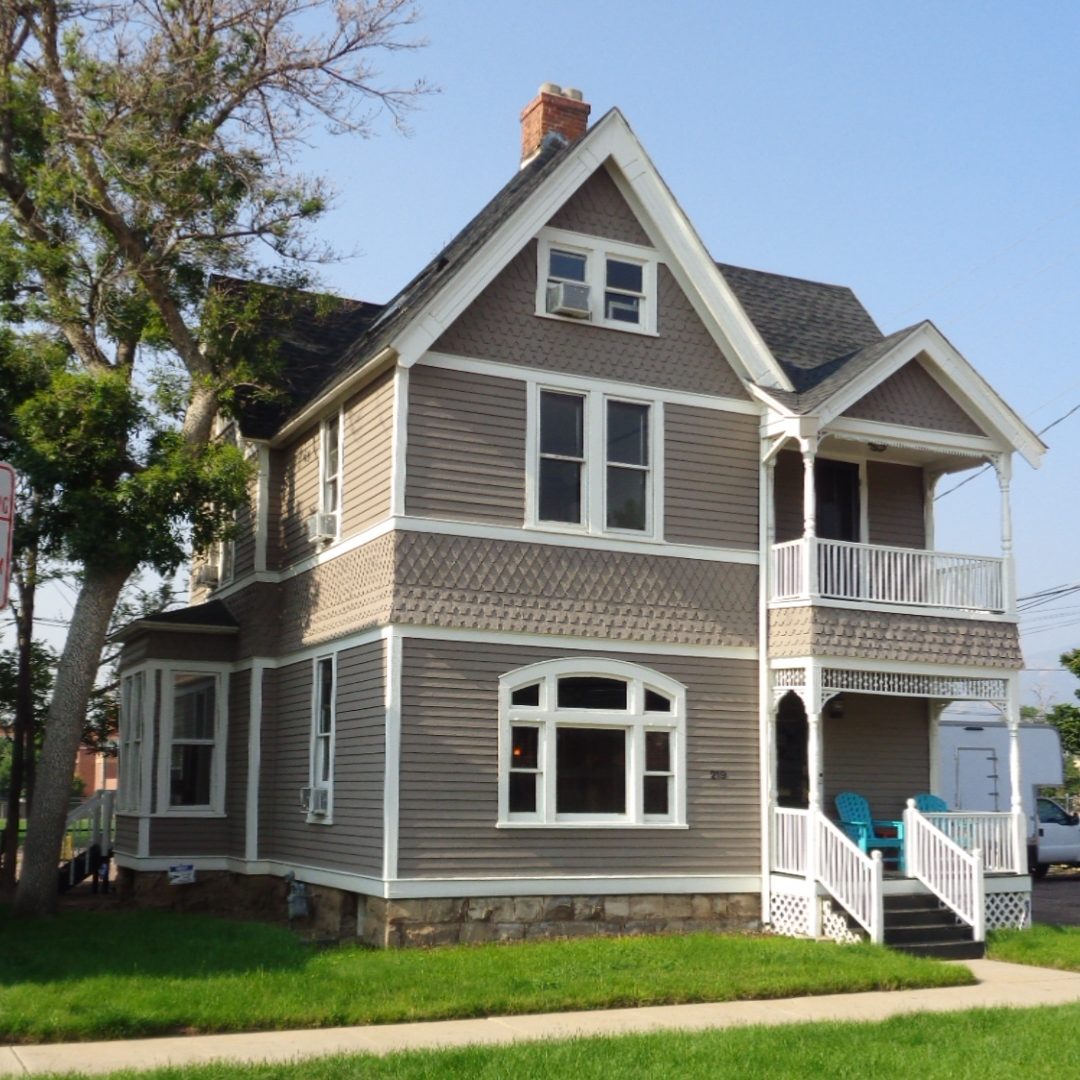
Johnson Residence
219 East Saint Vrain Street
Built 1894
Architect Unknown
This Late Victorian home was built by Frank E. Johnson in 1894. Johnson, his wife, and his sister were the initial residents. Johnson arrived in Colorado at 6 years old with his father, driving a herd of cattle from Iowa. He worked with his father in a dairy from 1880 to 1885 and then joined the Newton Lumber Company. By 1887 he rose to manager and then served as president of the firm from 1905 to 1915. The company did not just sell lumber, but constructed dwellings. Many homes and apartments followed, several in the Boulder Crescent area.
This is a two-and-one-half-story frame dwelling with ample detailing. It sits on a dressed stone foundation, and the façade features a two-story covered porch with narrow posts at the northwest corner. It has lap siding on the body; the floors are separated by a belt course of diamond, octagon, and arrow shingles, and gables display diamond and half-cove shingles.
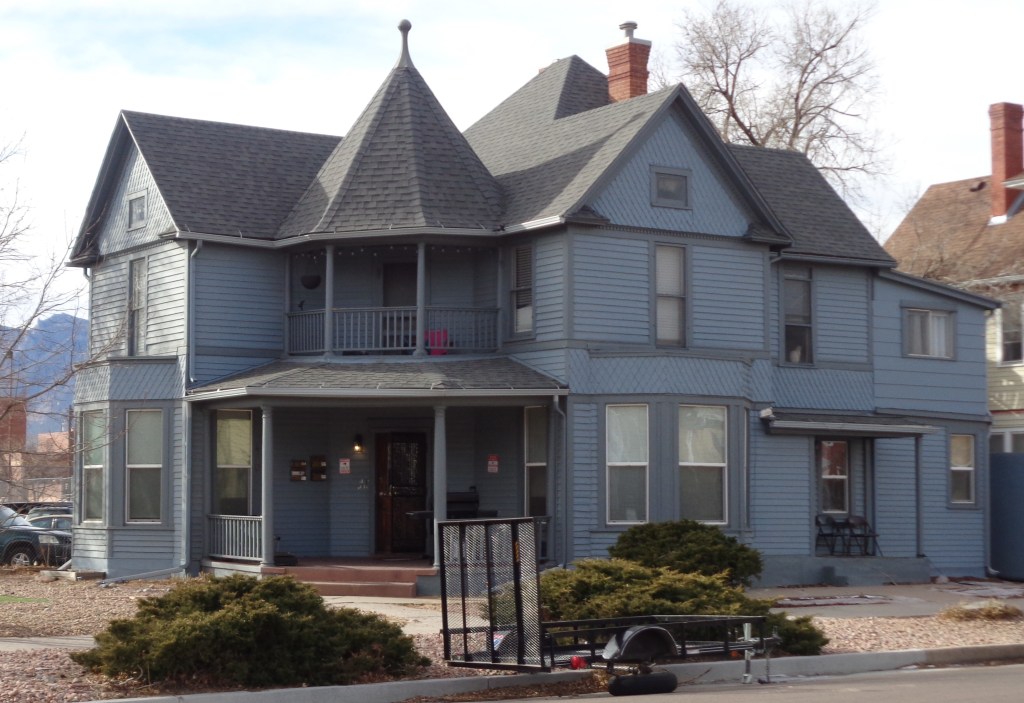
Weyand Residence
430 North Weber Street
Built 1894
Architect Unknown
The house was first occupied by Lawrence C. Wayand in 1894. He partnered with his brother Daniel to establish the Weyand Brothers Company, a real estate firm and mining brokerage. Both were also involved in the Cripple Creek gold mining district, with L. C. functioning for several years as president of the Anchor Gold Mining Co.
This is a two-story Queen Anne on a corner lot with lap siding. Diamond-shaped shingles appear in gables and belt courses between floors. There is an ornate chimney. A two-story central porch, originally round but now angular, dominates the facade, with the second story smaller than the first, topped with a turret. The two flat-topped bay windows to the north and east are original. The narrow-turned posts and narrow railings add additional detail.
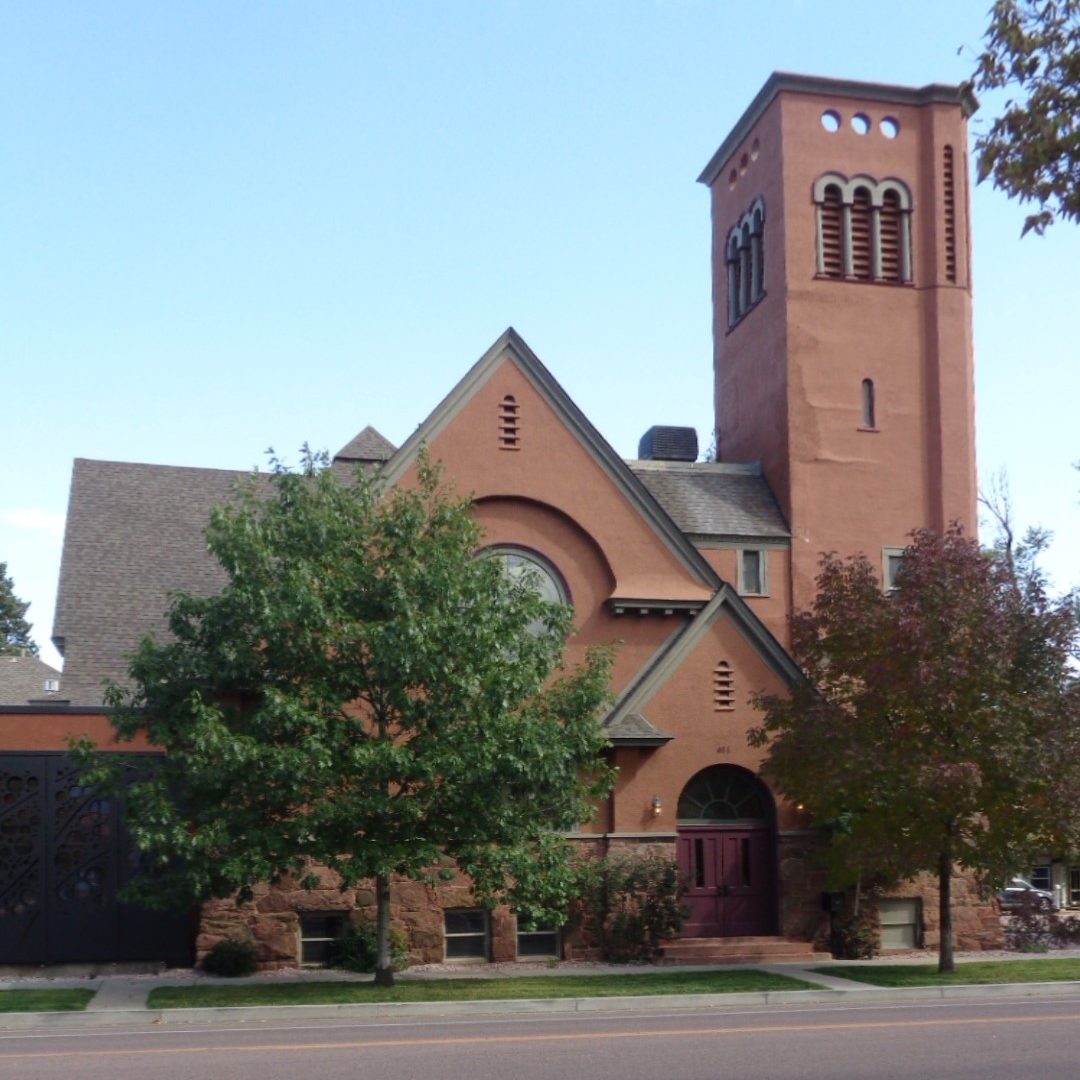
Cumberland Presbyterian Church
411 North Weber Street
Built 1898
Architect Barber & Hastings
The partnership of Barber & Hastings designed this building. They had 27 homes to their credit by that time. They also designed commercial buildings, including the DeGraff building on North Tejon in 1897. The church was started in August 1897 and finished by Christmas announced to the public with a large rendering that appeared in the local paper. Originally clad in wood shingles, it was stuccoed in 1970.
The Cumberland Presbyterian Church is an example of Richardsonian Romanesque architecture featuring an oversized, square tower, use of rough-faced stone, arched openings, and contrasting colors. Manitou greenstone forms part of the base. It displays ample ornamentation, with brackets, window muntins, arched openings, eave returns, and a multifoil round window inset into an arch on the south-facing façade. The main entry is on the south, but another is on the west elevation.
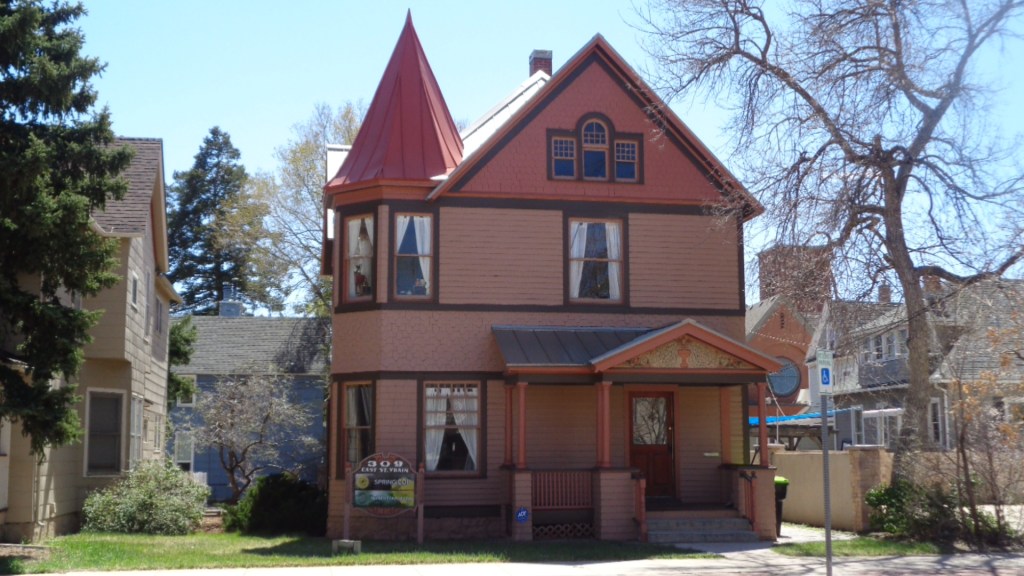
Ferguson Residence
309 East Saint Vrain Street
Built 1896
Architect Unknown
This dwelling was built in 1896 or earlier and was first occupied by H. A. Ferguson, who served as postmaster in Colorado Springs from 1893 to 1897. In addition to running the postal system, the postmaster had to negotiate occupancy issues, as the post office rented its space at the corner of Tejon and Huerfano (Colorado).
This is a two-and-one-half-story Queen Anne-style dwelling, with a two-story angular tower topped with a witches’ cap. A pedimented shed porch roof with a cartouche of painted wood sits on the west half of the façade supported by narrow columns, and a Palladian window is placed in the front-facing gable. The first-floor porch and tower are clad in square cut shingles; the remainder of the two floors show lap siding divided by a belt course of octagon alternating with square shingles.
Royal Grocery Market
501 North Wahsatch Avenue
Built 1896
Architect Unknown
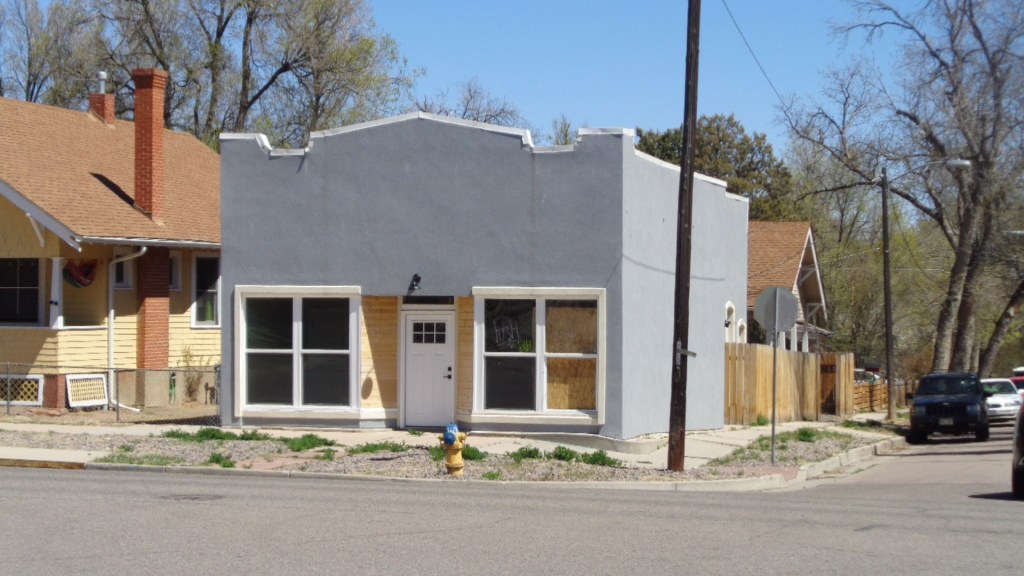
In an era when people generally walked everywhere, neighborhood markets were essential to supply food for families in neighborhoods. Occasionally, a market would have an attached residence where the proprietor could live. The earliest record of this market is in 1896 when the Royal Grocery operated. The proprietor, T C Byrd lived around the corner at 519 N Weber, while two clerks resided in upstairs living quarters. By 1898, it was the Cooper grocery and meat market. Ownership continued to change regularly over the years.
This building is a simple Mission form with a parapet. The front door is inset and flanked by display windows. A visible seam on the south side shows where the building was extended to the east.
Husung Residence
510 North Wahsatch Avenue
Built 1898
Architect John M. Husung
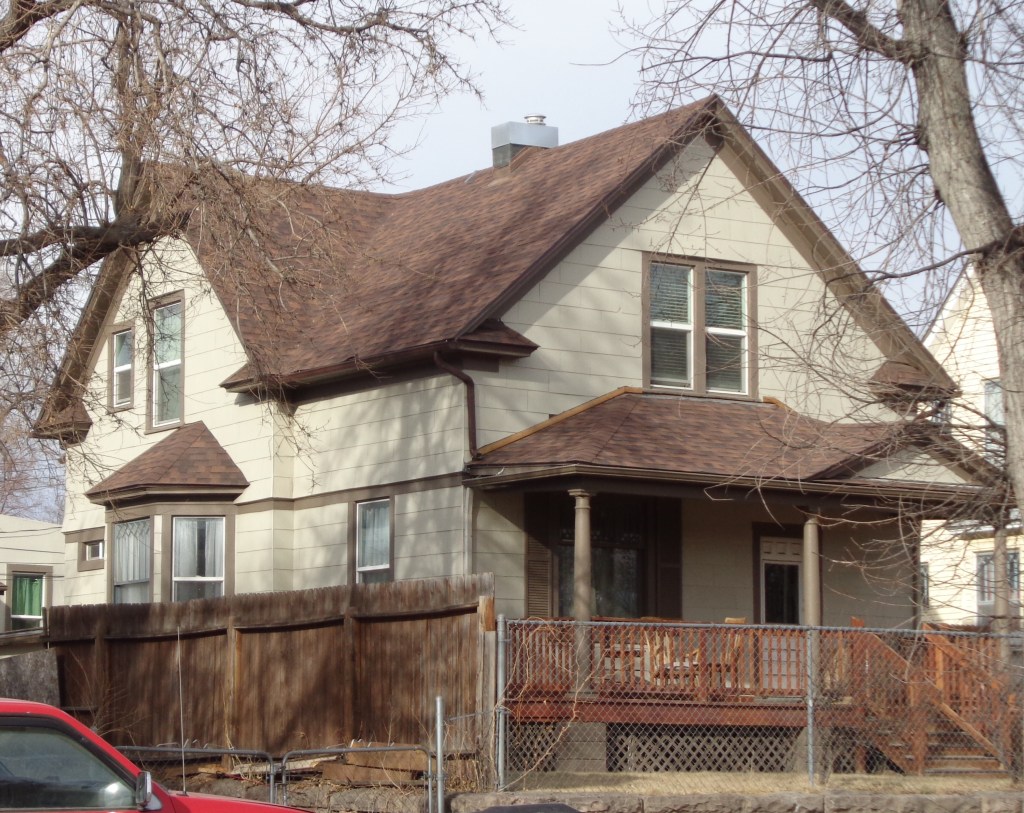
John M. Husung and his wife Mary were the first occupants of this house. John was a contractor, initially identified as constructing a house in West Colorado Springs in 1891. Other houses and business blocks followed. In 1899 he built this house as their home. He was active as late as 1908, and the family moved in 1910 to North Tejon Street.
This is a one-and-a-half Late Victorian gable end house with eave returns. Wings on both the north and south sides extend only slightly from the body of the house and are capped with gable ends. The south elevation displays a one-story bay window; the upper pane is ornamented with muntins. Husung built his shop at the rear of the property, which has since been removed for apartments.
Triffet House
521 North Wahsatch Avenue
Built 1906
Architect Unknown
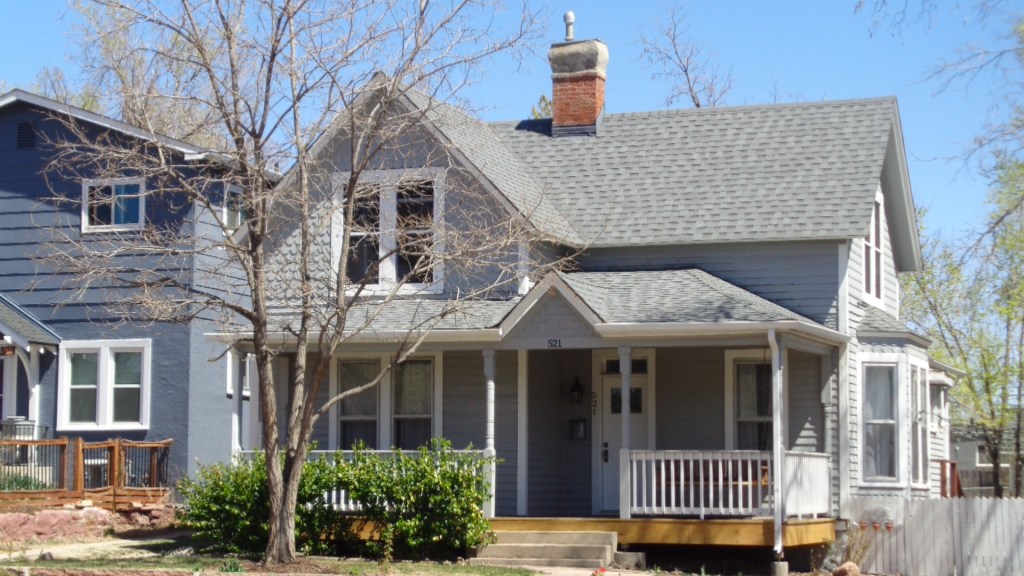
William Triffit and Henry Franz, partners in a barber shop downtown, purchased this parcel in 1889 and built two small houses, one in front and one behind, by 1894. This is an example of working-class townsfolk benefiting from the mining boom. These homes were rented to various tenants. Franz returned to Kansas, and Triffit continued as a landlord. Around 1906, the current house was constructed, generally located on and using portions of the westernmost house. Used as a rental until 1909, William moved into the home and lived there for 30 years.
This is a one-½ story Late Victorian wood frame house with a full-width porch There is a small pediment above the front stairs that displays a decorative checkerboard design. The gable end shows fish scale, octagon, and round shingles, while the body of the house has lap siding. A later addition bay window sits on the south side.
Shapiro Residence
529 North Wahsatch Avenue
Built 1900
Architect Unknown
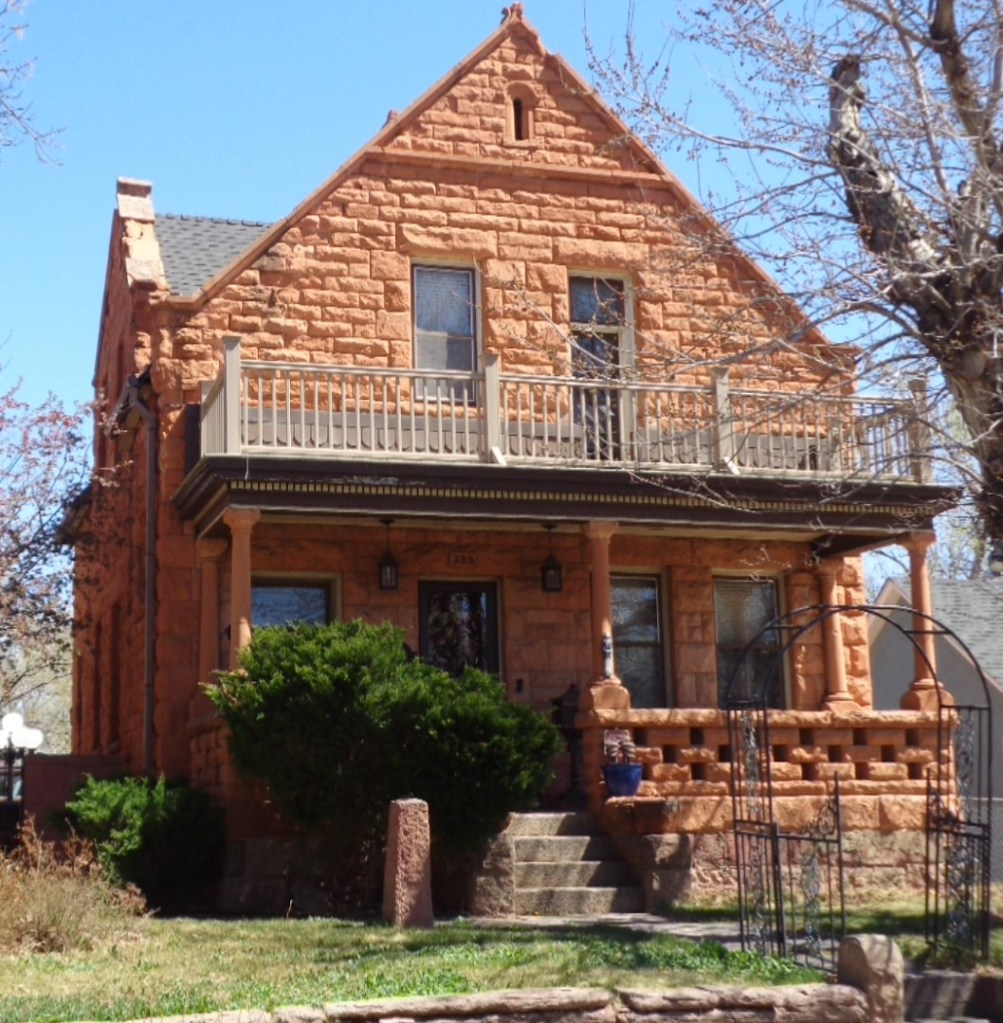
This is a striking one-½ story sandstone building atop a stone foundation near the crest of Wahsatch. According to Sanborn maps, the initial one-story building on this site was replaced by a one-and-one-half-story stone home by 1900. Its first occupant was Albert Shapiro, who lived with his wife Ellen for many years. Shapiro worked as a clothier, selling suits, shoes, and furniture to gentlemen, stimulated by the demand generated by the Cripple Creek fortunes. He earlier had clerked for the Oppenheim Brothers in their clothing store.
The home features a front retaining wall of Manitou Greenstone. The same stone forms a table for the house; the remainder of the house features semi-finished rectangular red stone blocks. The porch features round stone pillars atop a square base that supports the porch roof. Atop the roof is a flat balcony area. The windows on the south, west, and north elevations have sills. The house number is carved over the front doorway.
Shoup Residence
317 East Willamette Avenue
Built 1892
Architect Unknown
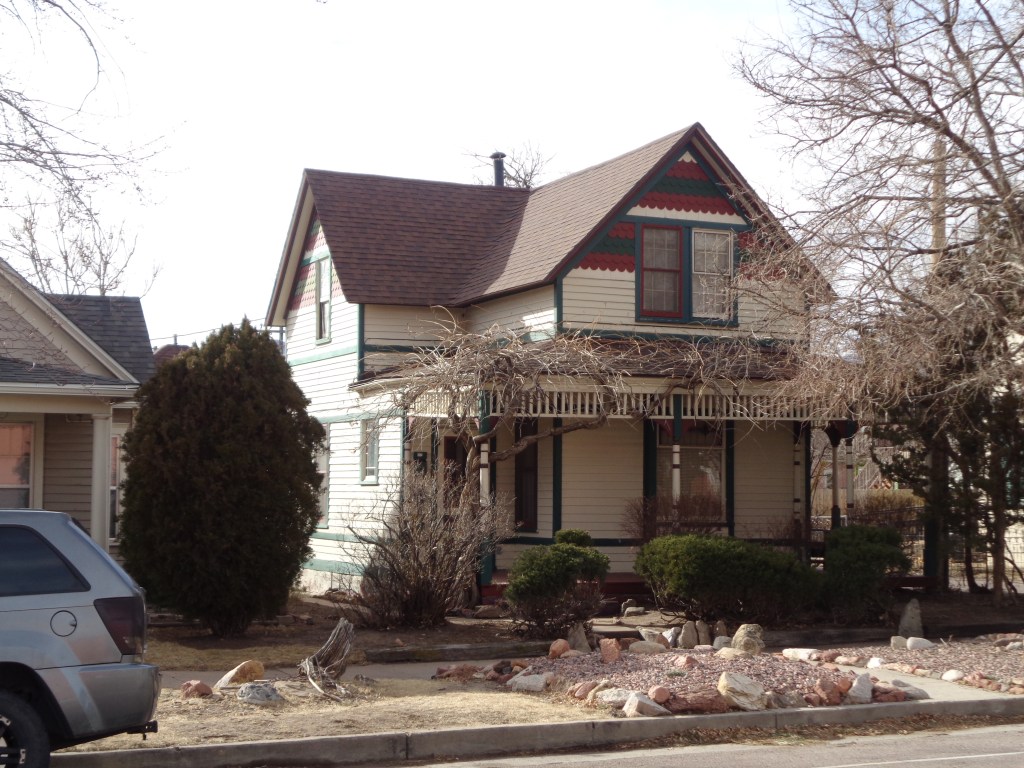
William R. Shoup, his wife Ora, and son, Oliver Henry Shoup, aged 13, arrived in the city in 1882. William worked as a stockman. Attending local schools, Oliver worked as a bookkeeper with General Palmer’s Colorado Springs Company while studying at the Colorado College. After 8 years, he served as personal secretary and then general manager to Verner Z. Reed’s real estate company. While serving on the board of directors of several gold mining companies, he invested in sugar factories on the West Slope, planting thousands of fruit trees. In 1910, he partnered in early oil drilling in the Salt Creek field of Wyoming, Later, he became the first president of the Midwest Oil Company With the support of local newspapers, Shoup was elected governor of Colorado in 1918, and re-elected two years later.
This is a one-and-one-half-story Late Victorian frame house, with a full-width wraparound porch supported by turned posts. It has lap siding and fish-scale shingles that decorate the top gables. A row of long, rectangular spindles sits below the porch roofline. There are multi-light windows in the façade gables, and a recessed door on the east.
Garfield School
332 East Willamette Avenue
Built 1886
Architect Wright & Davis
Builder Joseph Dozier
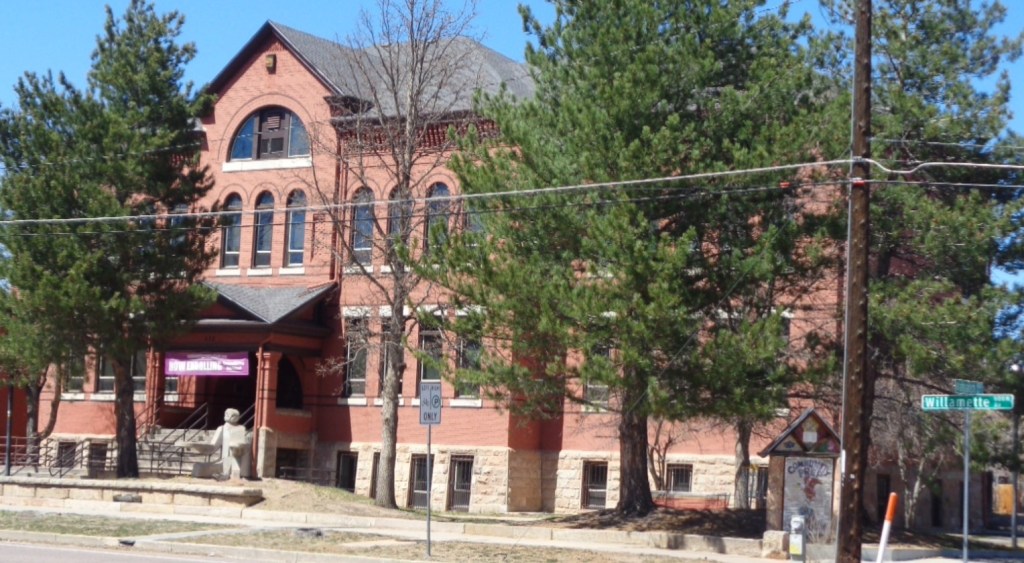
This large, two-story brick school building, costing $20,000, was named in memory of the assassinated James Garfield, the 20th president of the US. It was built with separate entries for boys and girls and the general public; it featured steam heat. Originally designed with only four classrooms, another four were added in 1888 and another six in 1896. A plain multipurpose addition was built in 1963.
The hipped-roof Garfield school was designed by Wright and Davis, who also designed the Hagerman mansion on North Cascade Ave that same year. Its builder was Joseph Dozier, a popular and skilled contractor, responsible for many buildings in the era before the Cripple Creek gold mining discovery.
The Manitou Springs Quarry supplied stone seen in the white trim. The Gillis Brothers noted contractors, applied the brickwork, particularly detailed at the cornice. It was a massive, solid brick structure implying permanence and commitment to the future. Belt courses of black brick and decorative brick are continued on the additions.
Hannon House
630 North Wahsatch Avenue
Built 1901
Architect Unknown
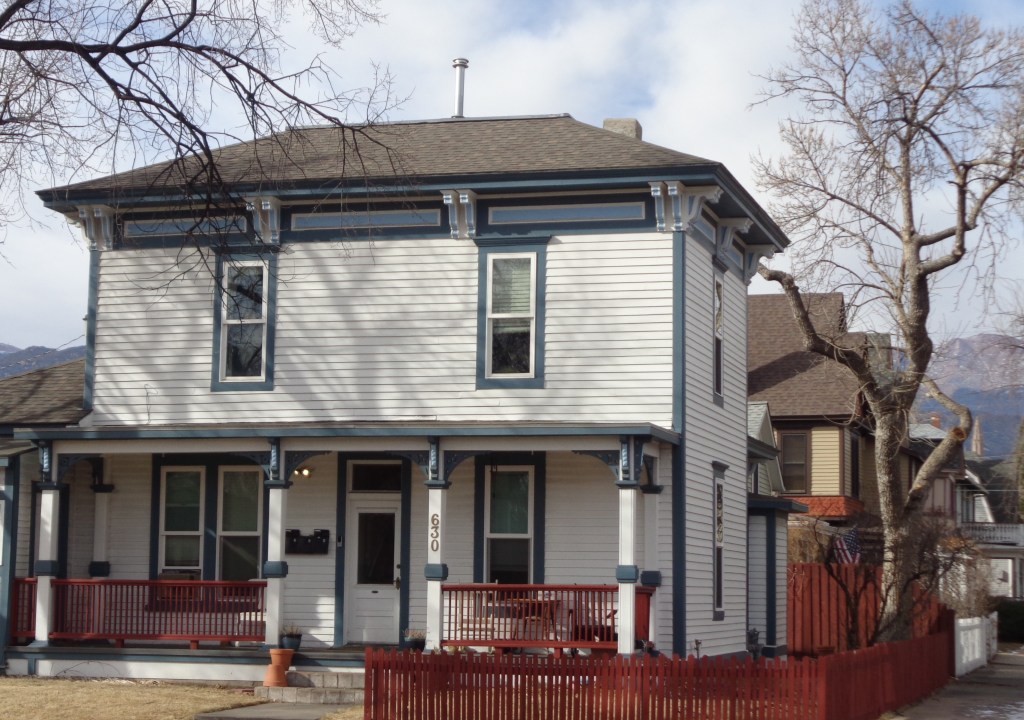
Another prominent home is the Hannon residence. William E. Hannon was a broker working at Gemming, Hammon & Co., a mining stock brokerage firm. He stayed here only one year, the next year William Wallace, also in mining, took over with his wife Buphemia and a couple of roomers. In 1903, Charles Walker and his wife Lucy began a long occupancy.
This Italianate-style home is notable for its double brackets below the roofline on the façade, and the single brackets on the north and south. It features a shallow roof with deep overhangs and an ornamented, tall, one-story front porch with scrollwork brackets. This style is tall, narrow, and well-suited for catching summer breezes to cool residents.
Hart House
321 East Monument Street
Built 1894
Architect Unknown
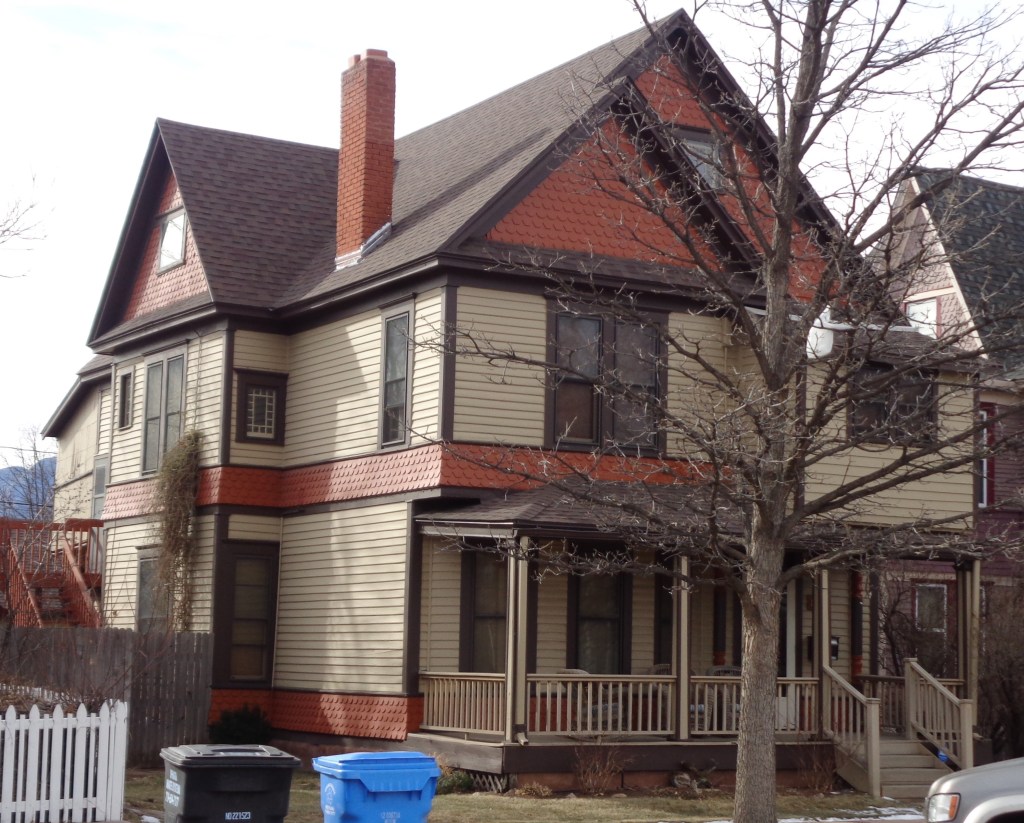
This home was built for A. Elliot Hart, then the manager of the El Paso Club, the most prestigious private club in town. He later became a mining broker. By 1898, he and his wife Catherine were referenced as participating in various fashion events, such as charity balls. They lived here for several years.
This is an imposing two-and-a-half-story frame house with a full-width, first-story porch with low railings. A sleeping porch was added to the northwest corner. The body is covered with lap siding. The boxed gables are faced with octagon-cut wood shingles alternating with round shingles. The same pattern forms a belt course between the first and second story and at the base of the first story.
W. H. Gandy Residence
317 East Monument Street
Built 1896
Architect Unknown
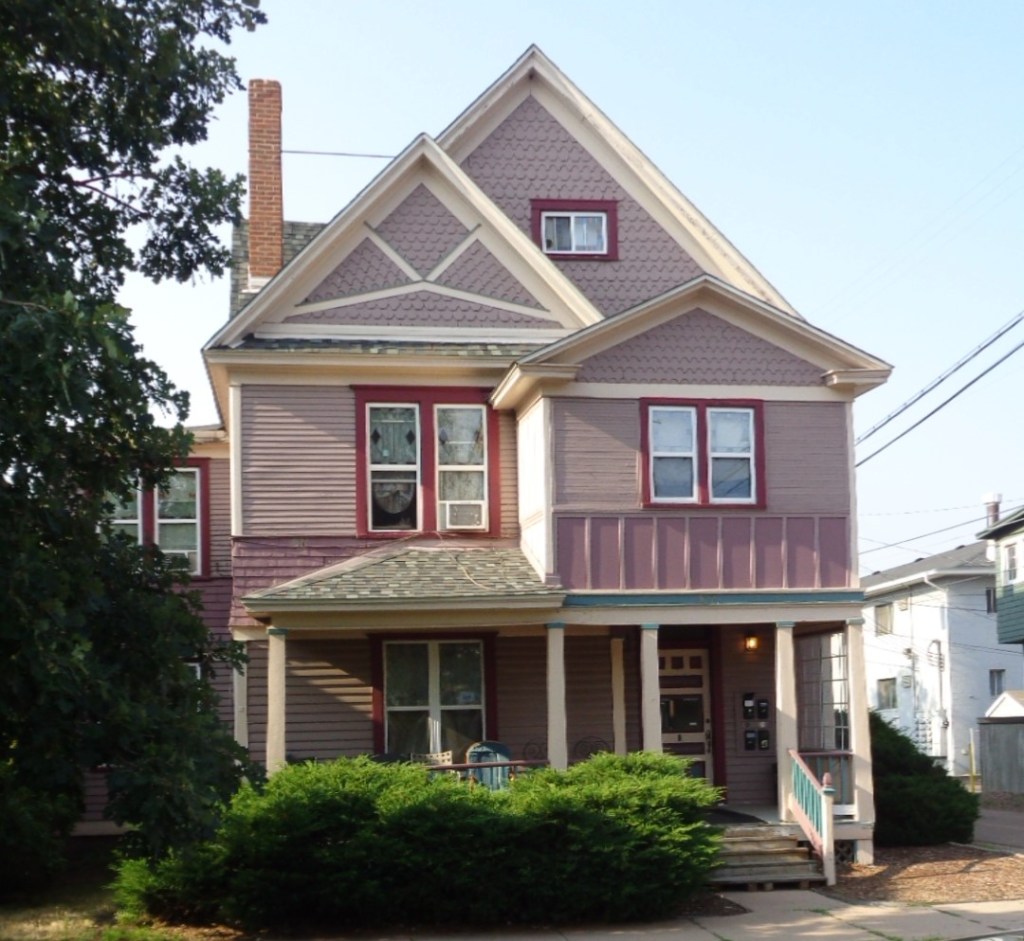
W. H. Gandy was the initial occupant of this house. He arrived in Colorado Springs and began selling boots and shoes. By 1892 Gandy rose to secretary of the Mutual Mining and Milling Company. Later he became a commission merchant, lending funds to enable manufacturing or farming. He formed his mining brokerage firm in 1896.
This is a two-story and one-half-story frame covered with lap siding, with a belt course of square shingles. The façade gable displays an array of shingle patterns, the top rear has an octagon alternating with half-cove shingles. Boxed-shaped gables are divided in the middle into sections by half-timbering. The top section features octagon shingles, the paired middle sections are half-cove set at a diagonal, and the bottom has only half-cove shingles. A second-story sleeping porch with very narrow lap siding occupies the northwest corner, atop a full-width-first porch.
Oppenheim Brothers Residence
630 North Weber Street
Built 1896
Architect & Contractor Barber & Hastings
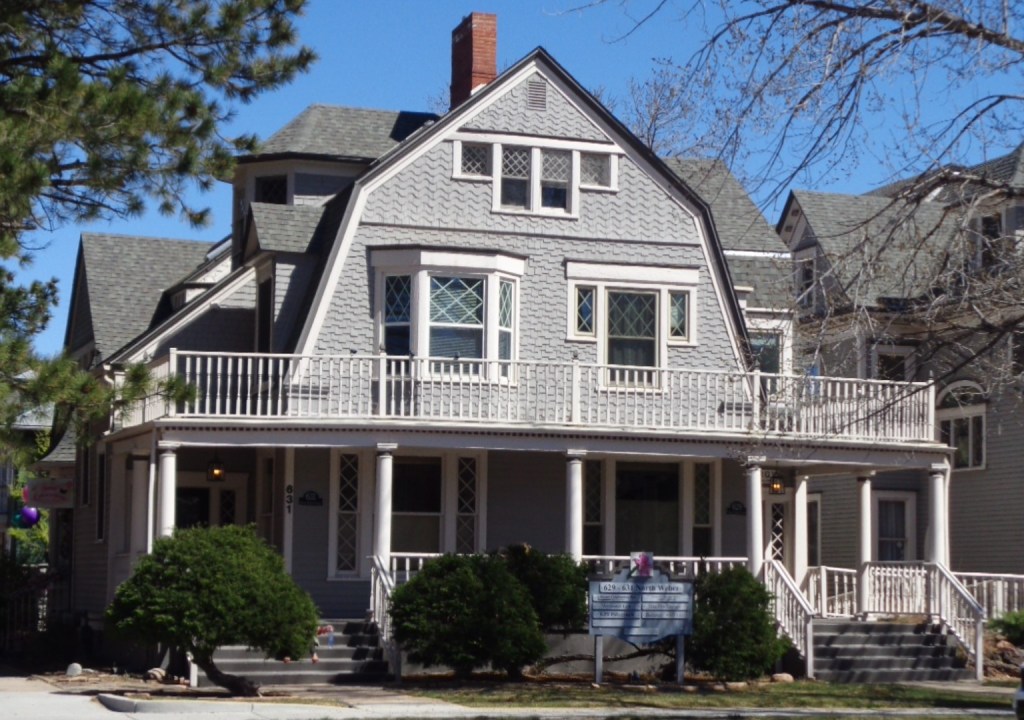
While this home is credited to Barber and Hastings, this differs from an 1896 announcement that Fred Hastings was both the architect and contractor. Two brothers, Joseph and William, owned 19 East Huerfano (Colorado Ave). Their business offered gentleman’s clothing, hats, boots, and shoes. In the early days, they also brokered loans.
This is a sizeable Colonial Dutch Revival dwelling. Elaborate Palladian windows appear in the façade second-floor gables, adjacent to a bay window to the north with diamond-patterned muntin; this diamond pattern is duplicated below in the sidelights adjacent to the picture windows. Narrow wood railings are displayed on the first-floor full-width porch and the second-floor porch balcony. Square-cut wood shingles are arrayed in a staggered pattern on the second floor, while the gable ends have curved shingles set in a wave pattern. Now symmetrical two entrances appear on the first floor, but it was built with a single entry on the south.
Van Dusen Boarding House
627 North Weber Street
Built 1902
Architect Unknown
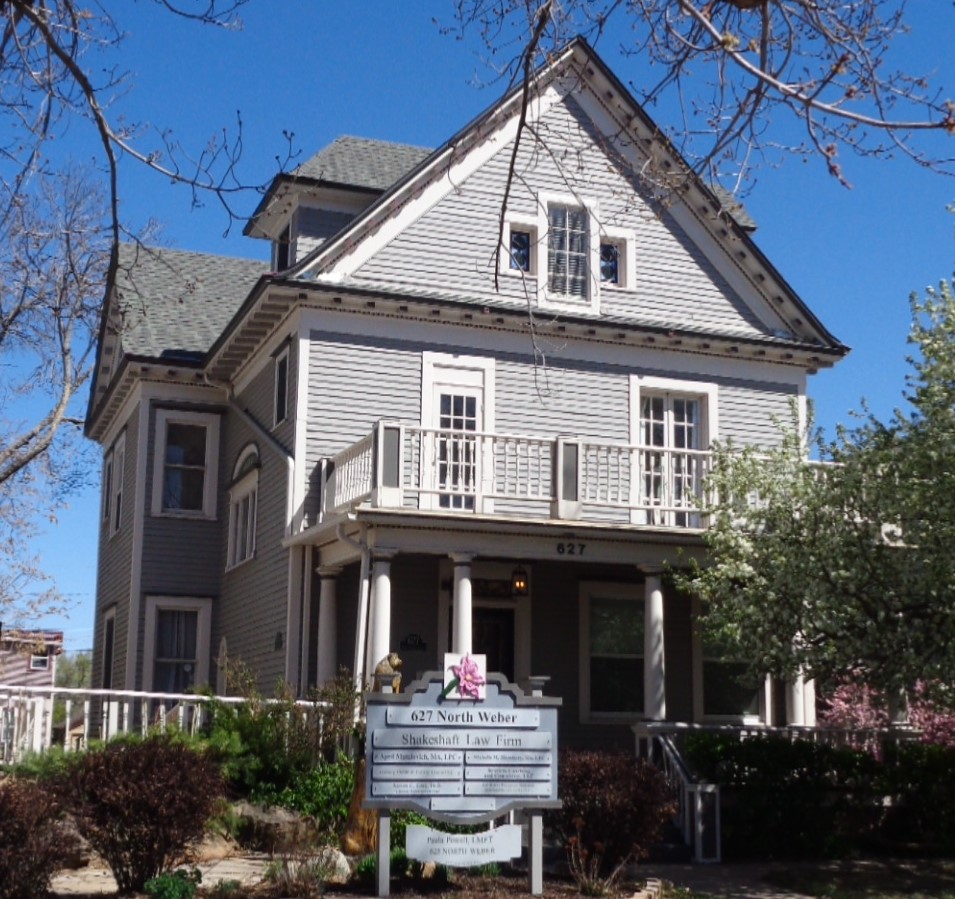
This house was built as a rooming house, first for the widow Mrs. Emma Fountain. The next year, Mrs. Euphemia van Dusen operated the home as a boarding house.
This is a Late Victorian gable end house, two and one-half stories tall, decorated with multiple brackets and dentils below the roof line and the porch balcony. There is a distinctive Palladian window set in the boxed gable. On the second-story porch, a doorway provides access plus a second-story railing across the full width of the home. The first-story porch also has a full-width railing with an offset front door featuring a top light. The building is clad in narrow lap siding.
Beshears House
624 North Weber Street
Built 1894
Architect Unknown
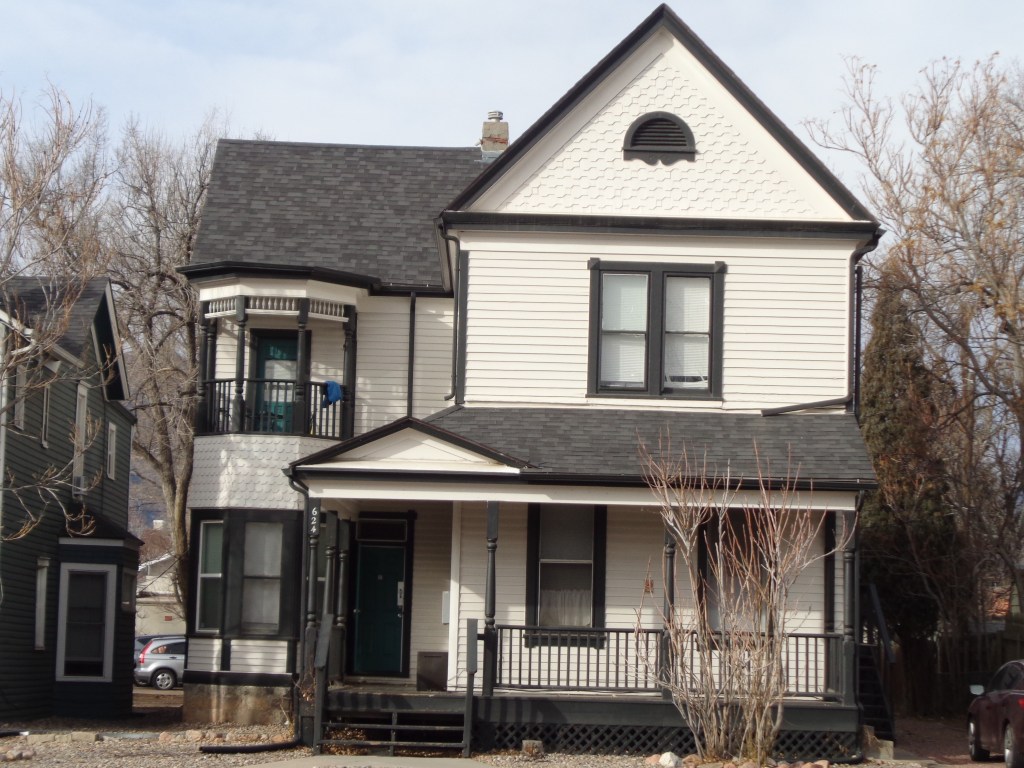
James Beshears was a long-time miner who owned claims in the Cripple Creek District. He lived here in 1894 with J. E. Beshears, who was also employed in the mining industry, and another resident, J. M. Alexander. Little is known of any of the three. James also formed Beshears & Reed, to provide carriages and harnesses. By 1900, this was a boarding house.
This is a Late Victorian dwelling with restrained ornamentation. The recessed octagonal two-story tower on the facades’ southern end has an interior room on the first floor and an open second-story balcony with narrow columns and railings. There’s lap siding on the 1st floor and octagon shingles on the second. It also features turned posts, spindles, and balusters. It lacks a turret, and Sanborn maps indicate it may have been built without one. The gable end displays octagon shingles alternating with rectangle shingles.
Ferrin Residence
224 East Willamette Avenue
Built 1900
Architect Unknown
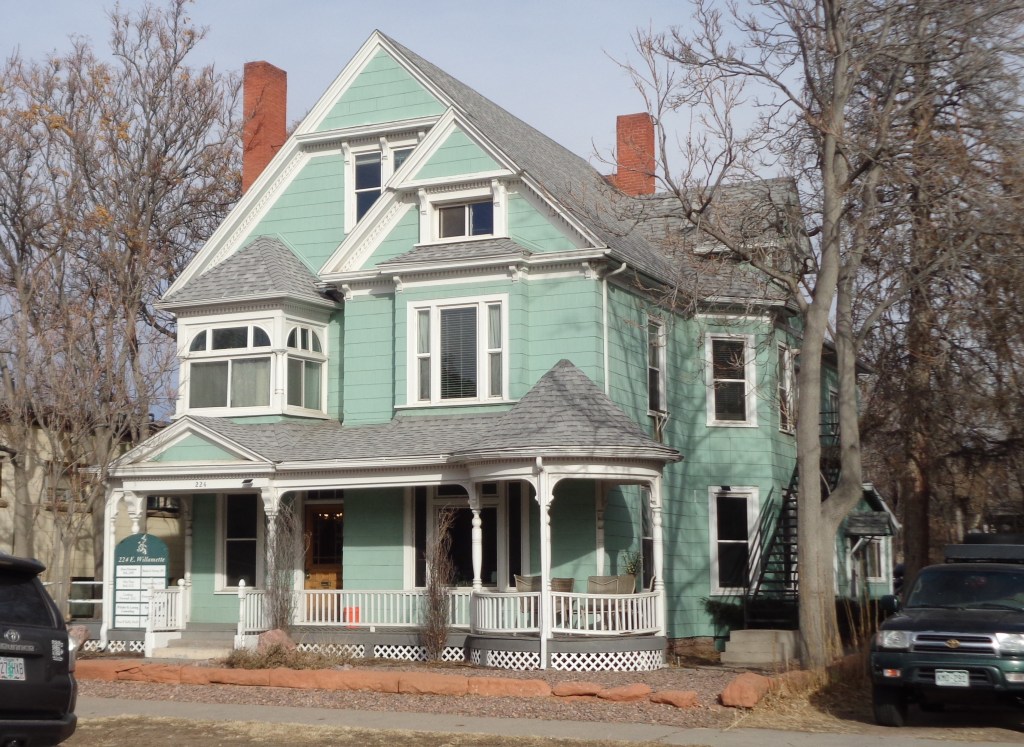
Charles Barnes Ferrin was born in Watertown, Conn, and arrived in the region in the early 1880s, and started working as a press boy for the Out West Publishing Co, the parent company of the Gazette Telegraph newspaper. He was elected fire chief of Colorado Springs in 1888, serving until 1890. In 1895, he married Nellie B. Stockbridge, daughter of Mr. and Mrs. Charles Stockbridge; Stockbridge had served as mayor of Colorado City and had founded one of the largest wholesale liquor businesses in Southern Colorado. By 1900, Ferrin had worked as a traveling agent of Out West for three years, selling office supplies, books for recording, paper, stationery, and election supplies. The wedding was one of the social highlights of the year. Ferrin eventually rose to president and general manager of the Out West.
This home is an ornate Queen Anne, with its asymmetrical façade, full-width porch, multiple gables, corner conical roof, turned spindles, and generous use of dentils.
Linney Boarding House
529 North Weber Street
Built 1900
Architect Unknown
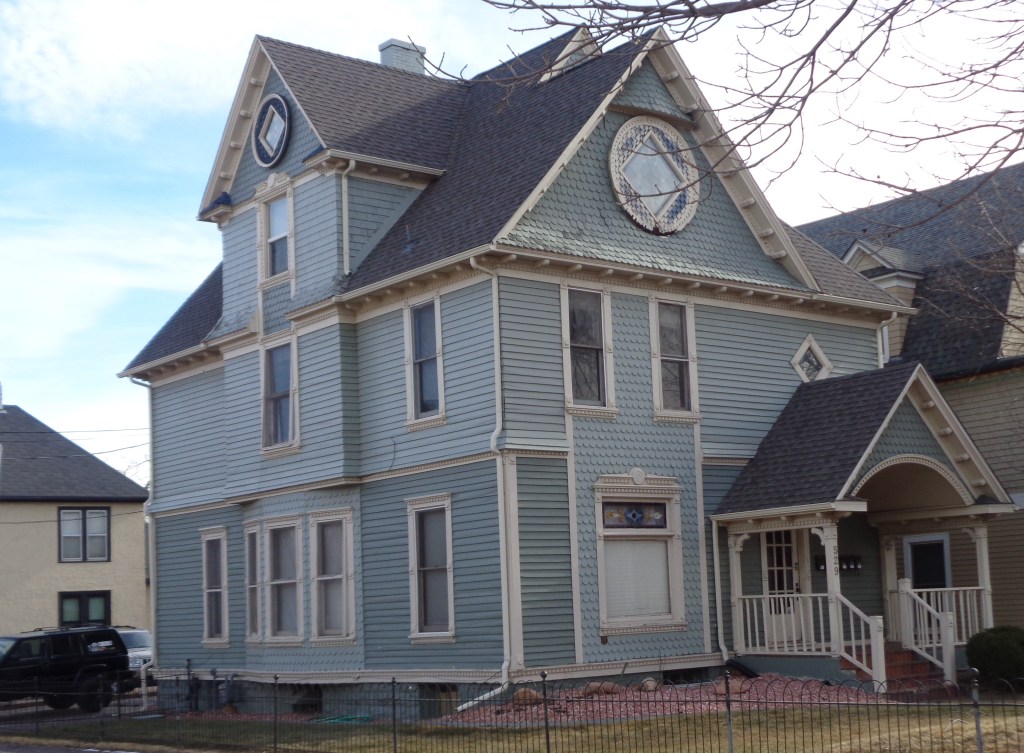
This detailed dwelling appears to have been built as a boarding house in 1900, initially under the management of Mrs. James H Linney.
It is a two-and-one-half-story Queen Anne with paired staggered front gables on the façade. Heavy brackets support deep eaves, and a pair of square windows rotated 90 degrees vertically; these are in the façade gables and the gable ends on the north elevation. They have glass panes inside a frame, surrounded by square shingles and a round wood trim border. Round shingles occupy the gables’ ends. A vertical ribbon course on the façade north of the entry has fish-scale shingles. The remainder of the house is clad in lap siding.
Heavy ornamentation includes corner boards, brackets, the use of dentils in several locations, and lap siding on the first and second floors
Newton Boarding House
528 North Weber Street
Built 1890
Architect Unknown
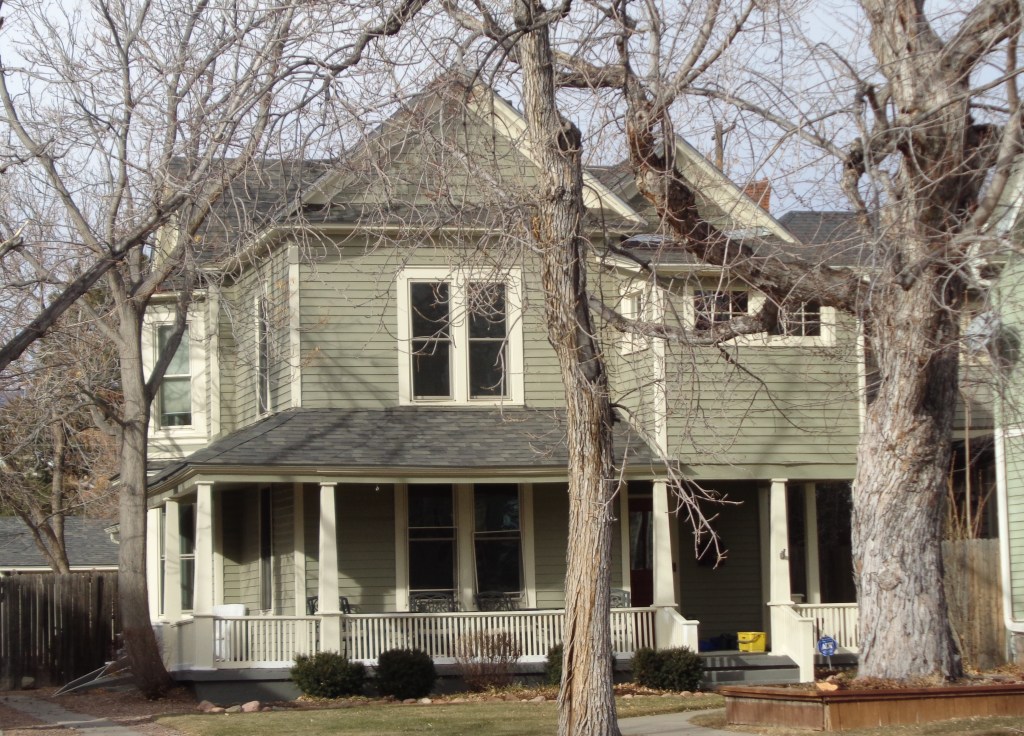
This dwelling was built as a boarding house. Mrs. Alda F. Newton operated it for several years. Arthur W. Newton also lived here; their relationship, if any, is unknown; he was a bookkeeper for the Newton Lumber Co.
This is a two-story, wood frame Later Victorian dwelling with lap siding. It features square shingles in the boxed gable ends, and lap siding elsewhere. There is a full-width first-floor porch with an offset entry. Tapered rectangular posts support the porch roof, and there’s a low railing. A tuberculosis sleeping porch appears on the northeast corner of the building, on the second floor. A two-story bay window also appears on the south elevation.
Samuel Bernard Residence
520 North Weber Street
Built 1895
Architect Unknown
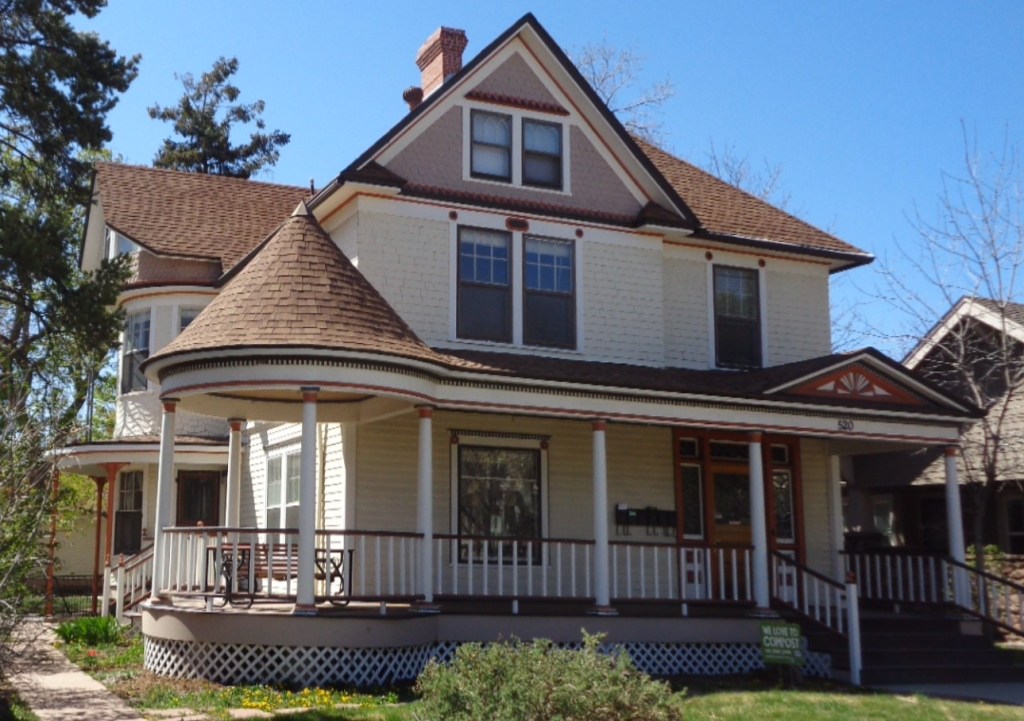
In 1893, local grocers Samuel S. Bernard and brother George grubstaked blacksmith William Shemwell to prospect the Elkton mine. Luckless, Shemwell turned over shares and his works, and the brothers agreed to continue work for only two weeks. They located a rich vein just in time. The Elkton was later merged with other claims and generated another local set of millionaires. Samuel became a mining broker and later founded a jewelry business.
This is a rich Queen Anne of two and one-half stories. Deep eaves with fish-scale wood shingles in the façade gable end, accented with arrow shingles. Both the first and second floors are clad in square-cut wood shingles. A fanlight display decorates the pediment over the steps leading to the front porch, and the front door has detailed sidelights and a topflight. The full-width porch wraps around the south elevation, and narrow columns support the porch roof. A turret tops a round corner. Yet another two-story tower sits on the southwest corner of the house, decorated with fish-scale over diamond cut shingles in a wavy pattern at the top and square cut shingles at the bottom.
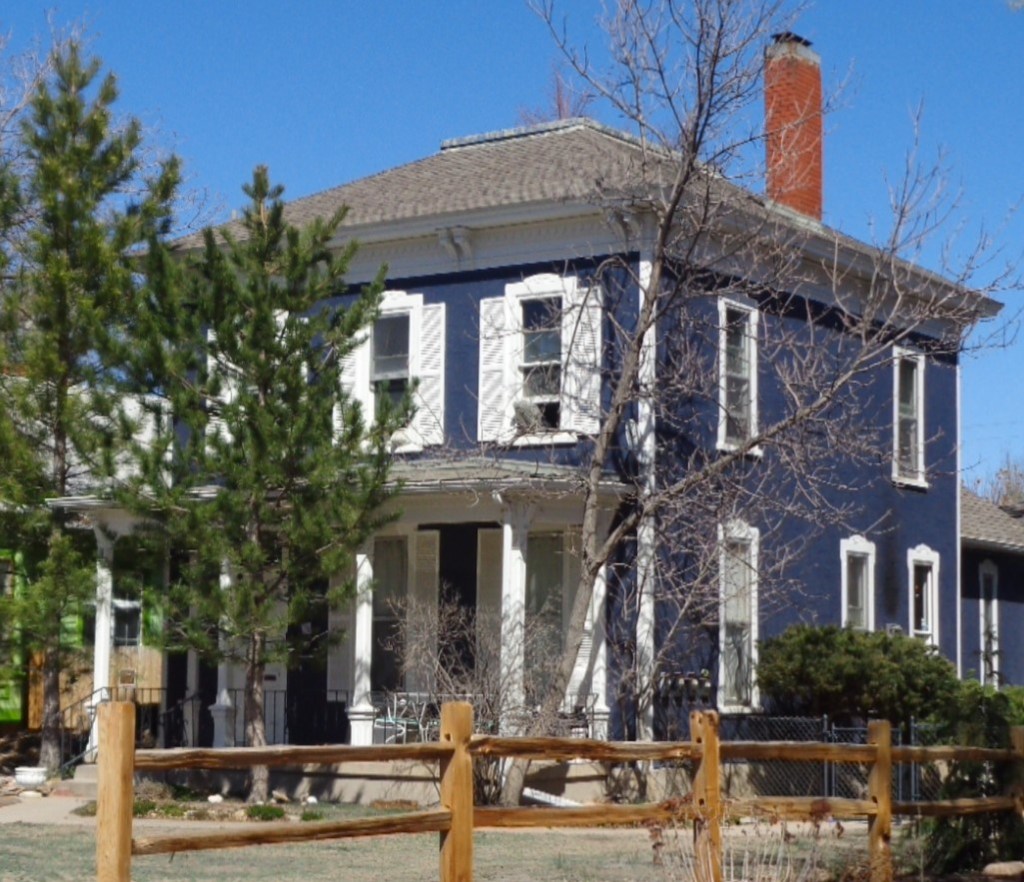
Crawford & DeGraff Residence
515 North Weber Street
Built 1882
Architect Unknown
One of the oldest dwellings in the Weber Wahsatch District, this was first the home of Robert R. Crawford, a mining operator. By 1888, David DeGraff was the occupant. Born in Ulster County, New York, he arrived in the region in 1871. The following year, he, purchased a ranch southeast of Colorado Springs and raised cattle and sheep. His holdings grew to 17,620 acres, the largest land owned by a single individual in Colorado. He turned to real estate. In 1897 he built his DeGraff building downtown. It was designed by architects Pease & Barber. It featured first-floor retail shops and offices, and many mining stock brokerages.
This is a small Italianate house of two stories. It has a shallow roof, paired brackets supporting the eaves, and square posts supporting the full-width porch roof. The façade displays corner boards. The north side lost its windows; they likely were similarly patterned on the south side of the house.
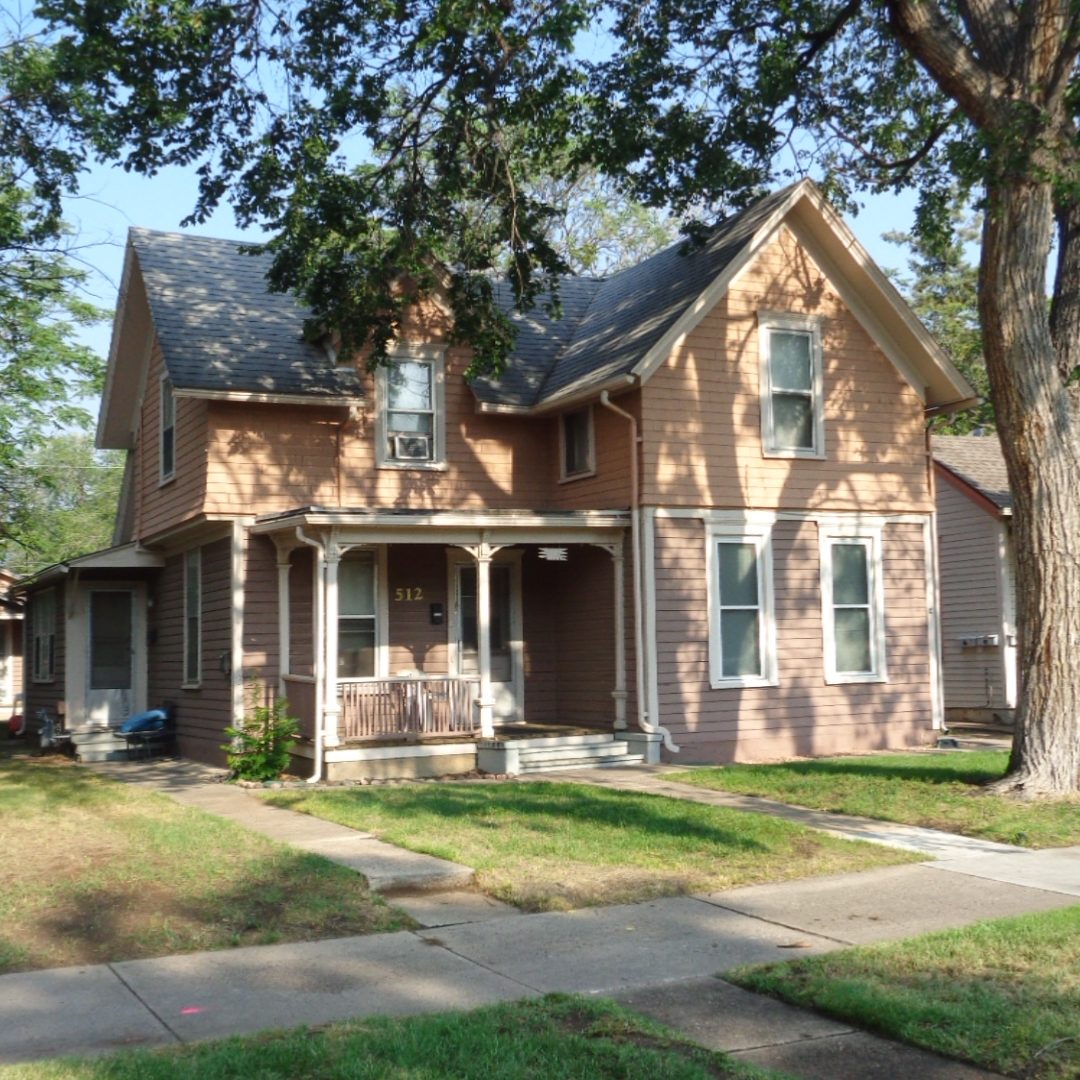
Bumstead Residence
512 North Weber Street
Built 1882
Architect Unknown
Another very early dwelling is the Bumstead House. Edward S. Bumstead arrived in Colorado Springs in 1878. The previous year, the City adopted an ordinance and passed bond issues to create a sanitary sewerage system, so this became a highly valued skill. In 1889, the City required all new buildings to connect to the system.
A professional plumber, Bumstead partnered in several firms before going solo in 1888. He also engaged in real estate for several years and was a member of All Souls Unitarian Church and the Odd Fellows fraternal organization. He was elected as a City Alderman in 1894.
This is a two-story Late Victorian with a projecting gable end on the north side of the façade. There’s a first-floor shed dormer on the north elevation. The second story is clad with square-cut wood shingles that flare above the first-floor lap siding. On the southern first floor is a half-width porch with narrow detailed porch columns. A separate entry is on the south elevation.
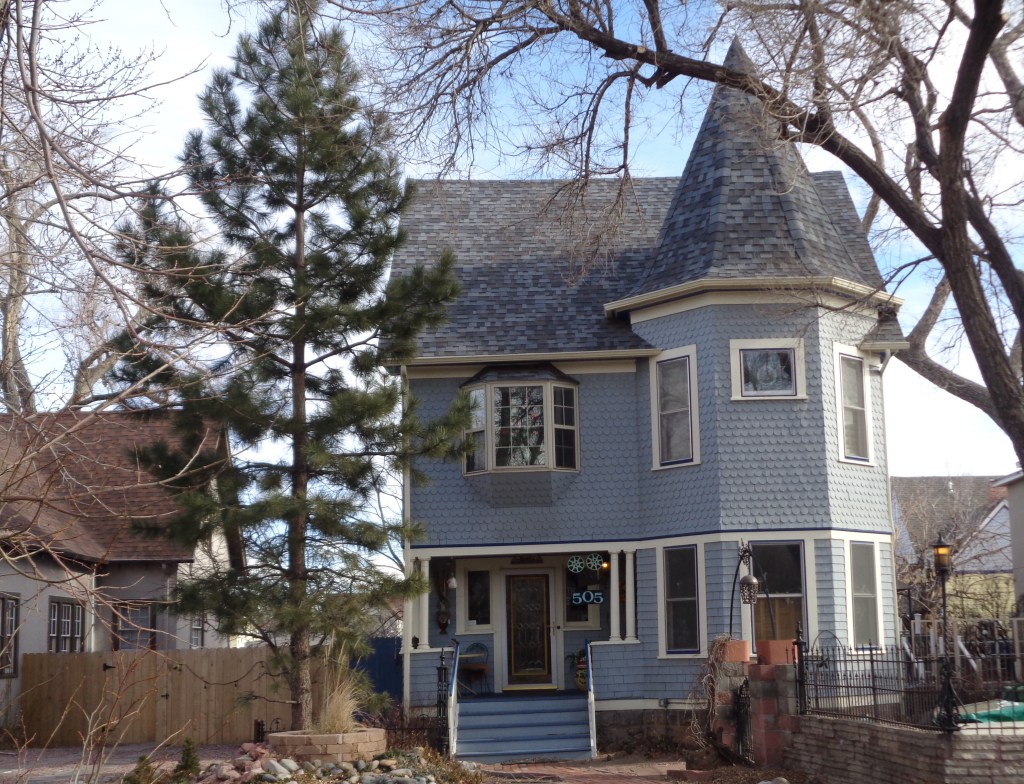
Reid Residence
505 North Weber Street
Built 1902
Architect Unknown
This home was built in 1902 for Herbert I. Reid and his wife Mary Belle Gibbs. Reid had arrived in 1882 at the age of 23 and spent the remainder of his life as a pioneering engineer, recognized as the father of the City’s water system. Starting in 1886, as County Surveyor, Reid then served 15 years as the City Engineer, constructing Lake Moraine, City Reservoirs 2, 6 & 7, the Ruxton Pipeline, Prospect Lake, the Broadmoor water system, the Strickler tunnel, and the High Drive, among other projects. Mary died in 1905, but Herbert raised their son and 4 daughters while living here; three taught in a local school. Reid lived in this home until 1941.
This Queen Anne emphasizes its verticality with a massive, octagonal two-story tower with a turret on the south edge of the façade. Decorated with fish scale wood shingles on the second floor and square-cut wood shingles on the first, it has a recessed porch on the north with paired, narrow porch columns, and an elaborate door with sidelights. The façade’s second-story oriel window is a later alteration.
Clark Double House Image Coming Soon!
Clark Double House
226-28 East Saint Vrain Street
Built 1893
Contractor W.C. Johnston
This is an early duplex. Originally, this building contained only two residences that were soon divided into four – a consequence of the rising demand for housing sparked by the gold mining boom. Owner John R. Clark was engaged in real estate and was employed by Holbrook and Perkins, purveyors of fine clothing and gentlemen’s furnishings. He lived in one of the units for many years. W. C. Johnston was the contractor.
It is a Late Victorian-style two-story building, symmetrical, with projecting covered porches on the southeast and southwest corners. It displays narrow-turned posts and spindles. Lap siding covers the two floors with curved shingles in a wave pattern in the gables. Decorative bargeboard underlines the gables. Double-hung sash windows are evenly placed on the building.

Leave a comment