Windmill House
615 Zyder Zee
Built 1926
Architect Benjamin Lefkowsky
Do you have stories, documents, or pictures of the Windmill House?
About
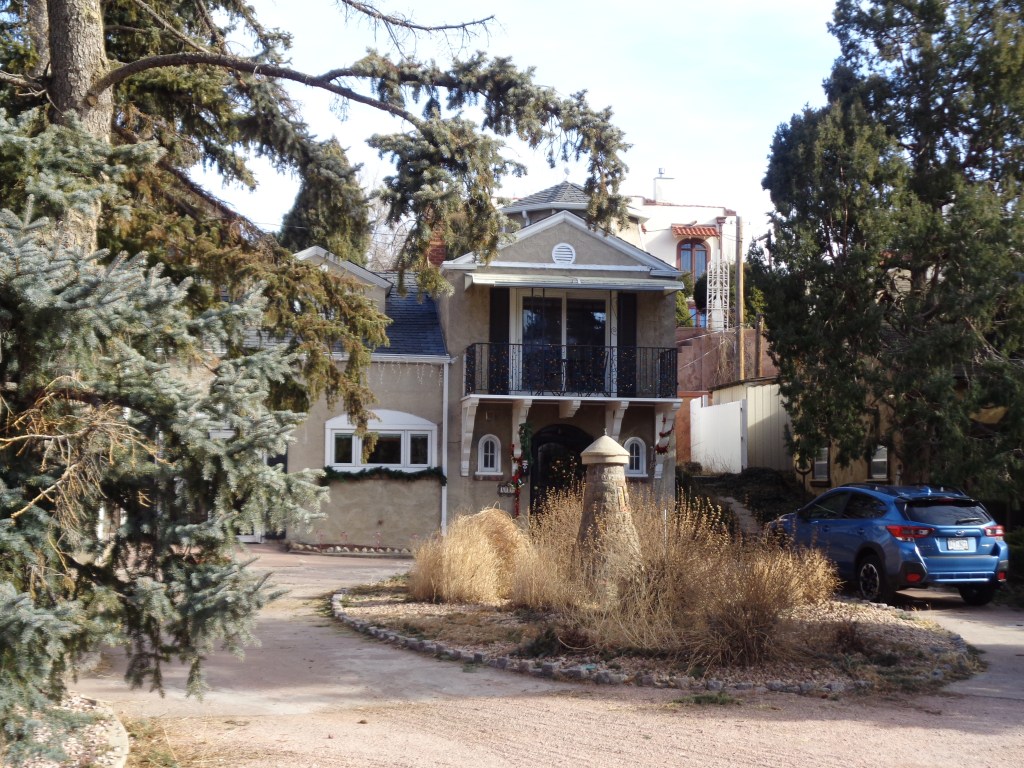
The Windmill House at 615 Zyder Zee is a Dutch-inspired example of Mediterranean Revival architecture. It is an irregular shape that appears to have the same interior layout as the two dwellings to the south. There’s a two-story gable end to the south with a cantilevered balcony over the front door. Attached on the north is a one-story wing with a hipped roof gable. A three-story octagonal tower forms a windmill shape at the southeast corner of the house. A brick chimney sits near the center of the house. At the north end of the wing, a garage door has been replaced by sliding glass doors. A north wall displays a curvilinear shape.
The building occupies 876 square feet on a 7,500 square foot lot, with another 747 square feet above. There is no basement. Monument Street is adjacent to the north, and Monument Valley Park is to the west. There is a shared gravel driveway flanked by two gateway pillars that provide vehicular access to all three properties.
Nestled against the backdrop of Monument Park, the irregularly-shaped stucco house stands as a testament to a bygone era, a canvas painted by the hands of Russian artist and real estate visionary Benjamin Lefkowsky in the roaring 1920s. A work of architectural art, the west-facing dwelling is a captivating blend of late 19th and 20th Century Revivals, specifically the enchanting Mediterranean Revival style.
As the sun sets in the west, the house reveals its distinctive features—a façade adorned with a two-story front gable roof bay to the south and a one-and-a-half-story wing to the north, sporting a charming gable roof dormer. Smooth stucco clads the walls, extending gracefully to the foundation, while a central brick chimney punctuates the composition roofing. The windows, adorned with brick sills, frame a narrative of their own.
The front gable, a pedimented masterpiece, boasts a round vent on its face, while the second story unfolds a story of its own with a cantilevered shed roof balcony supported by oversized, decoratively shaped wood braces. A delicate fabric covers the balcony roof, held in place by wrought iron balustrades and supports. Sliding doors face the balcony, inviting tales of evenings spent under the stars.
As we venture through the architectural marvel, we encounter a round-arched entrance flanked by two small round-arched four-light windows, all contributing to the allure of the first story. A wing to the north unveils its own secrets—a small gable roof stucco dormer with a single-light window and shutters, a testament to the intricate detailing that defines Lefkowsky’s creations.
The south wall of the front gabled bay hosts windows on both stories, while an eastward projection reveals a three-story stucco bay culminating in an octagonal third-story tower crowned by a whimsical ball finial. The tower window gazes westward, capturing the essence of Monument Park. The lower wall of the bay features windows with brick sills, creating a harmonious interplay of light and shadow.
The enchanting journey continues with a glimpse of the rear wall—an entrance with a security door illuminated by a whimsical metal lantern. The north wall of the north projecting wing offers a curvilinear-shaped parapet with a contrasting coping, a round vent at its apex, and two single-light windows sharing a brick sill and adorned with shutters.
Venturing beyond the architectural beauty, we discover a historical narrative that ties the house to the visionary Benjamin Lefkowsky. A man of diverse talents, from art photography in St. Petersburg to soldiering in the Russian czar’s Hussars, Lefkowsky’s journey led him to Galveston, Texas, and eventually to Colorado Springs. Acquiring the James J. Hagerman property and five acres of undeveloped land, Lefkowsky sculpted the area, giving birth to Park Terrace and Zyder Zee. The landscape, cited as “one of the show places of the region,” overlooks Monument Valley and the mountains.
This house was the largest built on Zyder Zee. Lefkowsky found it difficult to find buyers. Its construction was well publicized, and nearby homes were seldom vacant, but the Lefkowskys printed two real estate advertisements in September 1926 and March 1927. Lefkowsky himself was the occupant of record in the 1929 City Directory.
Through the pages of time, the house changed hands—from the Lefkowskys to residents like Minnie Britain, Robert A. and Irene MacDonald, and M. Wilber and Blanche S. McBroom. Each chapter unfolds, revealing the diverse stories woven into the fabric of this Mediterranean Revival gem.
Despite the alterations witnessed since 1985—modifications to the entrance, replacement of doors, and updates to windows—the house stands as a living testament to an era of artistic vision and landscape appreciation. In the dance between history and evolution, this residence, though altered, remains an integral part of the potential historic district—the North Cascade Residential District. A piece of Lefkowsky’s legacy, it beckons admirers to delve into the rich tapestry of its past, each modification adding a layer to its ever-evolving story.
Timeline
1925
The home was built by Benjamin Lefkowsky after pulling a building permit on December 1, 1925.

On December 5, 1925, the Gazette Telegraph published an article that reads:
New Construction Has Upward Trend
In the first three days of December, eight building permits, aggregating $25,940 in value, have been issued by the office of the city engineer. Last month set a high mark for construction this year. Indications are that December will set a record for the construction during 1925.
Permits have been issued this month for one stucco dwelling and four large remodeling and alteration projects.
Permits issued thus far this month follow:
American Unitarian association. $1,000, remodeling 732 North Tejon street; Anna Quinn, $100, repairs, 322 South Wahsatch avenue; Benjamin Lefkowsky, $5,000, dwelling, 615 Zuider Zee street; Lacy W. Thomas, $10, garage, 308 West Fountain street; Rialto theater, $1,150, repair organ loft, 126 East Pikes Peak avenue; Colorado Springs National bank, $3,500 remodeling Boston store, 27 North Tejon street; Stewart Brothers, $15,000, remodeling store building, 19 and 21 North Tejon street; James J. Ganghan, $150, repairs, 24 West Bijou street.
On June 20, 1926, the Gazette Telegraph published an article about the home being completed that reads:
Dutch Windmill Motif

Perhaps the most unique house in the Pikes Peak region today is the windmill house being completed on Zeyder Zee, just west of Cascade avenue in the 600 block, by Benjamin Lefkowsky, who has erected some of the different houses built in the city in recent years. The photo shows the partially completed windmill effect.
1926
On September 5, 1926, the Gazette Telegraph published an advertisement that reads:
Most Original Home in Colorado Springs
Designed and Supervised by Mr. Benjamin Lefkowsky
Your Closest Inspection Is Invited –
Do you crave the exclusiveness, quiet, and delicious air of the Country around your City dwelling? These beautiful homes are located amidst the most desirable surroundings – Monument Valley Park borders the West, new homes of the better type to the North, East, and South, and yet only a few blocks from the Antlers hotel.
There are no duplicates in Europe or America. Five rooms and sleeping porch with inside garage; hot water heat; best of fixtures; attractively decorated – strictly modern.
THE PRICE IS RIGHT TO THOSE APPRECIATING SUBSTANTIALNESS and BEAUTY
You have enjoyment of the grounds of a vast estate without the trouble and expense of upkeep.
Drive Out North Cascade Avenue, to Monument Street – Turn One Block West to the
Most Unusual Sub-Division in the Pikes Peak Region.

“The Robin’s Nest”
An artist with vision conceived the idea
Of building the beautiful Zuyder Zee;
Selecting a spot by the side of the stream.
He began to unfold a most comfortable dream
By the side of the lake in Monument park,
Where the swans and the awainè court from daylight till dark.
With a view of the Peak a perpetual frieze,
Uniting the heavens with flowers and trees,
Where the sun always sets in the tremendous array,
When signaling earth at the close of day.
‘Twas nested in trees and verdure green,
The most beautiful spot that aye hath seen;
And thus were the homes of the Zuyder Zee,
Built snugly and seedly for you or me.
But before the workmen pronounced them done,
There exists to the porch of the log-trimmed side,
Eve robin, a male and his charming mate,
And deeded there to try their fate.
A nest was begun with strings of moss,
And workmen wondered who had the avenue
To tag their logs, right over the door,
And keep on putting there more and more.
They decided to spy upon this pest,
And found him to be Mr. Robin Red Breast.
So hastily workmen beat a retreat,
That robin might build his love a seat,
On the topmost log, right over the door,
Under the balcony, and most secure.
Daily he made his trips to the nest
That did shield and protect his robin red breast.
Twins were born to the adoring pair,
And surely Good Luck has been left there
Is the Zuyder Zee, so quaint and still,
With the Lighthouse, the Well, and the old Windmill.
To the Zuyder Zee of Colorado Springs
Where robins meet and nest and sing –
We drink a toast: May they happy be
Who luckily inhabit the Zuyder Zee,
– By Mrs. Benjamin Lefkowsky
(This poem was inspired by the robin’s nest which still hangs over the door of the “log-trimmed eve.”)

Beginning Monday, September 6th, The Interior May Be Seen Only by Appointment With the Owner, Benjamin Lefkowsky 610 North Cascade Avenue Phone Main 2374
We shall preserve these homes faultlessly for your occupancy.
Buy a Home in Zuyder Zee
Because Only First Class Material and Workmanship Were Supplied by
A.E. Olson Plumbing & Heating Co.
All Plumbing and Heating
The Paint Supply Co.
Paints and Varnishes
Newton Lumber & Mfg. Co
All Lumber and Millwork
Metal Products Co.
Metal Work and Johns-Manville Roofing
Ray Baublits
Painting and Decorating
Joe Wallace
Stucco and Plastering
Scheffer-Nicoll & Co.
of Denver, Colorado
Tile, Marble Installation
Hagen Fuel & Feed Co.
1927
The home was listed as vacant until 1928 in the City Directory.
On March 6, 1927, the Gazette Telegraph published an advertisement that reads:
The Zuyder Zee
Only Two More Homes Left in the
Lefkowsky Resubdivision
The most unusual in the PIKES PEAK REGION
Six Blocks from the Antlers
LOCATED amidst the most desirable surroundings – Monument Valley Park borders the West, new homes of the better type to the North, East and South.
ARE YOU LOOKING FOR SOMETHING ORIGINAL?
There are no duplicates in Europe or America
FOR YOUR WINTER HOME
Well built for comfort in our glorious winter climate of almost perpetual sunshine; with a ne’er to be obstructed view of Pikes Peak-of the ver-changing sunsets; with the exclusiveness, the quiet and delicious air of the Country around your City Dwelling.

FOR YOUR SUMMER HOME
Would be ideal for your summer home enjoying the domain of a vast estate without the trouble and expense of upkeep. Walking distance of the City.
You Can Net 15% on Your Investment
Five rooms, glassed-in porches, inside garage; hot water heat; best of fixtures; attractively decorated – strictly modern.
THE PRICE IS RIGHT
Terms to Suit Purchaser.
SHOWN BY APPOINTMENT
BENJAMIN LEFKOWSKY
610 N. Cascade Avenue Phone Main 2374 Colorado Springs, Colorado
1929
The Lefkowskys were listed in the City Directory as occupying the house.
1930
Mrs. Minnie Britain was listed in the City Directory.
1931
Robert A. and Irene MacDonald were listed as residents in the City Directory. Mr. MacDonald was a broker.
1941
M. Wilber and Blanche S. McBroom were listed as residents of the home in the City Directory. Mr. McBroom was associated with the Modern Music Company and Blanche McBroom was affiliated with the Metropole Café.
1951
Thomas H. and Ruth Nicholl were the owners of the home. Mr. Nicholl was the president and general manager of the Colorado Springs Transit Company.
2004
An Architectural Inventory Form was completed between October 2003 and March 2004. At the time, the Colorado Historical Society-Office of Archaeology and Historic Preservation determined the property was not historically significant on its own, but could be included in a National Registrar district.
Additional Resources
- 615 Zyder Zee Research – a collection of documents compiled during the Historic Uptown Neighborhood’s historic preservation efforts.
- Benjamin and Ethyl Piland Leftowsky Biography by Tim Scanlon.

Leave a comment