Wray Residence
33 W Willamette
Built 1906
Architect Douglas & Hetherington
Do you have stories, documents, or pictures of the Wray Residence?
About
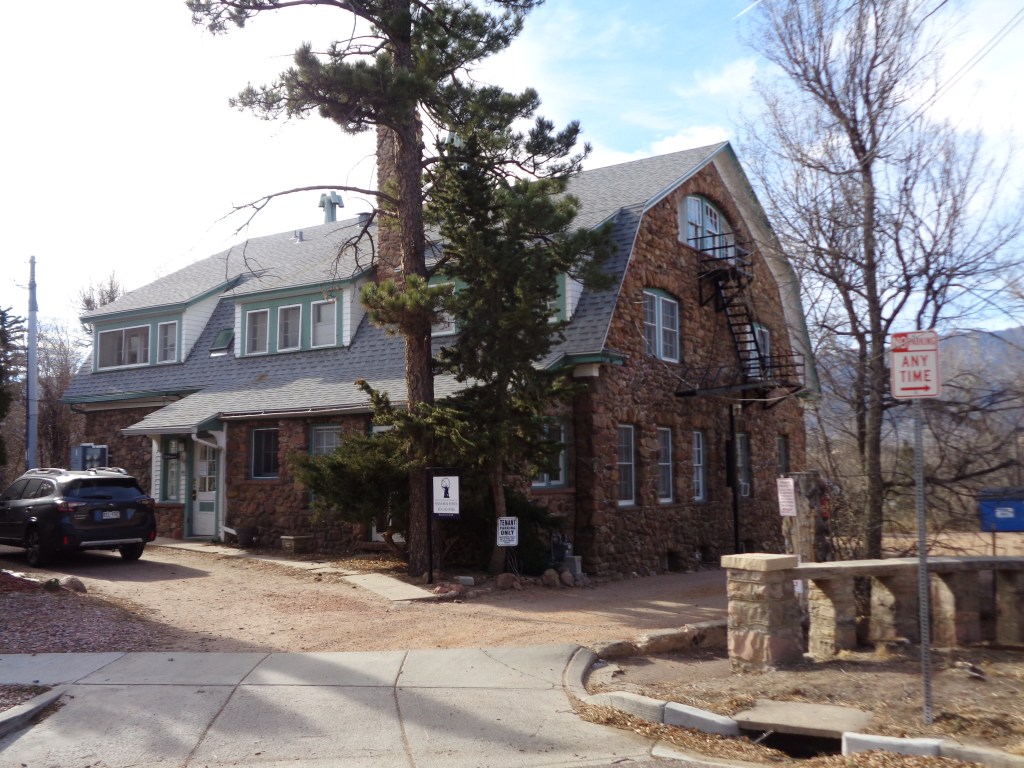
Nestled on the edge of Monument Valley, where the land drops sharply to the southwest, stands a two-story fieldstone dwelling with a captivating history. Built-in 1906 by the dynamic couple Henry Russell Wray and Martha L. Wray, this house is a testament to the cultural and intellectual vibrancy of early twentieth-century Colorado Springs.
Picture a picturesque gambrel roof with overhanging eaves, adorned with composition roofing and a wide, plain cornice board. Stone chimneys rise proudly from the roof, and the east wall boasts three shed roof dormers, each adorned with nine-light casement windows. The north end of the east wall juts outward, showcasing a paneled and glazed door framed by multi-light windows. A stone balustrade and more multi-light windows grace the southern side, all with sills of red sandstone.
On the north gambrel end, a large segmental arch window with multi-light sidelights commands attention, complemented by paired multi-light double-hung sash windows. Metal fire stairs lead from this architectural masterpiece. The west wall tells its own story with pedimented, shingled dormers and a newer wood deck, offering views of Monument Valley and the mountains beyond.
As you wander through the house’s history, you’ll discover that its occupants were no less fascinating. Henry R. Wray, a broker with offices in the Mining Exchange Building, and his wife, Martha, contributed significantly to the cultural tapestry of Colorado Springs. Wray’s involvement in various organizations, from the Chamber of Commerce to mountain climbing clubs, paints a vivid picture of a man who enhanced and enlarged the community.
Later, the house became a temporary haven for Henry C. Watt and Marjory Palmer, adding another layer to its narrative. Dr. Watt, a young English doctor seeking health in the Colorado Springs air, later married Palmer, the daughter of William Jackson Palmer. Their time in the house was marked by Dr. Watt’s dedication to his medical practice and passion for golf.
Over the years, the house changed hands, witnessing the lives of Mrs. Josephine P. Ellenwood, Mrs. Louisa Graham, and Elizabeth W. Forster. By 1951, Mrs. Helen Waring, a widow and reference librarian at Colorado College, took ownership, completing a cycle that began with the Wray family.
Despite alterations over time, the house’s charm endures, capturing the essence of a bygone era. An open porch enclosed, a deck replacing the once-extensive west porch — these changes tell a story of evolution while retaining the dwelling’s rustic charm. The house’s architectural significance, tied to its native fieldstone construction and ties to the city’s resort image, makes it a potential candidate for the National Register.
As you stroll through the rooms and corridors, you can’t help but feel the echoes of the past, where cultural luminaries and everyday life converged in this enchanting fieldstone dwelling overlooking Monument Valley.
Timeline
1901
On May 5, 1901, the Gazette Telegraph published an article about the beautification of the property around the home that reads:
Transformation In the Creek Bottom
If you haven’t anything else to do this morning before church put on your hat and take a little walk.
Go to the Mesa road bridge over the Monument and stand there for a few moments.
If you have something else to do put it off until after dinner and take this little walk anyway.
If you are a Colorado Springs property holder and you have not kept your lawn and the trees about your place in as good condition as your neighbors would have liked, then by all means take this little walk and see what a change would come over the town if everyone would do a little work of the kind that is being done in that vicinity. When you look at the ground over in the vicinity of the Mesa road bridge and realize the transformation that has taken place there, just bear in mind this is further fact:
It hasn’t cost very much money if Willamette avenue were to be extended westward from Cascade avenue across Monument creek to the right of way the Rio Grande railroad and Yampa street extended also to the railroad property, these two streets would bound on the south and north, a tract of land that bears little more resemblance today to the same tract of land two weeks ago than the average growing city of the west does to the “howling wilderness” which the same place was when the Fourth of July orator first saw it. Two weeks ago this section was covered, with an almost impenetrable entanglement of dead weeds, dead tree limbs, papers, and other rubbish that might be carried to a neglected spot by the winds of summers and as many winters and it would not have required any extreme degree of diligence on the part of a searching party to have located within the boundaries of this tract a tin can toward deliberately thrown there by some careless person. It was never set apart by the city as a dumping ground for rubbish but there was rubbish there and lots of it. If there had been posted along the Mesa road that crosses the tract from the Monument bridge to Cascade avenue, intersecting the latter at Willamette avenue, a few signs warning people that placing rubbish on this tract of land was a violation of a city ordinance, the tens of thousands of tourists who have driven over that road during the past few years would certainly have been justified to believing that the ordinance had been violated.
There is no road in the vicinity of Colorado Springs that is more traveled by tourists in their drives between the points of interest than this one. Nearly every tourist who comes wants to see Manitou and the Garden of the Gods and most of them go to Glen Eyrie. If the drive is from Manitou through the Garden and Glen Eyrie and there to Colorado Springs the trip to Colorado Springs is made via the Mesa road, if Manitou is the end of the drive instead of the beginning, then the Mesa road is the first road over which the tourist party rides.
The Mesa road bridge over the Monument can be reached from Cascade avenue by three thoroughfares. The Mesa road cut-off from Cascade runs down the hill from Willamette avenue passing the Lowe and Studder residence on the west and the Pastorius home on the east. Dale street extends down the hill west of Cascade avenue, passing the Beach and Chisholm places and Cache La Poudre street also leads to the Mesa bridge descending the hill between the Wolcott observatory of Colorado college on the north and the residence of Henry Russell Wray on the south. For years the drive to or from the Monument bridge by either of these thoroughfares has been one that the resident of Colorado Springs would try to forget immediately upon completing it and if he happened to be accompanied by a visitor from elsewhere he did the best he could to interest his friend in the mountains until this stretch of road had been passed. But not so now or hereafter.
At the cost of considerable muscle but of comparatively little money there has been a transformation wrought in this place. Fifty acres of ground have been cleaned. The papers have been burned and the weeds have been horned. The ground has been raked and cleaned and the dead limbs and evidences of neglect have been removed from the trees and disposed of. The hillsides have been smoothed, the hammocks have been taken off and the holes have been filled. Tall willows and cottonwoods that have always been an eye-sore are now an ornament. Ditch-boxes that were filled with dirt have been cleared and extended and ditch-boxes have been put in where formerly the rains cut their courses at will. The work has been done by the Colorado Springs company, owners of the property, and they are planning to make still further improvements. Grass seed will be sown over the entire tract and shrubs will be planted where they will add to the attractiveness of the place. Where there are no trees, willows, or cottonwoods will be set out in order that there may be a uniformity in this respect. There is nothing elaborate about this. It is simply making a cared-for place out of what has heretofore been a neglected one and it something that every property holder in Colorado Springs whose home is not in the condition that it should be in ought to do.
With the Colorado college campus a pretty stretch of green, which it will be within a short time, the city property south of the Antlers hotel added to the Antlers and the Mesa road creek bottom a clean and cared-for spot. Colorado Springs will be fifty per cent more beautiful and pleasing to the traveling public and to the resident of the city than ever before.
If every owner of a home site in Colorado Springs would put a little muscle and perhaps a little money into the improvement of the appearance of his property the percentage of improvement in the city as a whole would be too.
The improvements in the creek bottom have not been the only improvements made in this vicinity that are going to make the place a great deal more attractive than before. The Seusder place is being improved by the sodding of a broad expanse of the hillside, and the Pastorius place is being improved by the building of a retaining wall that is little less than a battlement in proportions. In fact there are three walls of stone to protect the Pastorius property from the weather that is paced above the other the lowest being along the Mesa road and the highest on the level of Cascade avenue. The property in front of the residence of Henry Russell Wray also is being improved by being made largest the ground to be terraced and otherwise improved.
1906
Henry Russell Wray, a broker with offices in the Mining Exchange Building, and his wife, Martha L. Wray built this house.
The Wrays had lived in a large older house on West Cache la Poudre until the time of the 1905-06 city directory but were listed here in the 1906-07 through 1909 city directories.
1909
Following their marriage in 1909 Henry C. Watt and Marjory Palmer rented this house for about a year. They are listed here in the 1910 city directory.
1921
The city directory listed Mrs. Josephine P. Ellenwood as the occupant of the house.
1927
On July 29, 1927, the Gazette Telegraph published an article that read:
WILL BURY ASHES OF ARTIST IN EAST
Henry Russell Wray Dies at Home Here After Long Illness
Henry Russell Wray, 62, who was closely allied with the business and cultural life of Colorado Springs for more than 30 years, died at his home, 33 West Willamette avenue, yesterday morning.
Mr. Wray returned to this city about two months ago after an extended absence abroad, and he returned here seriously ill.
In accordance with his own wish, private funeral services were held yesterday morning at 11 o’clock and the body made ready to be sent to Denver for cremation. The ashes are to be taken to Hollicong, Bucks county Pa., for burial int he Friends cemetery.
Mr. Wray came to Colorado Springs in 1893 from Philadelphia where he had been connected with the advertising department of the Pennsylvania railroad. He soon recovered his health here and became active in the Mining exchange, later establishing a brokerage business and finally becoming secretary of the Chamber of Commerce. Eventually he became city editor of the Colorado Springs Gazette and served in that office for some years. He was deeply interested in city beautification and was responsible for much of that work inaugurated here in the early days.
Mr. Wray was widely known as an artist and art critic. About 10 years ago he took up the painting of oils and he became highly proficient in this medium.
Mr. Wray was a member of the Cheyenne Mountain Country club and other local organizations.
He is survived by his widow, Martha Rihl Wray, and a daughter, Louise.
Death and Funerals
Mr. Henry Russell Wray passed away at his home Thursday morning. The body will be taken to Denver for cremation.
1931
Mrs. Louisa Graham was living here.
1941
Elizabeth W. Forster was the resident of the house.
1951
Mrs. Helen Waring, widow of William Waring a reference librarian at Colorado College, was the owner of the house. She reported
that she purchased the house from Mrs. Wray, who had retained ownership for many years.
Additional Resources
- 33 W Willamette – a collection of documents compiled during the Historic Uptown Neighborhood’s historic preservation efforts.

Leave a comment