Hagerman Mansion Carriage House
16 W Willamette
Built 1885
Architect C.S. Wright
Do you have stories, documents, or pictures of the Hagerman Mansion Carriage House?
About
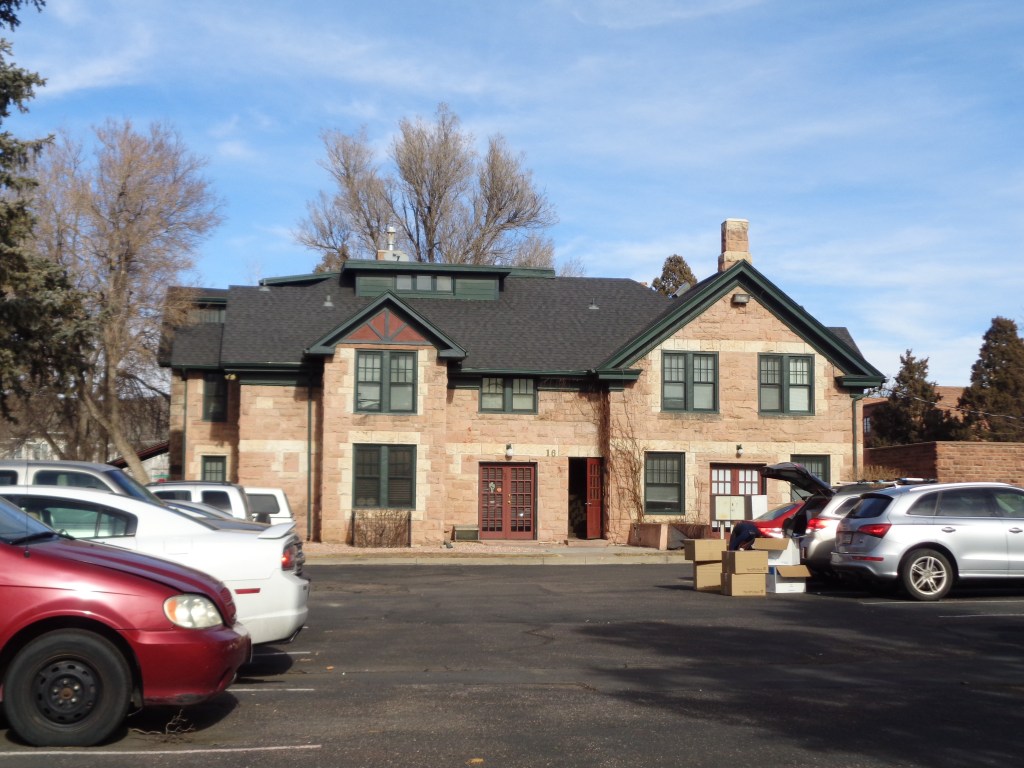
In the heart of history, there stands a two-and-a-half-story building, its face turned south, bearing witness to the passage of time with an irregular footprint, overhanging eaves, and a rooftop cloaked in composition roofing. As if etched by the hand of nature itself, the east, west, and south walls wear a cloak of rock-face pinkish rhyolite, arranged in a whimsical broken rangework pattern, while the corners, meticulously tooled, add a touch of craftsmanship. The north wall, a canvas of stucco, stands in contrast to its rugged counterparts.
Venturing closer, the façade reveals its secrets – two, two-story projecting gables, each with a story to tell. Paired French doors on the first story beckon, adorned with wavy glazing, while the second story boasts paired three-over-one light windows, guarded by a shed roof dormer adorned with lap siding and three single-light windows. The wider gable on the east plays host to a stone chimney, presiding over double French doors flanked by ten-over-one light windows on the first story and two sets of paired six-over-one light windows on the second.
Descend the ornamental wrought iron stairs to the basement, where the east wall reveals more tales – a narrower gable with stuccoed and half-timbered charm, paired with six-over-one-light windows on both stories. A continuous lintel course, composed of whitish rhyolite, graces the center and east gables, framing the windows like works of art.
To the west, two projecting gables beckon, revealing a symphony of design. The south gable mirrors its counterpart on the façade, while the north boasts stuccoed elegance with paired multi-over-one-light windows, a three-part window on the second story, and a shed roof porch with stuccoed walls, guarded by paired three-over-one-light windows and double French doors.
As we journey around, the west wall unravels its mysteries, offering two more projecting gables – one identical to the west projecting gable on the façade, the other boasting a stuccoed face with paired six-over-one-light windows on each story. A northward glance reveals a stuccoed section with multi-light-over-one windows, a paneled and glazed door, and a promise of stories within.
Tracing the footsteps of time, we learn that this architectural marvel was once a humble carriage house, heating plant, and servants’ quarters for the grand James J. Hagerman mansion to the east. A silent witness to history, the building underwent substantial changes after 1907, transforming its form and function.
The narrative unfolds further as we delve into the past – a secondary gem on the grounds of the Hagerman mansion, born in 1885 alongside its grand counterpart, at a combined cost of $110,000. Designed by the skilled hands of architect C.S. Wright and brought to life by builders Dozier and Roby, it served as a stable, a carpenter shop with living quarters above, and a heating plant with a boiler that warmed the main house.
James J. Hagerman, a man of iron and fortune, found solace in Colorado Springs, leaving a legacy entwined with the Colorado Midland Railway. As president of the Midland, he orchestrated its construction, connecting Colorado Springs, Leadville, and Aspen. Hagerman’s departure marked the entry of Absalom Hunter, who saw the property as an investment canvas. The mansion and carriage house waited patiently until 1922 when Benjamin Lefkowsky, a Russian hussar turned American, breathed new life into them, creating the Russ-Amer Apartments.
The building’s story continued to unfold through various owners – from Henry E. Thielecke in 1931, who rechristened it Park View Apartments, to the Lefkowskys, caretakers until 1960. In its halls lived notable figures like Frances Folson Hart, a librarian and artist, and Dr. E.B. Liddle, a surgeon who settled in after World War II.
The passage of time left its mark on the carriage house, altering its structure in the 1920s, yet it stood resilient, a testament to adaptive transformations. The undated photograph in Sprague’s Newport in the Rockies hints at a cupola that once crowned its silhouette, while the 1962 and 1907 Sanborn maps tell a tale of removal and addition, shaping the building we see today.
In the dance of years, the carriage house has become a mosaic of stories, its walls echoing the whispers of those who once called it home. Though its present form may not align with its past, the spirit of the James J. Hagerman era lingers, inviting us to step back in time and embrace the layers of history woven into its very foundations.
Timeline
1885
The carriage house was designed to serve the adjacent Hagerman Mansion by C.S. Wright for $110,00. The builders were Dozier and Roby.
1899
Absalom Hunter purchased the property as an investment. The property remained vacant but well-maintained.
1907
The Sanborn insurance map shows the building containing a stable, carpenter shop with living quarters above and a heating plant with a boiler that supplied heat to the main Hagerman house.
1922
Benjamin Lefkowsky purchased the property with plans to convert the building into an international art studio. The plans fell through and the building was converted to apartments instead.
1931
The building was known as the Park View Apartments and had 10 dwelling units and was owned by Henry E. Thielecke. Thielecke and his wife, Myrtle, lived in the building and continued to be shown as the owners through at least 1951.
1941
The building has fourteen units.
1938
In 1938 one of the residents here was Frances Folson Hart, a librarian at the Fine Arts Center. Frances Hart was born in La Junta, Colorado, and educated in public schools there. She attended Kansas University and had library training at Pratt Library in New York City.
1949
Another prominent resident of the apartment building was Dr. E.B. Liddle and his wife, Louise. Dr. Liddle, a surgeon, was a native of Louisiana and a graduate of Tulane Medical College. After serving in World War II he settled in Colorado Springs, where he conducted a medical practice in urology. Dr. Liddle died here at the age of 62 in 1949.
1951
The building has twelve units.
1960
The building’s name has been changed to Park Terrace Apartments and has sixteen units.
1962
A comparison of the 1962 and 1907 Sanborn maps shows that the heating plant section was removed and
replaced with a large section on the north and the narrow stone bays on the west, south, and east were added
after 1907.
Additional Resources
- 16 W Willamette – a collection of documents compiled during the Historic Uptown Neighborhood’s historic preservation efforts.

Leave a comment