2022
Historic Uptown History and Architecture Tour
A self-guided tour through the Historic Uptown Neighborhood.
More walking tours can be found on Our Neighborhood page.
Select the frame in the top right corner of the map to explore the properties. Once the larger map is opened, you can select each property’s pin to view more information about it.
Historic Uptown is a neighborhood of homes and businesses located between the downtown core of Colorado Springs and the southern boundary of the Colorado College campus. It includes Cascade Ave., which is the westernmost of the broad boulevard-style streets of the original 1871 town site of Colorado Springs.
The plan for the city was drawn up by the founder, General William J. Palmer, and his Colorado Springs Company, to create a resort-like setting. Their new settlement was being promoted to the wealthy and leisured classes of the eastern United States and the British Isles. The development of the blocks along N. Cascade, N. Tejon, and N. Nevada avenues illustrate well the transition from a frontier town to an established community with modern conveniences and amenities.
Historic Uptown includes a portion of the original town site, as well as Addition #1 (1873), which extended to the north, south, and east. In 1883 the Colorado Springs Company platted Addition #5 west of Cascade Ave., which featured curvilinear streets and picturesque sites that overlooked Monument Creek. This more elaborate street design was rare for a Western community. It attested to the efforts and planning by the town company to give their settlement a distinctive appearance and charming character.
The 1880s marked the period of the greatest expansion in population in the city’s history, before or since. The number of residents climbed by 11,140 by 1890, reflecting a 164% growth.
Immigrants to the city were attracted through promotional efforts by its founders, but also for health reasons due to its altitude, sunshine, and clean air. Several substantial and costly structures, designed by architects in the Queen Anne, Shingle, Italianate, and Tudor styles, were constructed on the main thoroughfares north of downtown toward the Colorado College. In addition, several churches were erected. The area reflected the community of culture and refinement that was envisioned by General Palmer.
The 1890s through the first decade of the 20th century marked a second period of development. It followed the Cripple Creek and Victor gold mining boom that began in 1891. The large houses built during this period represent the homes of the newly wealthy mine owners, as well as residences built for merchants and industrialists attracted by the mining boom. The architectural styles of these opulent houses run the gamut from Tudor stone castles to Mediterranean Palazzos to Spanish Mission haciendas.
Over the years, many events occurred that affected Historic Uptown. During the 1930s the economy of the United States was in crisis and many of the large residences became boarding houses or apartments. There were also housing shortages after World War II that contributed to the conversion of homes to apartments.
Businesses sought space for commerce, causing once-residential properties to be converted to business use. This area thus reflects many historical influences in the evolution of Colorado Springs.
Buildings selected for description are those that are over fifty years of age and are listed, or eligible for listing, in the National Register of Historic Places or the State Register of Historic Properties, or have local historical significance.
Much of the information is taken from a 2003-04 historic buildings survey of downtown Colorado Springs, conducted by Front Range Research Associates, Inc. Another principal source of information was the 1983-85 Downtown Intensive Historic and Architectural Survey conducted by Deborah Edge Abele.
Additional information regarding these and other buildings, as well as the history of Colorado Springs, may be found on the City of Colorado Springs website, at the Penrose Branch of the Pikes Peak Library District, and the Colorado Springs Starsmore Center in the Pioneers Museum. Interested parties may also contact the Colorado Springs Historic Preservation Board.
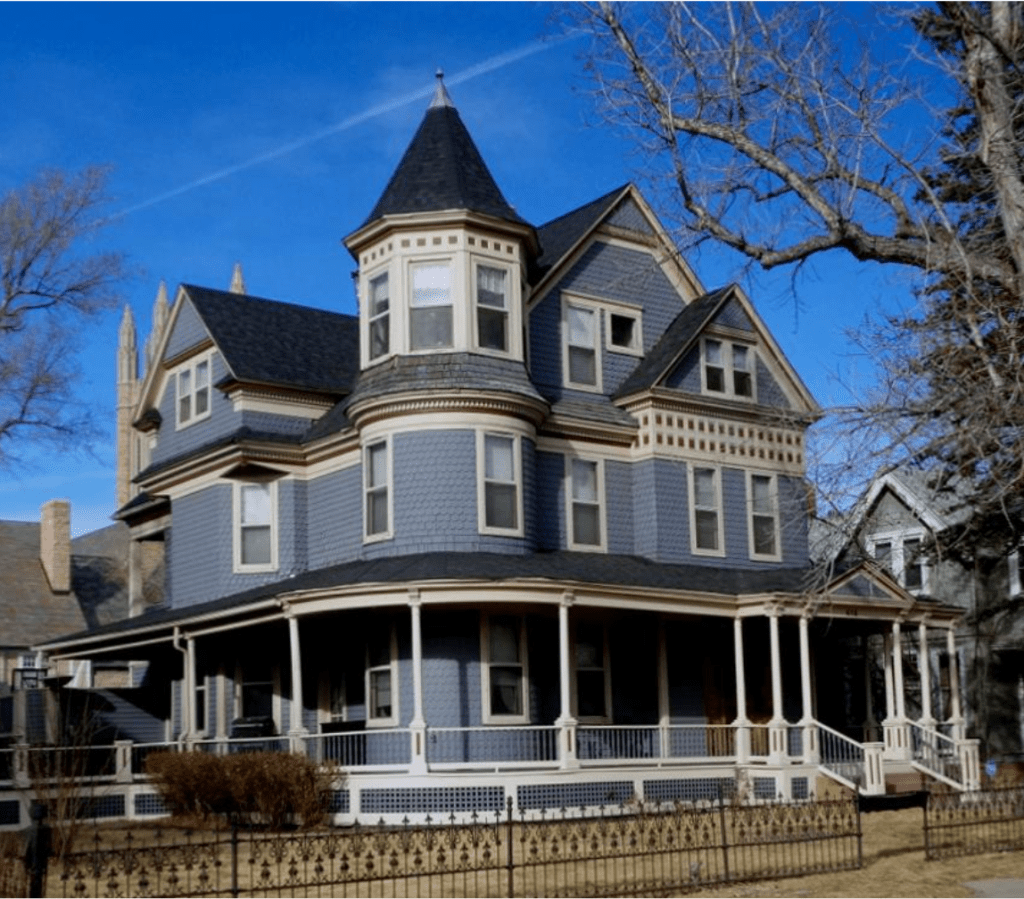
- Tour Stops
- No. 1: McAllister House
- No. 2: Shepard’s Citations Building
- No. 3: Gutmann Residence
- No. 4: Bemis House
- No. 5: Hagerman Mansion
- No. 6: Russ Amer Arms
- No. 7: Wray Residence
- No. 8: Biggar-Weller Residence
- No. 9: Hagerman Mansion Carriage House
- No. 10: Jones-Will Residence
- No. 11: Woman’s Club
- No. 12: Garrett Residence
- No. 13: Pastorius Residence
- No. 14: Gwynne-Love House
- No. 15: Fine Arts Center
- No. 16: Schlesinger-Birdsall Residence
- No. 17: Gregg Residence
- No. 18: All Souls Unitarian Church
- No. 19: Murray Apartments
- No. 20: Burgess Residence
- No. 21: Lowell Residence
- No. 22: Manchester-Van Diest Residence
- No. 23: Castello Residence
- No. 24: Peck Residence
- No. 25: Stark-Buchanan Residence
- No. 26: Giddings-Stark Residence
- No. 27: Craftsman Residences
- No. 28: Bernard-Sill Residence
- No. 29: Grace Episcopal Church
- No. 30: St. Stephens Church
- No. 31: Bunts Building
- No. 32: Columbine Building
- No. 33: Hazlehurst Residence
- No. 34: Rice Residence
- No. 35: Stubbs-Proctor Residence
- No. 36: First Congregational Church
- No. 37: Colchester Flats Apartments
- No. 38: St. Vrain Court Apartments
- No. 39: Gladstone Apartments
- No. 40: Waugh Residence
- No. 41: The Crescent
- No. 42: Salisch Residence
- No. 43: Hudson Boarding House
- No. 44: Mathewson Boarding House
- No. 45: Half Way House
- No. 46: Caledonian Hall
- No. 47: North Park, now Acacia Park
- No. 48: Colorado Springs High School, now Palmer High School
- No. 49: Acacia Park Hotel
- No. 50: El Paso Club
- No. 51: First Christian Church
- No. 52: First Church of Christ Scientist
- No. 53: Pearl Laundry
- No. 54: Swan Mortuary
- No. 55: The Lennox
- No. 56: St. John Brothers Plumbing
- No. 57: Stonework
- Walking Tour Credits
Tour Stops
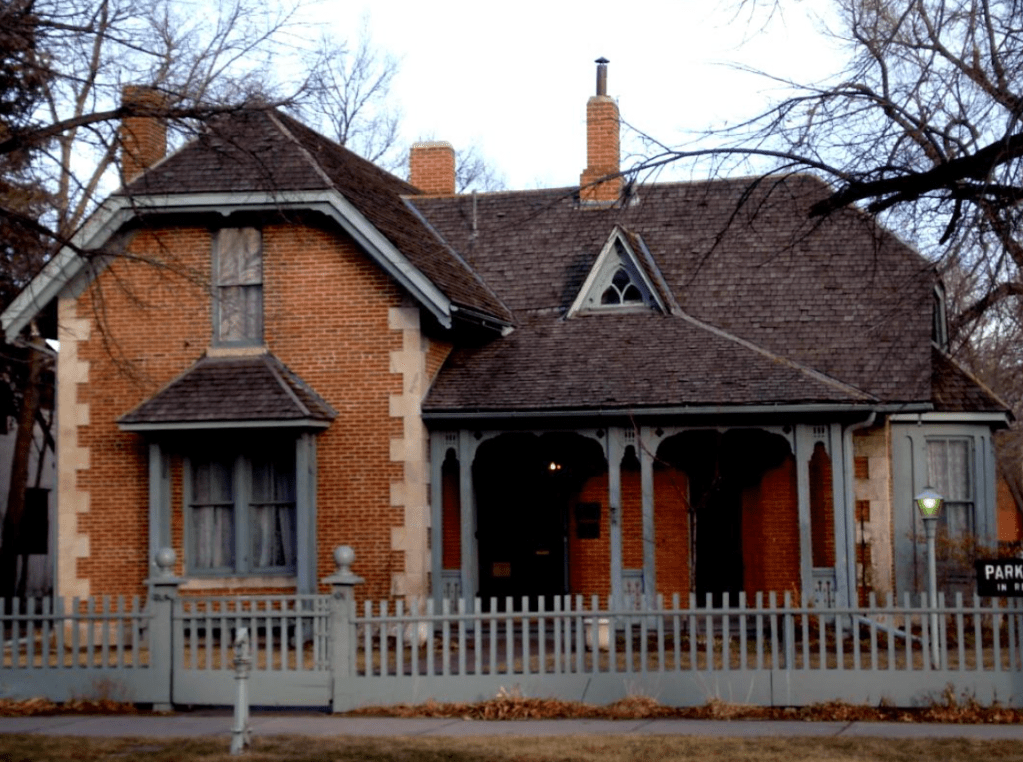
No. 1: McAllister House
423 North Cascade Avenue
Built 1873
Architect George Summers
Website
This English Gothic Revival Cottage was built in 1873 by Major Henry McAllister, a close associate of General Palmer. He was the principal manager of Palmer’s Colorado Springs Company and a member of the Board of Directors for the Denver & Rio Grande Railroad.
The McAllister House is one of the oldest homes in Colorado Springs, one of three remaining from 1873. It reflects the English preference at the time for Gothic architecture, as well as the English influence seen throughout Colorado Springs in buildings of this era. The three marble fireplaces and the brick used for the exterior were imported from Philadelphia, and the walls are over two feet thick to withstand wind.
The home was built by W. S. Stratton, a carpenter who later became a gold mine millionaire. He hand-carved the bargeboard trim. The house was designed by the Philadelphia architect George Summers, whom Palmer brought to Colorado Springs to serve those seeking to build. In 1894, Summers designed the First Episcopal Church, portions of which remain.
The McAllisters lived here until 1921. The house was ultimately purchased by the El Pomar Foundation, a local charity, on behalf of the National Society of Colonial Dames. The home was restored, as much as possible, to its original colors as well as original wallpaper design and furnishings. It is currently open to the public and maintained as a museum. It is listed in the National Register of Historic Places.
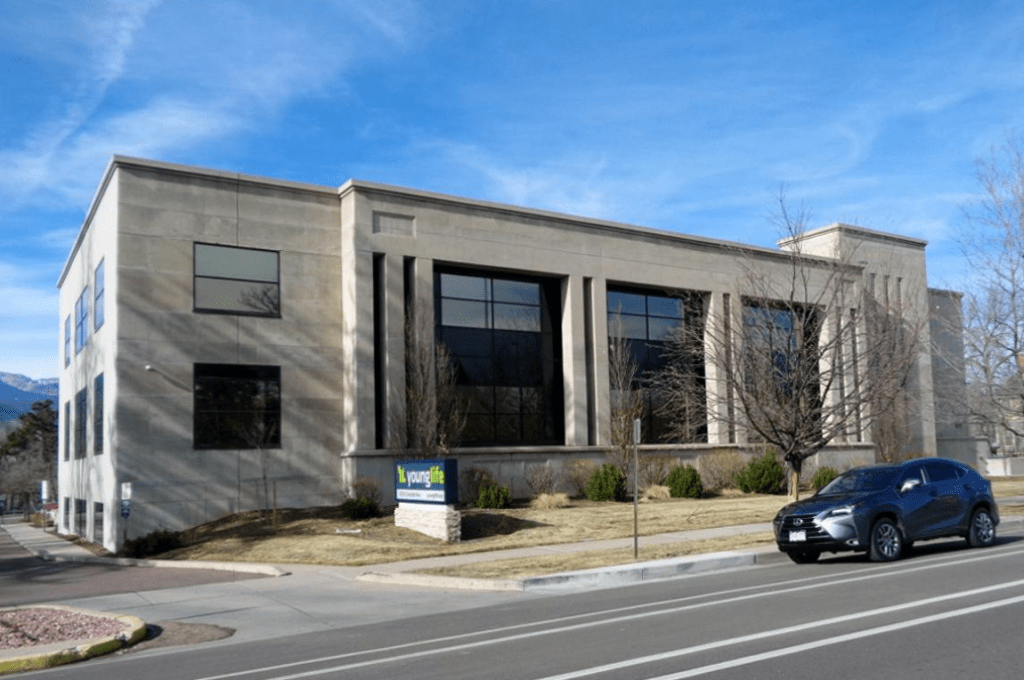
No. 2: Shepard’s Citations Building
420 North Cascade Avenue
Built 1947
Architects C. E. Thomas and Gordon Sweet
Wikipedia
This building was designed to house Shepard’s Citations, a renowned producer of legal publications. In 1966, Shepard’s Citations became part of McGraw-Hill.
The building is significant for its association with the growth of commerce and industry in the city during the post-war era. Shepard’s Citations was a unique nationwide legal publishing business. Its decision to move its headquarters to Colorado Springs from Chicago after World War II reflected the city’s growing desirability as a relocation site for businesses.
The building is an important representative of the transition between the Modernistic and International styles. The reinforced concrete construction also reflected the post-war scarcity of lumber, which was needed for veterans’ housing.
This property is National Register eligible.
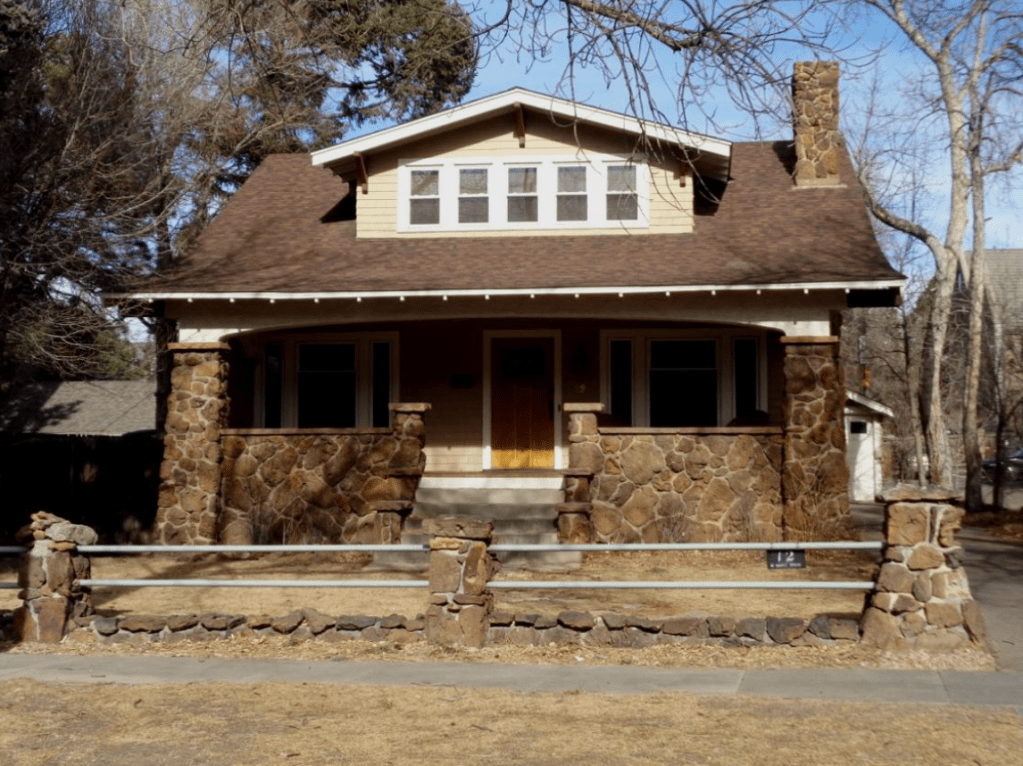
No. 3: Gutmann Residence
12 West St. Vrain Street
Built 1922
Architect Unknown
The Gutmann Residence is a Craftsman-style home in much the same configuration as when it was completed in 1922. The stylistic features include flared, widely overhanging eaves with exposed rafters and triangular knee braces, and shingled walls. The style is further typified by the divided light windows and the large front porch that frames the central entrance. The stonework is notable.
The original residents of the home were Ferdinand L. and Thusmelda Gutmann. He operated a pharmacy at 124 N. Tejon Street in the Everhart Building. The store’s motto was: “Remember, we don’t sell liquors.” Gutmann built the brick business block at the southwest corner of E. Platte and N. Tejon in 1924, sometimes known as Park Place. The Gutmanns and their heirs lived in the home as late as 1965, when Arthur A. and Allys Gutmann were listed as residents.
The building is currently owned by Young Life. A plaque on the wall identifies it as the “St. Vrain Bungalow.” Young Life is a nondenominational Christian youth organization that is active throughout the United States and abroad. The organization was founded in 1941 and created to show high school-age children that “faith can be fun.” The group moved its headquarters to the Colorado Springs area in 1946.
This home is locally significant.
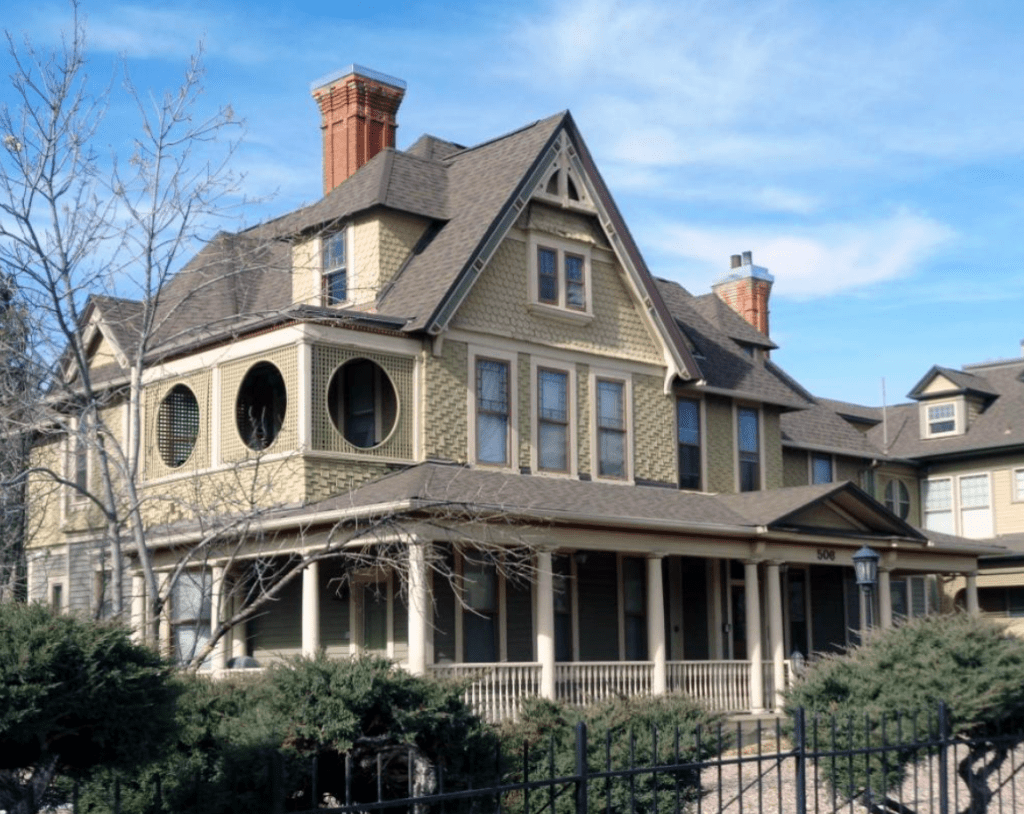
No. 4: Bemis House
506 North Cascade Avenue
Built 1885
Architect W. F. Ellis | Contractor Joseph Dozier
Wikipedia
The Judson Moss Bemis House is the southernmost portion of the Hearthstone Inn. It is designed in the Queen Anne style. It exhibits a high level of craftsmanship, including an asymmetrical form, multiple gable roofs, a prominent front porch, contrasting materials, and decorative detailing.
Mr. Bemis built this home for his wife, Alice Cogswell Bemis after they moved here for her health in 1881. Bemis had made his fortune producing cloth bags for flour merchants. He also supplied the U.S. Army Quartermaster Corps during the Civil War. Mr. Bemis was an early trustee of Colorado College, donating funds for Jackson House and Bemis Hall on the campus.
Their daughter, Alice Bemis Taylor, who became a prominent philanthropist, lived at this house in her youth. Also interested in education, she was the first female trustee of Colorado College. Taylor Hall at the college is named in her honor. She funded the construction of the Colorado Springs Day Nursery to care for the children of working mothers. She also built the Colorado Springs Fine Arts Center and donated her collection of Native American art of the Southwest to it.
The building was converted to apartments in 1935 by Charles E. Thomas, a prominent local architect, and in the late 1970s was converted to a bed and breakfast inn.
The building is listed in the National Register.
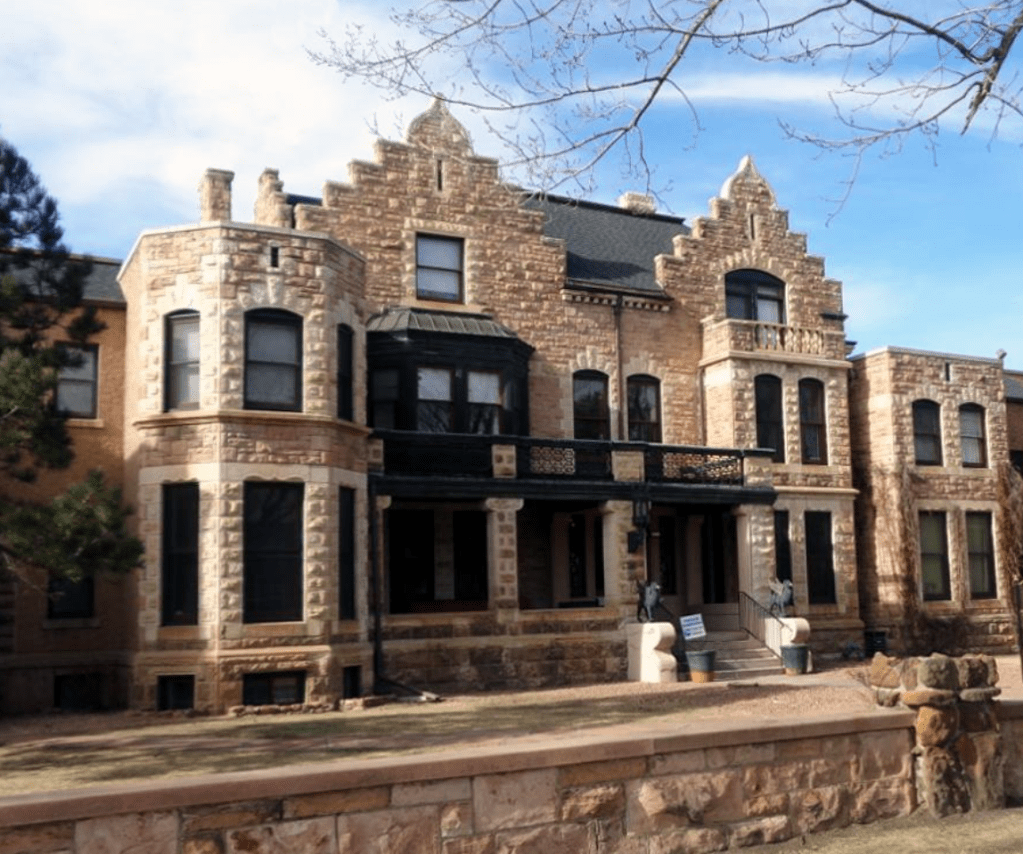
No. 5: Hagerman Mansion
610 North Cascade Avenue
Built 1885
Architect C. S. Wright | Contractor Whipple & Roby
Gazette Article | Gazette Telegraph Article | National Registrar | Parkside District
J. J. Hagerman, a peppery millionaire industrialist from Michigan, was another of the consumptives who arrived in Colorado Springs chasing the cure to tuberculosis. He arrived in 1884. He built this exotic mansion in 1885 as he was seeking financing for the construction of the Colorado Midland Railroad, the first standard gauge railroad to cross the Colorado Continental Divide. The home helped to establish North Cascade Avenue as the most prestigious address in the fledgling city.
The original residence, defined by the two central gables, was designed by C. S. Wright of Colorado Springs. Two flat-roofed sandstone wings were added sometime before 1899. The style is Victorian eclectic. The interior contains splendid woodwork, which was crafted by W. S. Stratton in his carpentry years. The stepped stone parapets in front of the gable ends are called Flemish Gables. The stone used is peachblow sandstone, extracted from Hagerman’s quarry near Carbondale, on the Frying Pan River.
In 1927, the Russian émigré, Benjamin Lefkowsky, having owned the mansion for 5 years, constructed the wings to the north, west, and south. He then converted the building into 22 luxury apartments. The stucco wings on each side define these later additions.
The home is listed in the National Register.
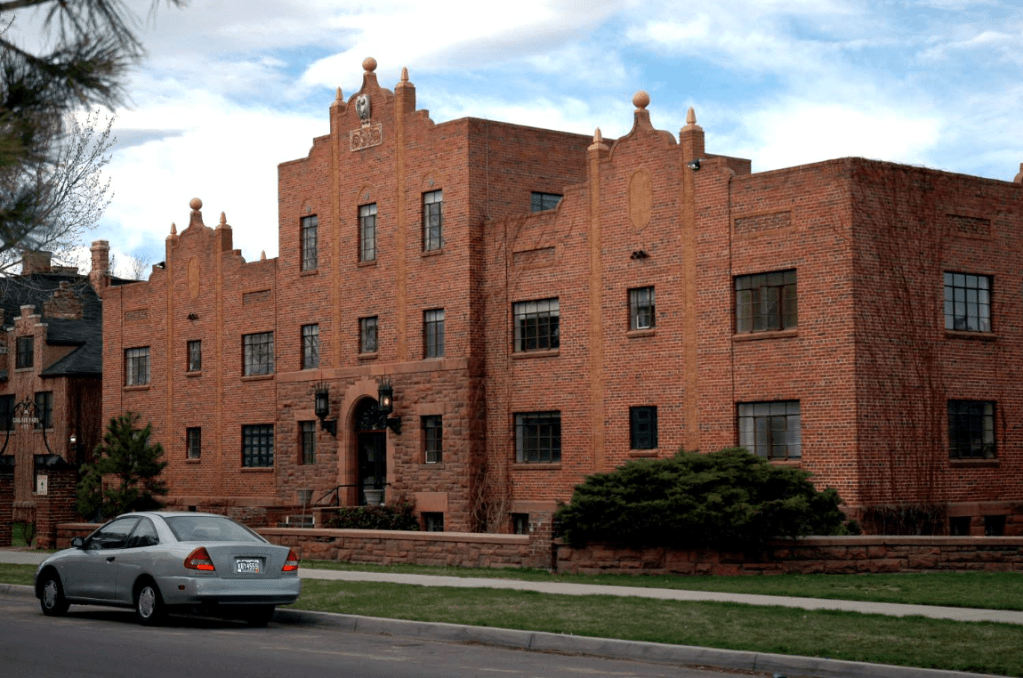
No. 6: Russ Amer Arms
624 North Cascade Avenue
Built 1939
Architect Charles E. Thomas
Parkside District
An exotic mixture of Russian and American motifs is displayed here. It reflects the background of its developer, Benjamin Lefkowsky. Born in Russia, he studied art photography and drawing in St. Petersburg and Germany. Lefkowsky arrived in Galveston, Texas, in March 1914. He operated a photographic studio in Beaumont, Texas.
He met and married Ethel G. Piland, a concert pianist, in Texas. The couple moved to Colorado Springs in 1922 because of its climate, scenery, and artistic advantages.
The Russ Amer Arms was constructed over several years as luxury apartments, finishing in 1939. Construction took eight years due to the economic downturn related to the Great Depression. The architect, Charles Thomas, was prominent locally and was associated with the City Auditorium at 231 East Kiowa Street, several structures in Monument Valley Park, and the Shepard’s Citations building at 420 North Cascade Avenue.
The building is principally composed of brick and sandstone. It includes a terra cotta eagle and decorative panel, probably a Russian emblem. Also, note the ball and obelisk decorations on the roof parapets.
Locally designated as a historic landmark, this property is National Register eligible.

No. 7: Wray Residence
33 West Willamette Street
Built 1906
Architects Douglas & Hetherington
The first residents here, Henry Russell Wray and his wife Martha L. Wray were prominent Colorado Springs residents. Mr. Wray was a longtime secretary of the Colorado Springs Chamber of Commerce. He was described by Manley D. Ormes as one of the intellectuals who “enhanced and enlarged the living here.” Mr. Wray was involved with the Town & Gown Golf Club, the Saturday Nights (a mountain climbing club), and the Art Club (later the Broadmoor Academy).
The Wray home is a two-story side gambrel fieldstone dwelling. It is notable for its setting at an angle on a lot overlooking Monument Valley Park. The Rustic-style influences harmonize with the setting, and the house is representative of dwellings tied to the city’s image as a resort area in a spectacular natural setting. The Wray home is National Register eligible.
In 1910 for about a year, the home was the residence of Marjory Palmer, daughter of General Palmer, and her husband Henry C. Watt. Marshall Sprague reported that Dr. Watt served as General Palmer’s doctor after Palmer’s riding accident in 1906. Dr. Watt moved to Glen Eyrie, Palmer’s home, to care for General Palmer.
Dr. Watt was born in Liverpool, England in 1872. He received his education from English universities. In 1901 the Watts moved to a house at 1801 Culebra Avenue. That home was designed by Thomas MacLaren in 1901.
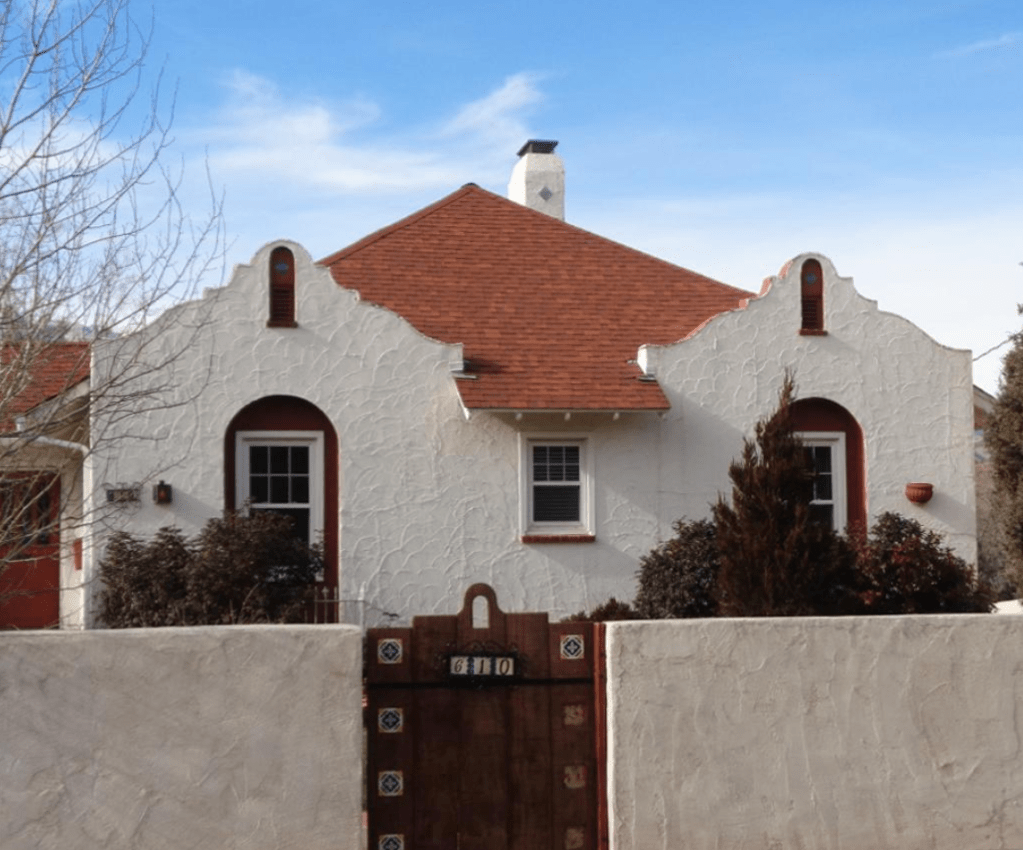
No. 8: Biggar-Weller Residence
610 Park Terrace
Built 1925
Architect and Contractor Benjamin Lefkowsky
Parkside District
This house is part of a residential area developed by Russian émigré Benjamin Lefkowsky during the 1920s. Lefkowsky purchased the Hagerman Mansion and five undeveloped acres of land next to it in 1922. The mansion had been vacant for about 15 years. He developed the area, adding two streets: Park Terrace and Zyder Zee.
The houses of the neighborhood were noted for their picturesque quality, which took advantage of the splendid natural setting. Mr. Lefkowsky, who also owned the Russ Amer Arms, was cited as an “artist, businessman, soldier in the Russian czar’s Hussars, an adventurer and a gentleman.”
The Biggar-Weller residence is a modest mission-revival-style home built in 1925. It exhibits a textured stucco exterior with a hipped roof and tile ornamentation. The curvilinear parapets have small round-arched vertical inset openings at the top. Wrought-iron balconettes are placed below the windows. The mission-revival style reflects the influence of the Hispanic architecture of the Southwest.
The house was initially occupied by Mrs. Marie L. Biggar in 1927. By 1941 this was the residence of Verne H. and Dorothy Weller. Verne Weller was president of Weller Lumber & Supply Company.
The house is locally significant.
No. 9: Hagerman Mansion Carriage House
16 West Willamette Street
Built 1885
Architect C.S. Wright (assumed)
Gazette Article
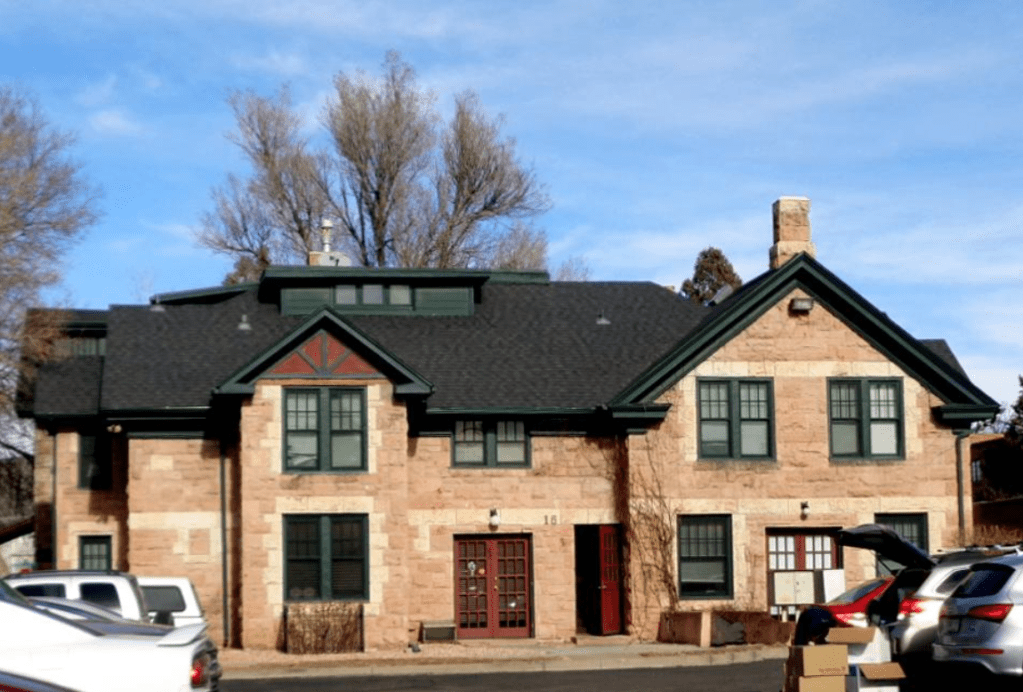
This exceptional 1885 carriage house was designed to serve the adjacent Hagerman Mansion and was probably designed by the same architect, C.S. Wright. The 1907 Sanborn insurance map shows the building containing a stable, carpenter shop with living quarters above and a heating plant with a boiler that supplied heat to the main Hagerman house. The 2½ story building consists of the same pink sandstone from which the main house is constructed.
The original construction was altered after 1907 to include narrow stone bays on the west, south and east walls. The heating plant was removed and replaced with a large addition. This addition comprises the stucco areas.
The building was purchased by Benjamin Lefkowsky, who converted the mansion and carriage house to apartments, sometime after 1922. By 1931 the building had 10 dwelling units and was owned by Henry E. Thielecke.
In 1938 the carriage house had a prominent resident in Frances Folson Hart. She was a librarian at the Fine Arts Center. She was born in La Junta, Colorado, was educated at Kansas University and had library training at Pratt Library in New York City. Besides being a librarian, she was an artist and exhibited paintings in museums in Denver and at the Colorado Springs Fine Arts Center.
The home is locally significant.

No. 10: Jones-Will Residence
620 Park Terrace
Built 1927
Architect and Contractor Benjamin Lefkowsky
The Mediterranean flair exhibited by this house is accentuated by the central entrance tower and the tile roof. It is noteworthy for its widely overhanging eaves, stucco walls, wrought iron details, and multi-light windows with balconettes. It appears to have had few alterations since its original construction.
Built approximately 1927, the city directory reports the house was initially occupied in 1931 by R. C. Jones. By 1941, Harold L. and Bird Z. Will were the owners. Harold Will was listed as an osteopathic physician.
This house is located in the residential area developed by Russian émigré Benjamin Lefkowsky during the 1920s. Records show this home was erected by Lefkowsky, who designed his homes to take advantage of the spectacular views of Monument Valley Park and the mountains to the west.
The home is National Register eligible and is an excellent example of the Mediterranean Revival Style.
No. 11: Woman’s Club
20 Mesa Road
Built 1940
Architect Unknown
Gazette Telegraph Article | Website | History | Parkside District
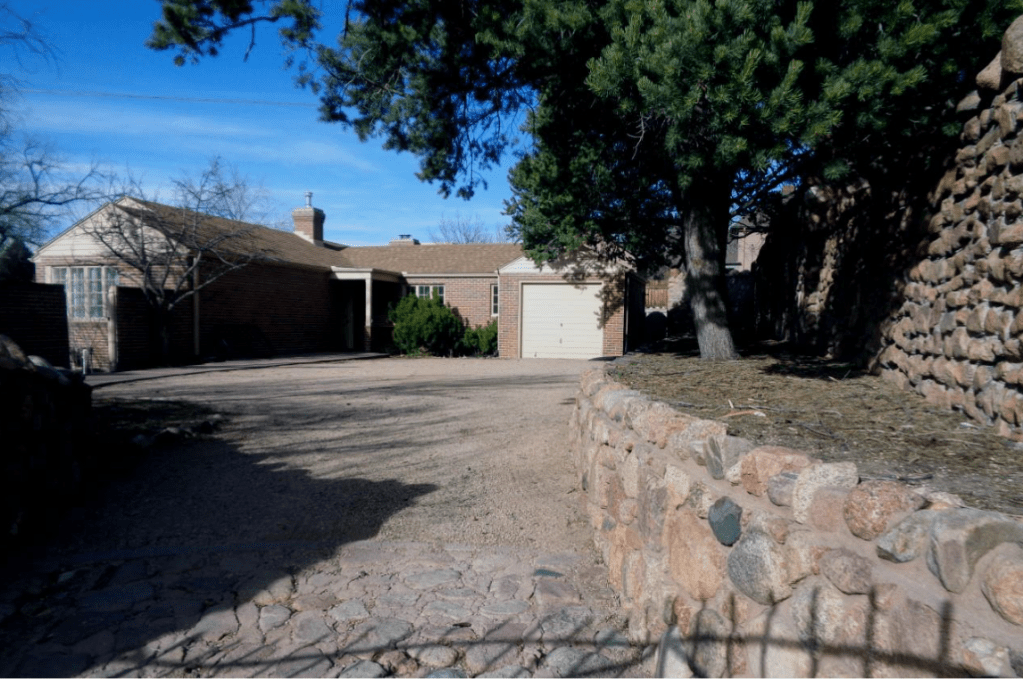
Henry and Ina Parsons were the first residents of this house, which was built in 1940. Around 1955, the Woman’s Club converted it for their use. The Woman’s Club, organized in 1902, was the largest women’s club in the city. Its initial membership was 100 women. The club’s purpose was: “To stimulate intellectual development, to promote unity and good fellowship among the members, and to strengthen individual and philanthropic effort.”
The Woman’s Clubhouse is currently owned by Colorado College. It was donated to the college in 2003 by the Woman’s Club “in exchange for the foundation of a scholarship fund for young women, the goal of which is to develop female community leaders.”
This building is representative of the Modern style of the Minimal Traditional subtype. Features common to this style are the unornamented brick composition, multi-light windows, and the small porch. The landscaping here is notable, with a monumental stone wall enclosing the property. Ruby Shouse, a longtime member of the Woman’s Club, remembers that this wall was constructed by inmates of the State Penitentiary in Canon City.
The house is locally significant.

No. 12: Garrett Residence
710 North Cascade Avenue
Built 1913
Architect Unknown
Parkside District
This 1913 residence is an excellent example of the Craftsman-style homes erected in Colorado Springs during the early twentieth century.
Notable features include the gabled roof with widely overhanging eaves and triangular knee braces, large gabled dormers, multi-over single-light double-hung windows with slanted surrounds, shingled walls, and a brick foundation. The ends of the bargeboards (facia boards at the eaves) are fashioned to resemble the heads of flying ducks.
The house has undergone very complimentary alterations, including the extension of the porch and the addition of a carport.
John W. and Fannie C. Garrett were the longtime owners/residents of the dwelling. John Garrett operated a sporting goods business selling guns, ammunition, sporting goods, confectionary items, and cigars. He was an early member of the AdAmAn Club and a nationally famous marksman.
Mrs. Garrett was born in Iowa about 1870 and was a member of the First Christian Church and the Portia Club. The Portia Club was organized in 1895 in Idaho to “read and discuss books and follow the line of self-improvement.”
The home is locally significant.
No. 13: Pastorius Residence
724 North Cascade Avenue
Built 1901
Architect Charles Pastorius | Contractor Sebring and Mahoney
HPA Article | Find A Grave | Parkside District
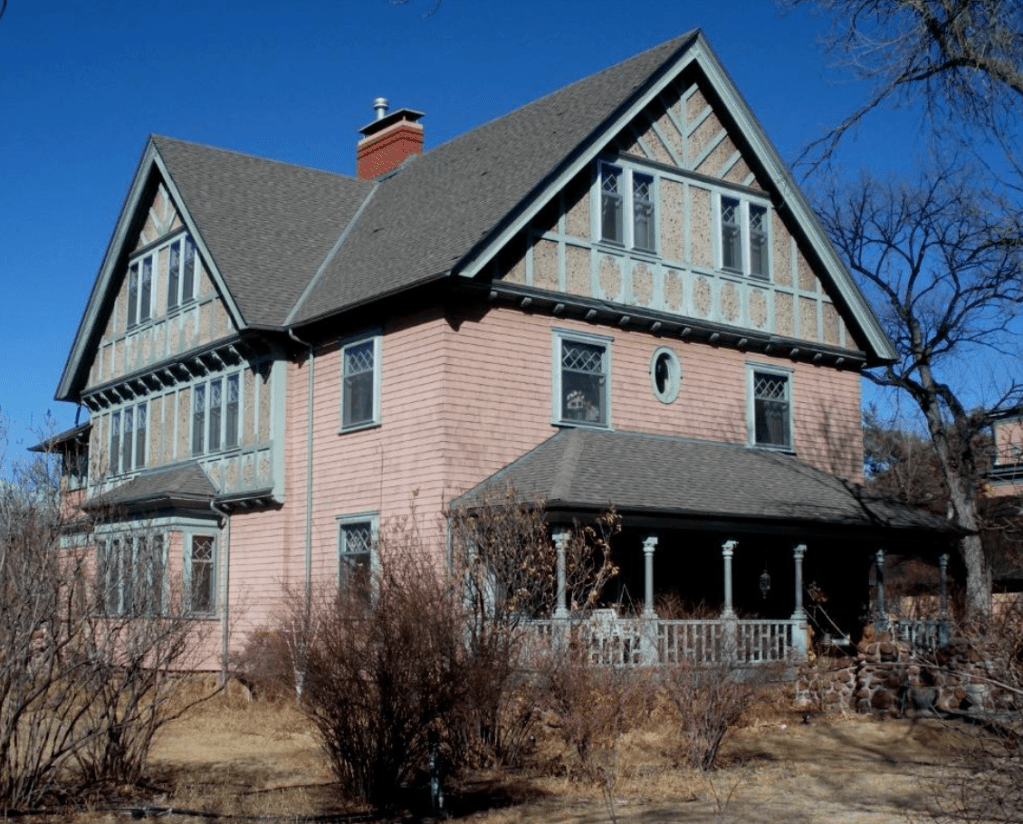
The 1901 Cripple Creek-Victor mining boom was the impetus for the development of substantial residences like this one along North Cascade Avenue. According to recent studies, it is the “only remaining Cripple Creek era mansion south of Colorado College still in single-family use on its original lot.”
The house was built and resided in by the family of Francis D. Pastorius, who was president of the Colorado Investment & Realty Co. He also was a founder of the Colorado Springs Garden Club.
Francis Pastorius died in 1926. His widow then married Victor Hungerford, a lawyer. Victor Hungerford moved to Colorado Springs in 1909 from New York. He served on the City Council from 1921 to 1929 and as mayor from 1927 to 1929. He was very active in the local community. He died in this house from a heart ailment in 1949.
The house is significant as an elaborate example of the half-timbered version of the Queen Anne style. It is notable for its gables of stucco with embedded mineral specimens. The landscape architecture reflects the gardening skills and plantings of Francis Pastorius. There is a high stone wall at the rear with views of the mountains. The gardens were considered a showplace of the region.
The house is National Register eligible.

No. 14: Gwynne-Love House
730 North Cascade Avenue
Built 1886
Architect Willard B. Perkins | Stonework by Clement & Russell
Wikipedia | History Colorado | National Registrar | Colorado College | Parkside District
This area was popular with affluent health seekers who built sizeable mansions with extensively landscaped grounds. Little is known about Edmiston Gwynne, the original owner. It is said he was a fine musician and a popular member of the early Colorado Springs men’s clubs and social organizations. He died at the age of 25 shortly after his house was completed in 1886.
The home is an imposing Victorian structure, and its size is a bit of a mystery, being built for a single man. Following Gwynne’s death, the building was converted to a guest (or boarding) house to meet the demand for gracious living during the boom of the Cripple Creek-Victor mining industry.
The house combines Queen Anne forms and English detailing and is an excellent example of the domestic architecture constructed in Colorado in the late 19th century. The light brown, pinkish stone was quarried from the “Divide,” as the area north of Colorado Springs near the present-day town of Monument was called. The half-timbering in the large roof gables gives it an English look, exemplifying the “Little London” moniker often applied to Colorado Springs.
It was the residence of Robert Love in the 1920s and is currently owned by Young Life.
This house is listed in the National Register.
No. 15: Fine Arts Center
30 West Dale Street
Built 1936
Architect John Gaw Meem
Website | History
Called “the region’s most important tribute to culture” by noted historian Marshall Sprague, the Colorado Springs Fine Arts Center is a unique community treasure. It was envisioned and constructed through generous donations by Alice Bemis Taylor and Julie Penrose, prominent local philanthropists. Besides organizing community support for the project and donating funds, Alice Bemis Taylor donated her extensive personal collection of Native American Southwestern art. Julie Penrose donated the land, which had been the site of her home.
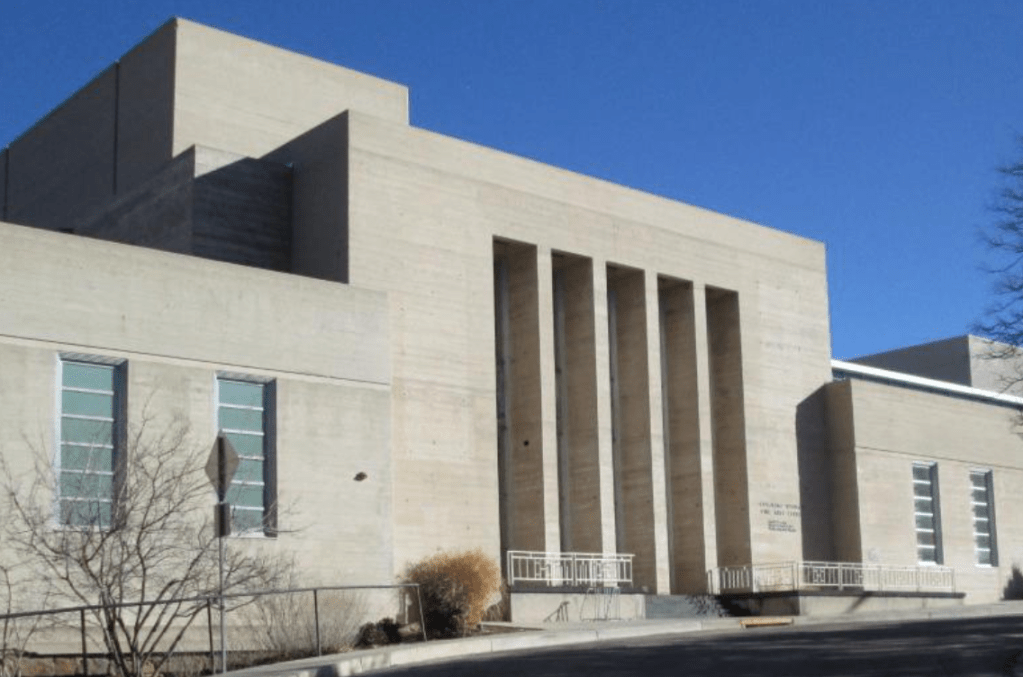
The Fine Arts Center was designed by John Gaw Meem of New Mexico, one of the Southwest’s leading architects. He developed the “Santa Fe style,” derived from Pueblo and Spanish Colonial architecture. The design here was the most modern he was ever to create. He skillfully integrated stylistic elements of the Southwest, modernism, Art Deco, and classicism.
The Fine Arts Center is designed to be both functional and aesthetically pleasing, considering its multiple uses as a performance venue, a museum, and an educational facility. Its architecture is reflective of a two-level Native American pueblo-style structure, including stepped massing, minimal fenestration, and absence of decoration.
This award-winning building has been described as architect Meem’s crowning achievement.
It is listed in the National Register.
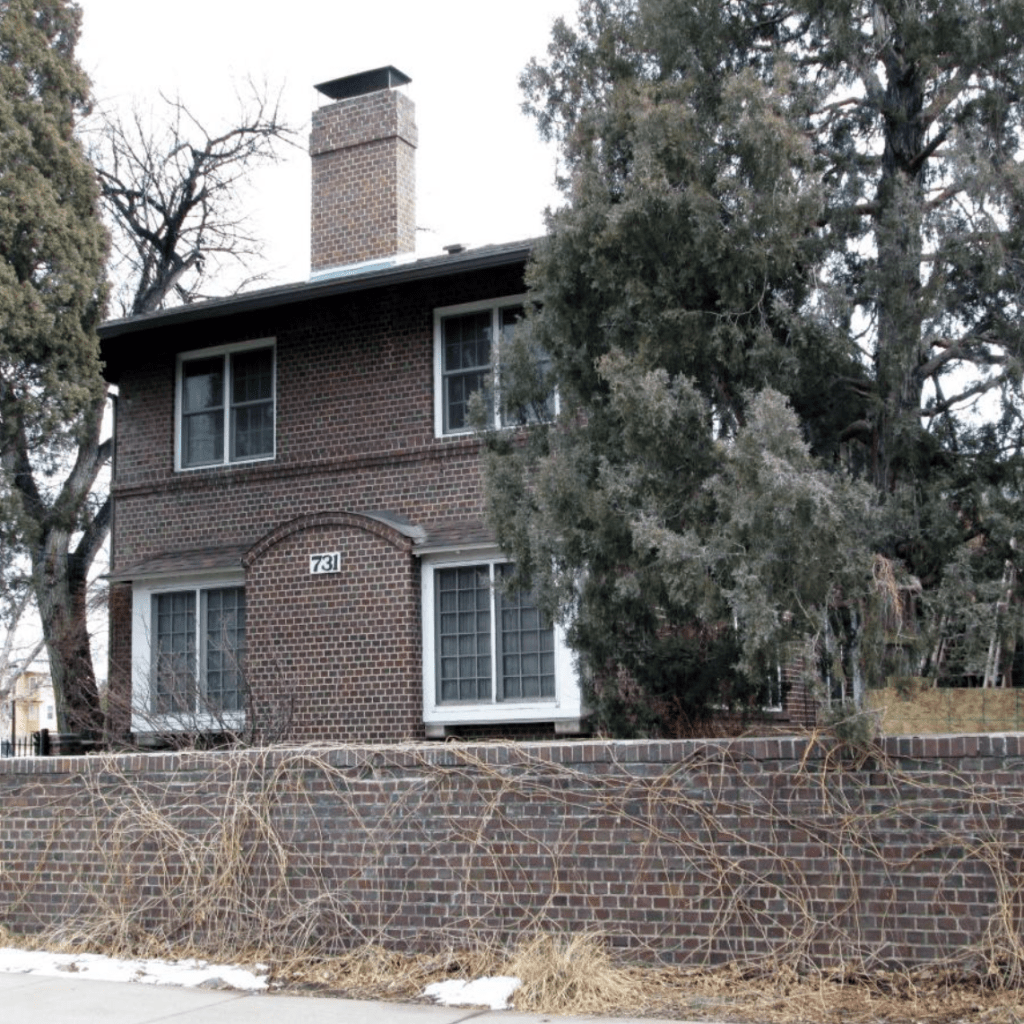
No. 16: Schlesinger-Birdsall Residence
731 North Cascade Avenue
Built 1911
Architect T. P. Barber | Contractor Schlesinger
This two-story, brown brick house is representative of the large, architecturally distinguished houses erected along North Cascade Avenue during the early 20th century. Constructed in 1911 and considered Italian Renaissance in style, it features an asymmetrical façade with an arched central bay and a stepped-back entrance on the north. Two coal chutes still exist on the north wall, along with what appears to be an incinerator door.
The first occupants were Isadore & Sarah R. Schlesinger. Isadore was a partner in the contracting business of Schlesinger & Harlan. Harlan was part of the Harlan family, prominent in the early brick industry. In 1931, the home was occupied by Miriam P. Shoup. Her husband was Oliver Henry Shoup, Jr., the son of Colorado Governor Oliver Shoup.
By 1941, this was the home of George G. and Mable Birdsall. George Birdsall served in the Colorado City Fire Department and as sheriff of El Paso County. He founded the automobile dealership of Birdsall-Stockdale Motor Company and served on the City Council for 22 years, 14 of them as mayor. He was acclaimed for his leadership in securing water resources and expanding Colorado Springs Utilities. The North Nevada Avenue municipal power plant was named in his honor in 1954.
This house is locally significant.
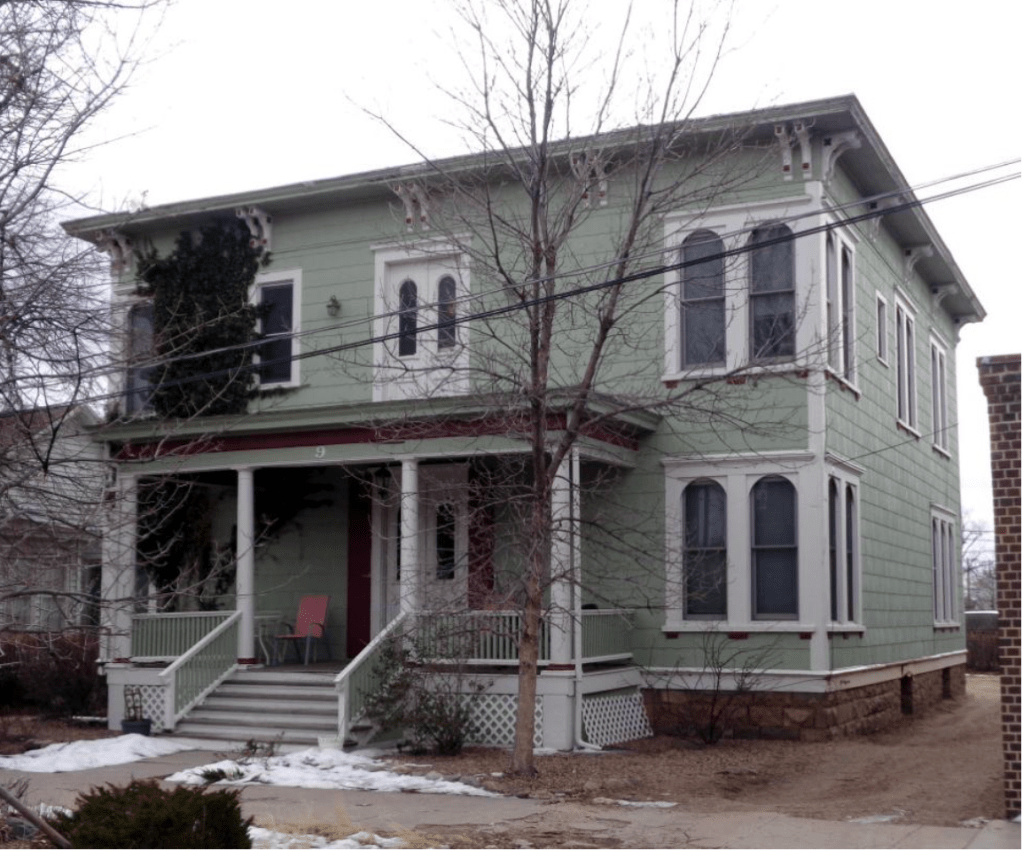
No. 17: Gregg Residence
9 East Dale Street
Built 1885 (estimated)
Architect Unknown
Before 1907, this home was moved to its present site from 731 North Cascade Avenue, now the site of the Birdsall Residence. Starting in 1886, it served as the residence of Rev. James B. Gregg, who was pastor of the First Congregational Church (No. 36) for 27 years.
Reverend Gregg moved to Colorado Springs in 1882 from Hartford, Connecticut, and lived in this house with his family. It was said of the Gregg home that it was often taken as an orphan asylum because so many children were always about. The Gregg family included seven children.
Reverend Gregg directed the congregation in constructing the First Congregational Church at 20 E. St. Vrain St. He was a mainstay among church pastors in Colorado Springs. He was a trustee of Colorado College for 25 years and won the first honorary degree awarded by the college.
This house is significant for its representation of the early architecture of Colorado Springs, reflecting the Italianate style popular in the late 19th century. Features of this style include the low-hipped roof with overhanging eaves, the paired eave brackets, the paneled double door with round-arched lights, and the tall, narrow round-arched windows.
The home is locally significant.

No. 18: All Souls Unitarian Church
730 North Tejon Street
Built 1892
Architect W.F. Douglas
Website
The All Souls Unitarian Church was dedicated in 1893. It was reportedly one of the first churches built expressly for a Unitarian house of worship west of the Mississippi. Although additions have enlarged the building by about one-third, the original components are readily evident.
The building style is Late Victorian/Queen Anne and includes a tall square stone tower with overhanging flared eaves and exposed rafters. Other characteristic elements are the bold projecting front gable, fieldstone base, wood shingle walls, and steeply sloping roof with eave brackets and eyebrow dormers.
The Unitarians were active in Colorado Springs in the 1870s, led by Eliza Tupper Wilkes, who was an ordained Universalist minister. Founding members of the congregation included James J. Hagerman (No. 4), Jerome B. Wheeler (who built the Aspen Opera House), Irving Howbert (El Paso County clerk and recorder), and William S. Jackson (husband of author Helen Hunt Jackson).
Walter F. Douglas served as the architect and his design was based on a standard plan used by Unitarians in the East.
On the south side is a carefully crafted addition, which was accomplished through a design by local architect Elizabeth Wright Ingraham, granddaughter of renowned architect Frank Lloyd Wright.
This building home is locally significant.
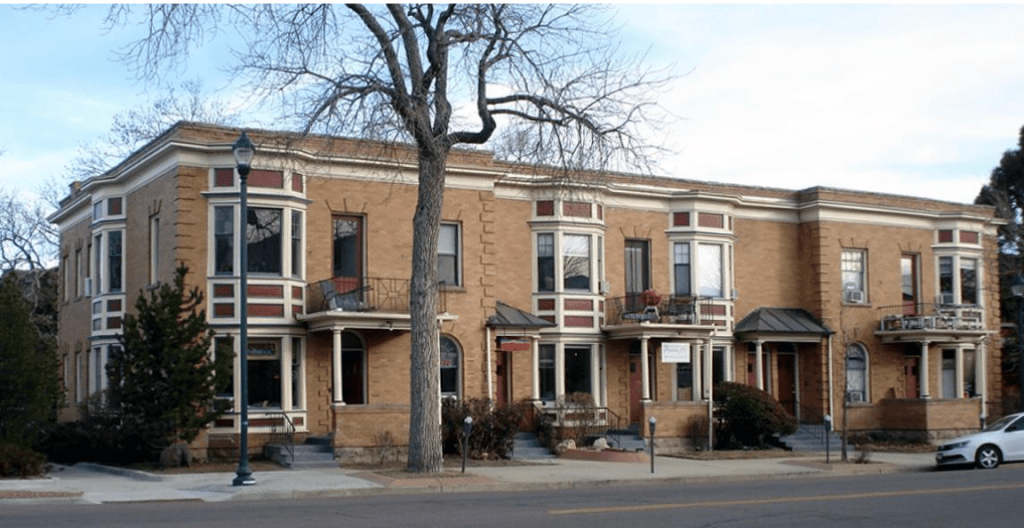
No. 19: Murray Apartments
725-33 North Tejon Street
Built 1902
Architect L. A. Pease | Contractor G.M. Young
Apartment buildings grew in popularity in downtown Colorado Springs at the beginning of the 20th century. These dwellings gained acceptance in urban areas after the Civil War as cities faced a shortage of desirable building sites. Many of the early apartment buildings were designed to look like large houses, with the more expensive buildings resembling large mansions. Others took on the appearance of a row of interconnected houses.
This 1902 apartment building exemplifies the architecture and quality materials typically used in those days. It has brick and stone construction, a flat roof, is two stories high, and has classical details. It illustrates Classical Revival features and terrace-style architecture in its multiple porches and repetition of design elements.
Built by J. F. Murray, it attracted professional workers, such as Dr. William Fowler, a dentist, who lived at 725 with his wife Marietta. In later years, it began to house offices and shops.
It is National Register eligible.

No. 20: Burgess Residence
730 North Nevada Avenue
Built 1888
Pattern Book Design
Colorado College | Wikipedia | History Colorado | Gazette Telegraph Article
This rambling simplified Queen Anne was built by Charles H. Burgess, who moved to Colorado Springs from Sandwich, Massachusetts. This home represents the lifestyle of the early mercantile class of the 1880s that resided principally along North Tejon Street, North Nevada Avenue, and North Weber Street.
When Burgess purchased this property, it had an existing house which was moved to the west end of the lot. The children’s playhouse to the south was built in 1874 by Joseph Dozier, a well-known local builder. It was moved to this site in the early 1900s. The garage was once a barn, built about 1874, and predates the house, which was completed in 1888.
The residence served the Burgess family for almost 100 years. Charles and his wife moved back to Massachusetts in 1900. Then his son Willard and his wife moved in. A major remodel was carried out in 1988, during which many of the original aspects of the home were restored, including five fireplaces.
Architecturally this building is probably a pattern book design. The plans were taken from a book of architectural designs, usually providing enough information for non-architects to build structures that are copies or derivatives of major architectural works.
The home thus is representative of the vernacular Queen Anne style constructed in Colorado in the late 1800s. Although simpler in design than some, it has all the key elements: irregular shape, multiple gable roofs, prominent corner towers, front porches, contrasting materials, and some decorative detailing. The roof on the tower is called a “witch’s hat.”
This home is listed in the National Register.
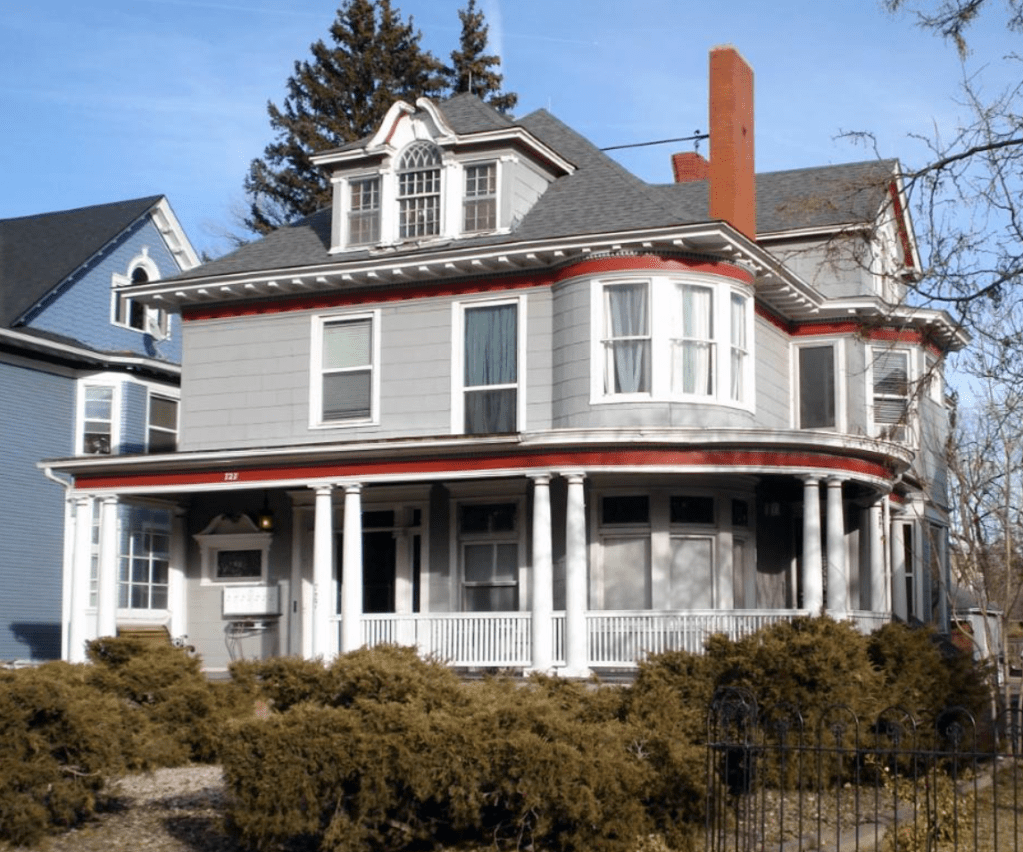
No. 21: Lowell Residence
727 North Nevada Avenue
Built 1902
Architect Thomas P. Barber
In February 1902, Facts Magazine reported that “B.F. Lowell of the Lowell-Merservey Hardware Co. will build a fourteen-room residence at No. 727 North Nevada Avenue to cost $10,600.”
The 1903 city directory indicated it was the residence of Ben F. and Clorinda L. (Brackett) Lowell. Ben Lowell was identified as president-treasurer of the Lowell-Merservey Hardware Co., which was described as having “roots … extending back to the very early days of Colorado Springs.” Before coming to Colorado Springs around 1890, Ben Lowell had operated hardware stores in Blackhawk and Central City.
The Beta Theta Pi Fraternity of Colorado College occupied the house in 1931. Dr. Anna M. Margetts lived in the house with her husband in 1938. She was born in San Francisco in 1880 and attended the National College of Chiropractors in Chicago. She established her practice in Colorado Springs in 1931. The house was known as the Eleanor-Ann apartments by 1941.
This house represents a transitional design with both Queen Anne and Colonial Revival style elements (dormer with broken pediment and porch with classical columns). The original siding would have been wood lap or cut shingle, rather than the asbestos of today.
The house is locally significant.
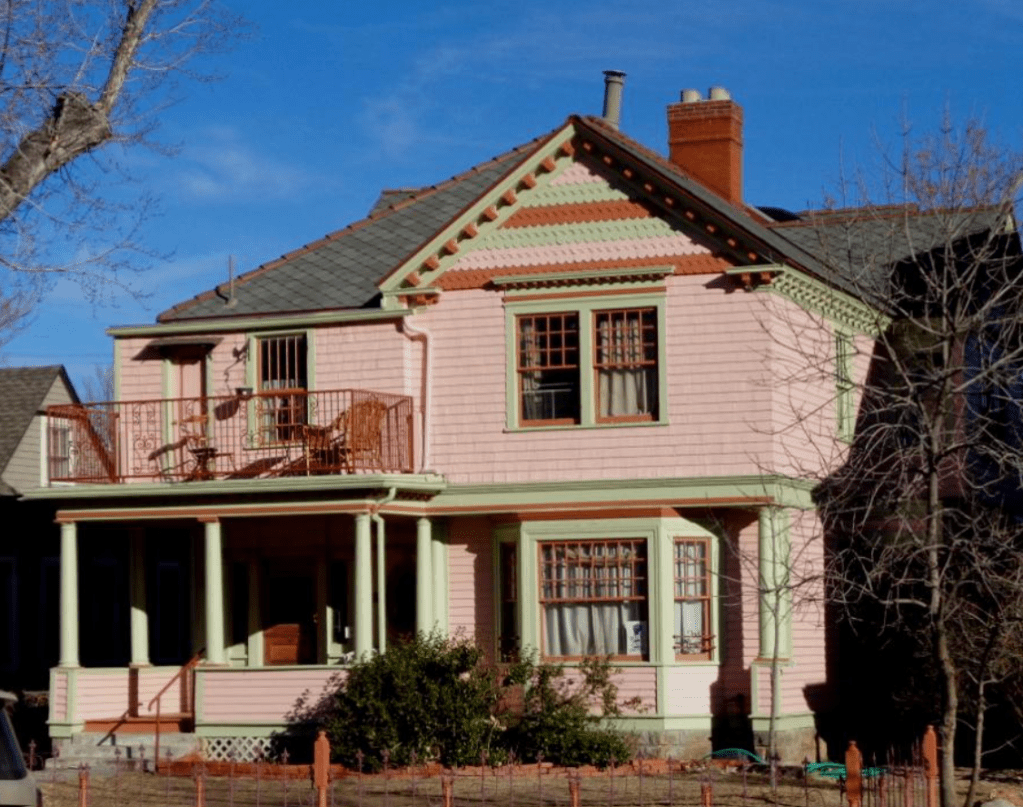
No. 22: Manchester-Van Diest Residence
719 North Nevada Avenue
Built 1895
Architect G. L. Savage, Bar Harbor, Maine
Mining broker John Manchester built this Colonial Revival-style home in 1895. By 1910 it became the residence of Edmond Van Diest, engineer for General Palmer’s Colorado Springs Company, and principal designer of Monument Valley Park. His wife, Anna L. Van Diest, was a prominent educator and sociologist at Colorado College.
Edmond Van Diest was born in the Dutch East Indies (now Indonesia) in 1865 and attended the Colorado School of Mines in Golden. In 1890 he married Anna L. Meyer in New Mexico. Between 1904 and 1909 he worked as a construction engineer, laying out Monument Valley Park in Colorado Springs. He later organized and was president of several mining companies.
Anna Van Diest was born in San Luis, Colorado, in 1894 and was educated at Colorado College, Columbia University, the University of Madrid, and the New York School of Social Work. She worked in the field of teaching and social work, and she became Director of the El Paso County Welfare Department in 1928.
The house has many notable features but is remarkable for its variety of windows, including the front bay, the oxeye (oval) with decorative glass at the entrance, the round window on the south, and the Palladian window on the north.
This home is eligible for the State Register.
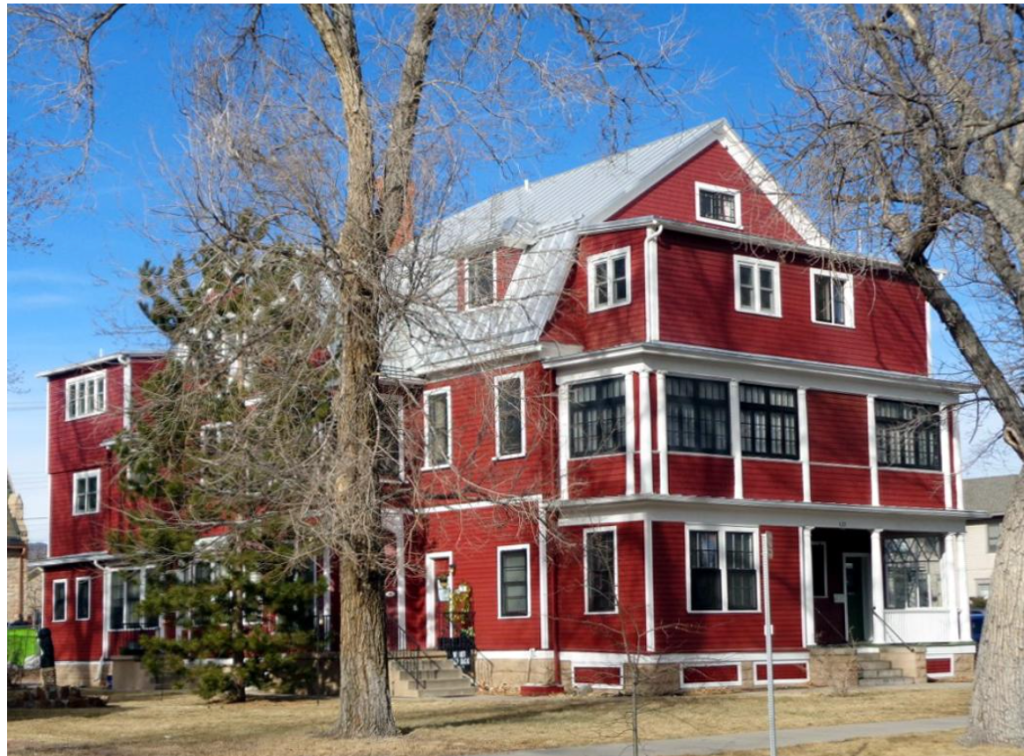
No. 23: Castello Residence
632 North Nevada Avenue
Built Pre-1895
Architect Unknown
Many prominent Colorado Springs families lived on North Nevada Avenue, and this house represents one of these late Victorian residences. The owner in 1896 was Cripple Creek mine owner and investor Frank F. Castello. He lived in the house with his wife Marie.
Frank Castello was a member of a pioneer family that settled in Florissant in 1870. The family operated a cattle ranch and general store.
Frank Castello was one of the first mine operators in the Cripple Creek-Victor mining district. He moved to Colorado Springs and married Marie in 1897. He was identified with the “progressive life of the city,” and served as president of the Mining Stock Exchange.
Built before 1895, the building retains features of its late Victorian design. That includes multiple gambrel and gabled roofs, shingles and horizontal siding, a stone foundation, a variety of windows, and classical porch columns.
The original house was described on the Sanborn Insurance maps as having several one-story open wraparound porches which, over the years, have been enclosed and altered, obscuring the design of the original house.
Like many of the larger dwellings in the area, the house served as an apartment building in subsequent years.
The house is locally significant.
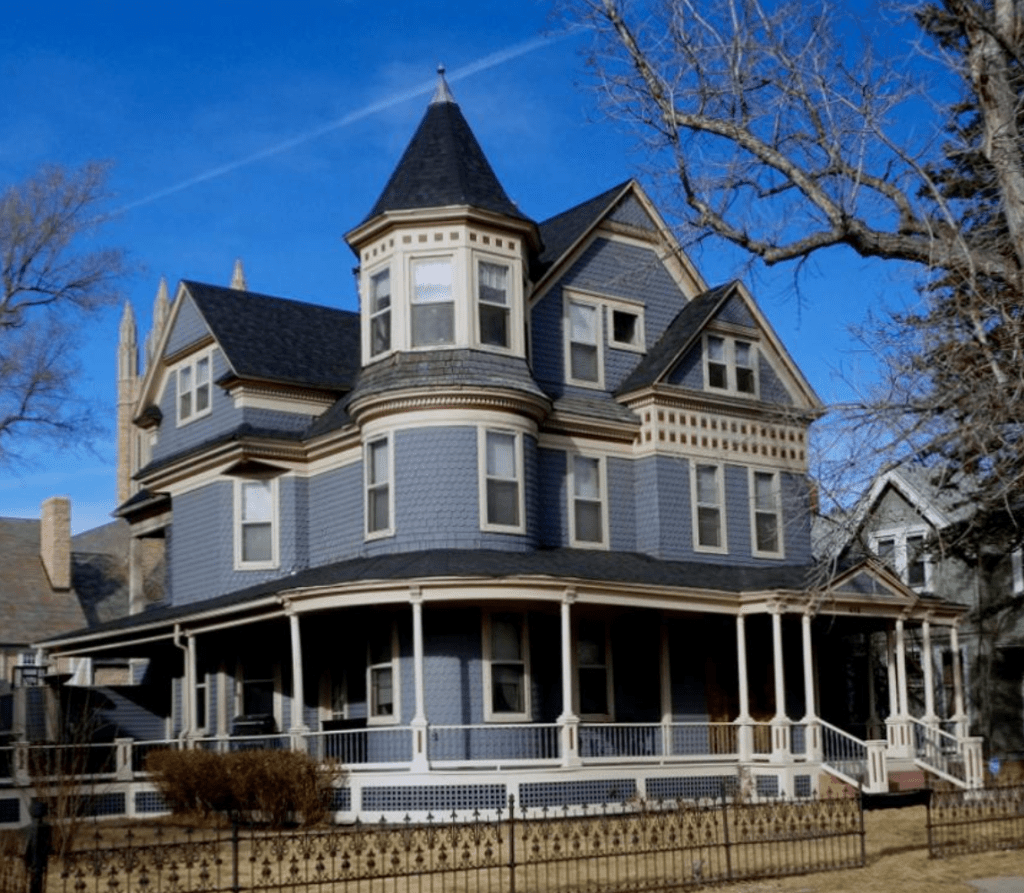
No. 24: Peck Residence
618 North Nevada Avenue
Built 1896
Architect Unknown
This house is an excellent example of the larger Queen Anne-style dwellings erected in Colorado Springs in the late 19th century. Representative features include the asymmetrical composition with multiple gables and a corner tower with a witch’s hat.
Note also the shingled walls, decorative cornice with dentil molding and paneling, cut-away corners of the bay on the south, a variety of windows, the elaborated entrance, and the wrap-around porch.
Built about 1896, the initial residents were Arthur and Lucinda D. Peck. Arthur Peck arrived in Colorado Springs in 1872 and was engaged in real estate. He later participated in the Cripple Creek District-Victor mining boom. He was described as “one of the earliest pioneers of Colorado Springs.” He was born in Watkins Glen, New York, in 1835.
Lucinda Peck was also described as a pioneer in the city. In 1885 the Rocky Mountain News reported that Lucinda D. Peck was a merchant in Colorado Springs. The Peck’s son Frank was a prominent businessman who was secretary of the Portland Gold Mining Company.
In 1911 the home was purchased by Mae S. Eaton. She resided there with her husband, E. J. Eaton. Both were prominent Colorado Springs citizens. She was the daughter of Lewis Whipple, builder of General Palmer’s home Glen Eyrie. E. J. Eaton served the community in several posts, notably as deputy assessor for El Paso County and later as county clerk and recorder.
This home is National Register eligible.
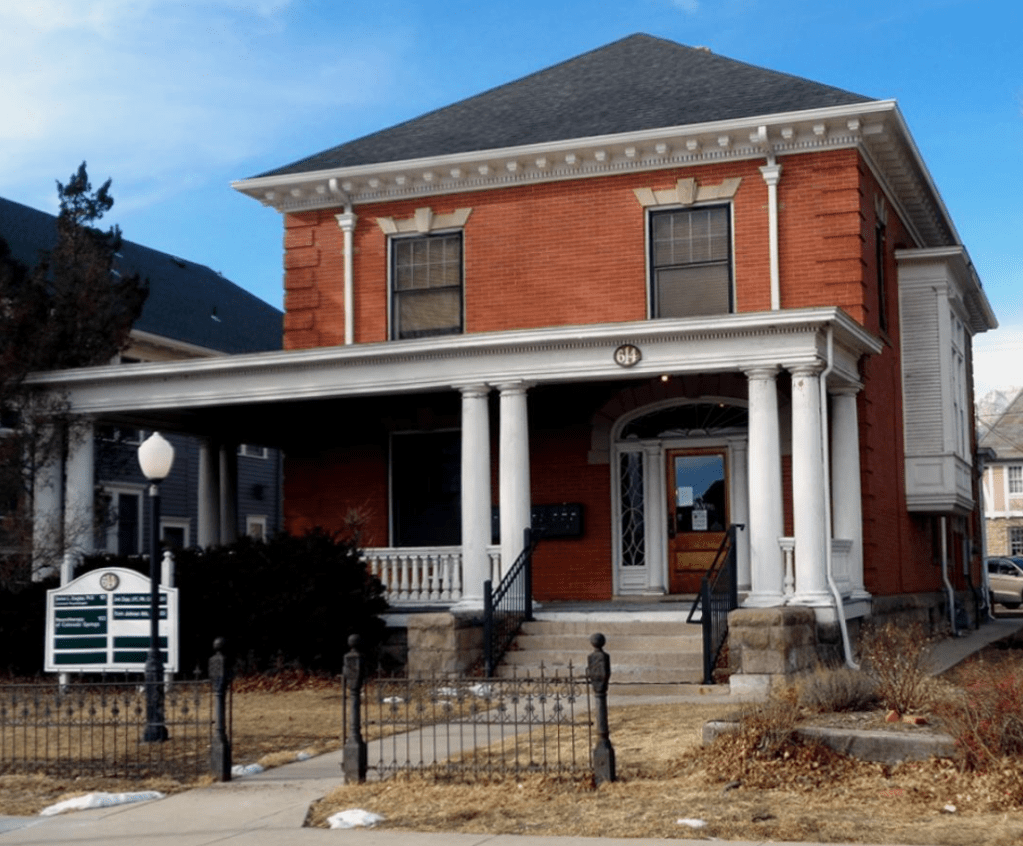
No. 25: Stark-Buchanan Residence
614 North Nevada Avenue
Built 1906
Architect Unknown
William C. and Mary A. Stark, prosperous Colorado Springs residents who owned the successful Stark-Lowell hardware store, erected this house. William Stark was born in 1851 in Germany, and moved to this country in 1870, arriving in Colorado Springs in 1872.
The Starks’ daughter, Mrs. Amelia B. Buchanan, owned the house until 1941. The 1960 city directory indicates that John C. and Ketah Young were the subsequent owners. According to the Pike’s Peak Landmarks Council, John Young was one of the American judges presiding at the Nuremberg trials of Nazi leaders following World War II.
Built around 1906, the house is a well-preserved example of the popular Colonial Revival style. The house displays a hipped roof with a full-width porch with classical columns, modillions, dentil molding, brick construction, splayed lintels with keystones, and an entrance with an elliptical fanlight and sidelights.
The house is potentially eligible for the National Register.
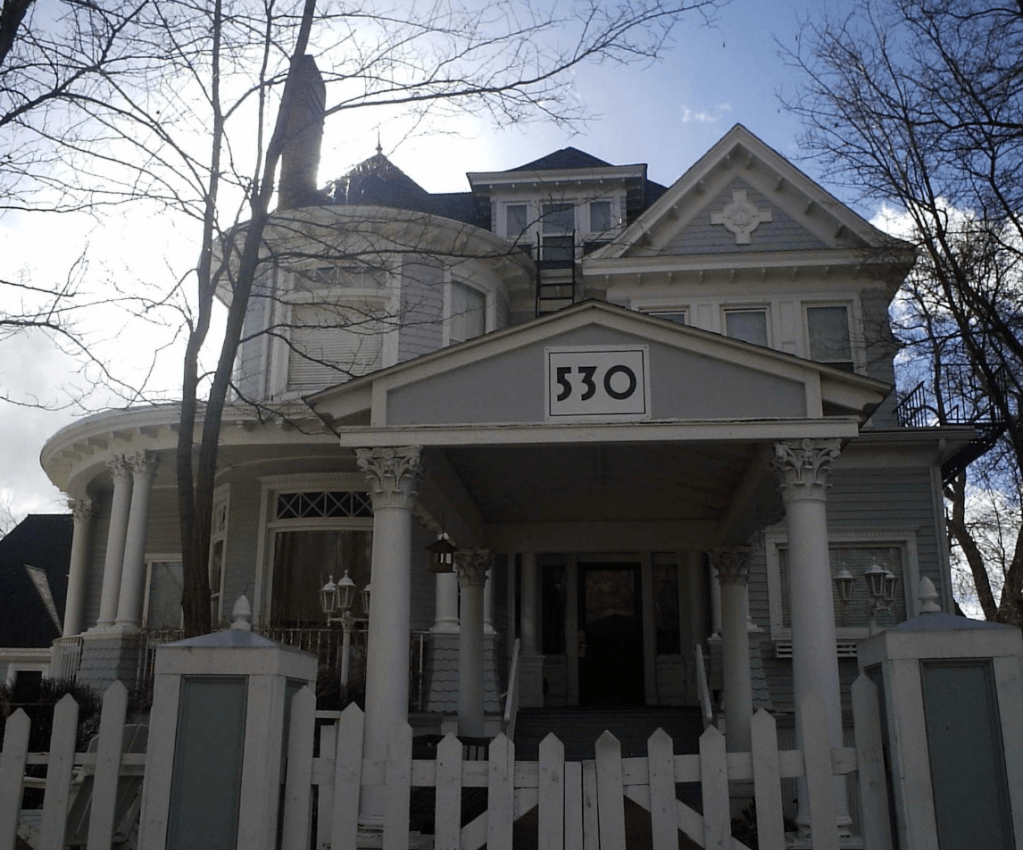
No. 26: Giddings-Stark Residence
530 North Nevada Avenue
Built 1901
Architect Unknown
Website | History
Mary C. Giddings is listed as the first owner of this home. She lived here with her husband, L. A. Giddings, who along with his brother Ralph operated the Giddings Brothers and Company dry goods store at 101 North Tejon Street. The residence was sold in 1901 to Edwin R. and Belle H. Stark. Edwin Stark was vice president and treasurer of the Raven Mining Company.
By 1909-1910, this property was known as Deaconess Cottage, with Ida Tobschall as matron of the facility. Subsequently, Daisy D. Hill operated “elegant rooms” in this house, which was described as having electric lights, baths, and every modern convenience.
This is a large-scale Queen Anne style dwelling, representative of the Free Classic subtype of the style, with its pedimented gables and porch with paired classical columns atop pedestals. The structure exhibits typical Queen Anne characteristics such as the asymmetrical composition, multiple gables, and conical roofed (witch’s hat) tower. The detached portico in the front was added in about 2003.
It is currently used as a bed and breakfast inn.
The house is locally significant.
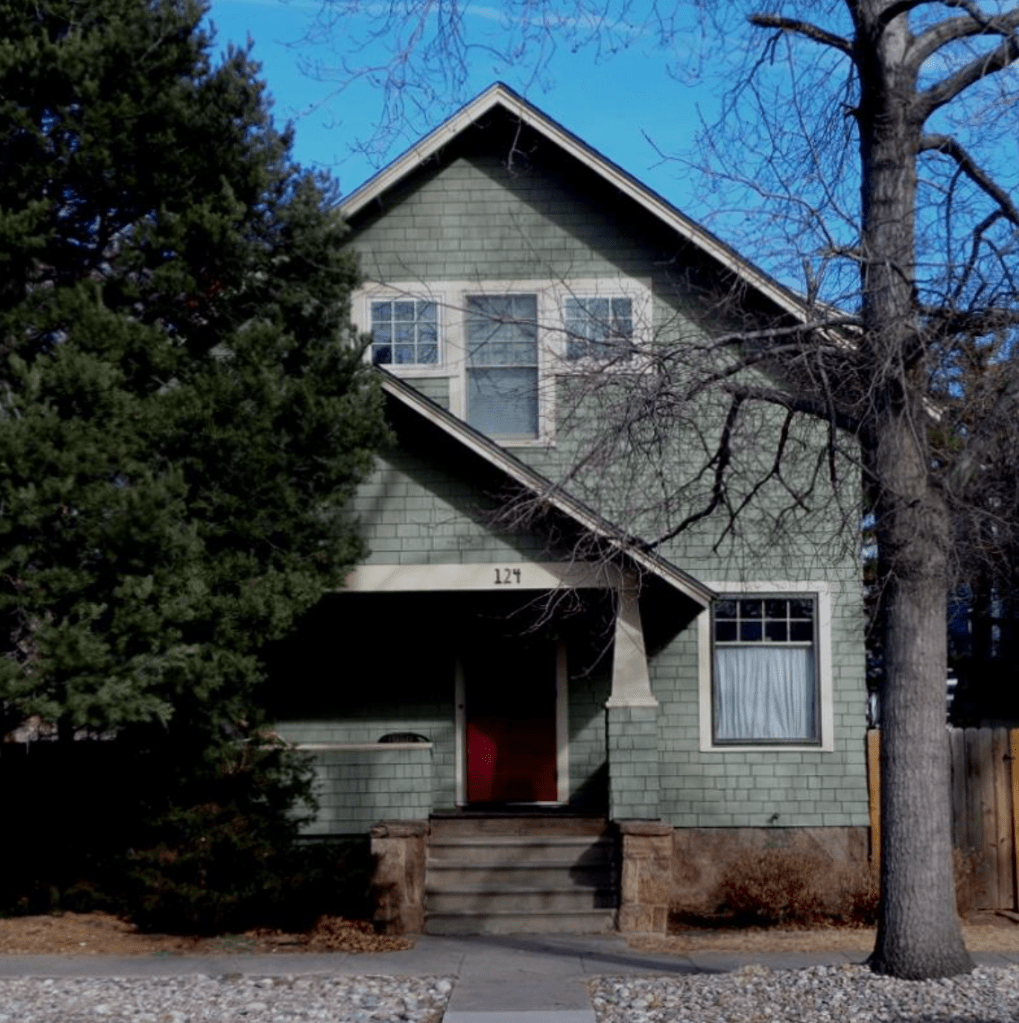
124 East Willamette Street
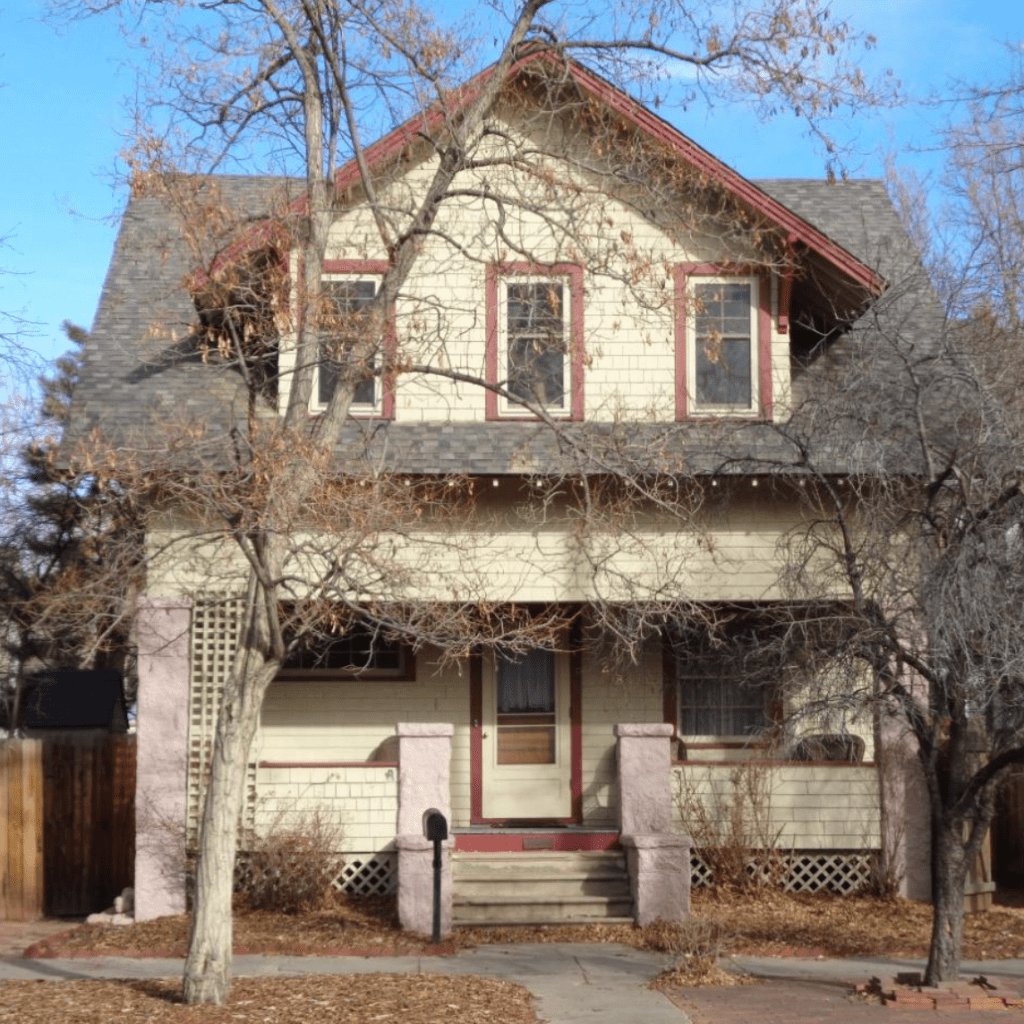
128 East Willamette Street
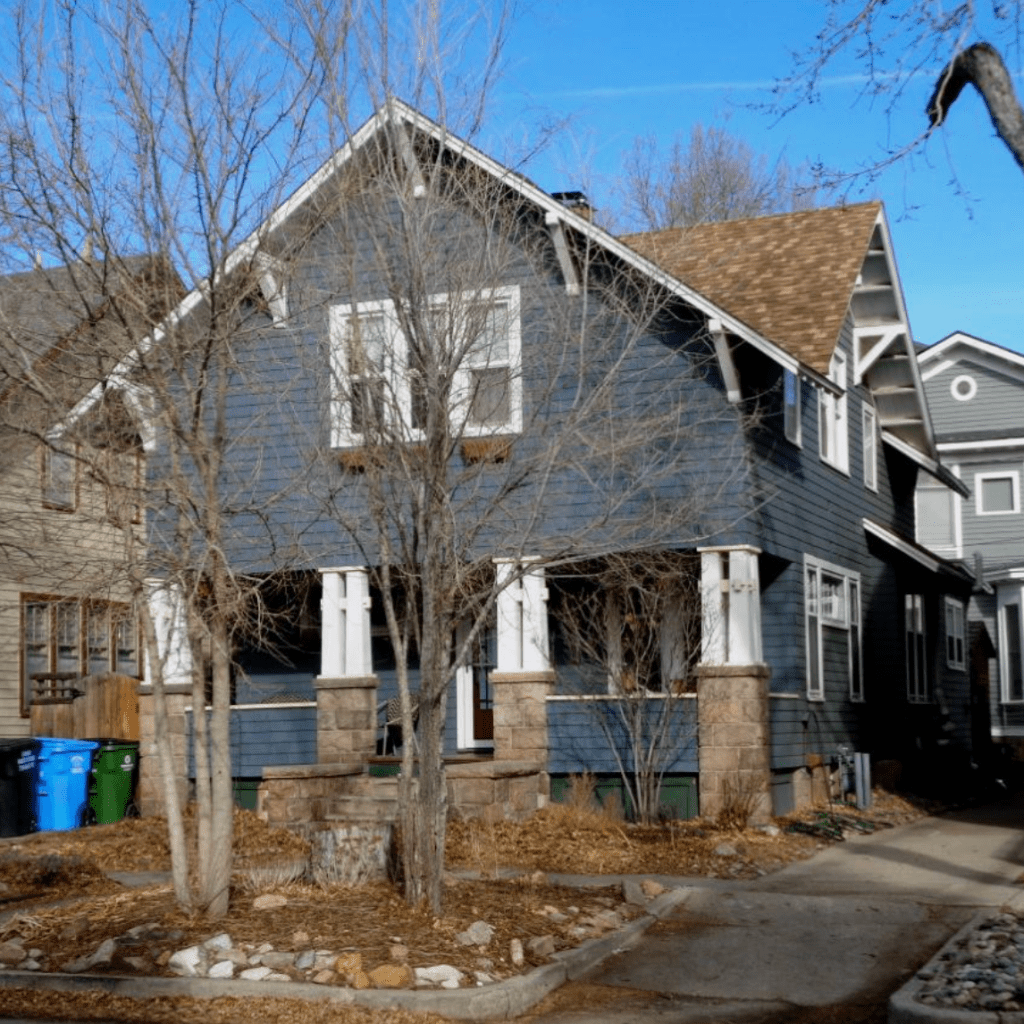
130 East Willamette Street
132 East Willamette Street
No. 27: Craftsman Residences
124-132 East Willamette Street
Built 1909-1910
Contractor James F. Crawford
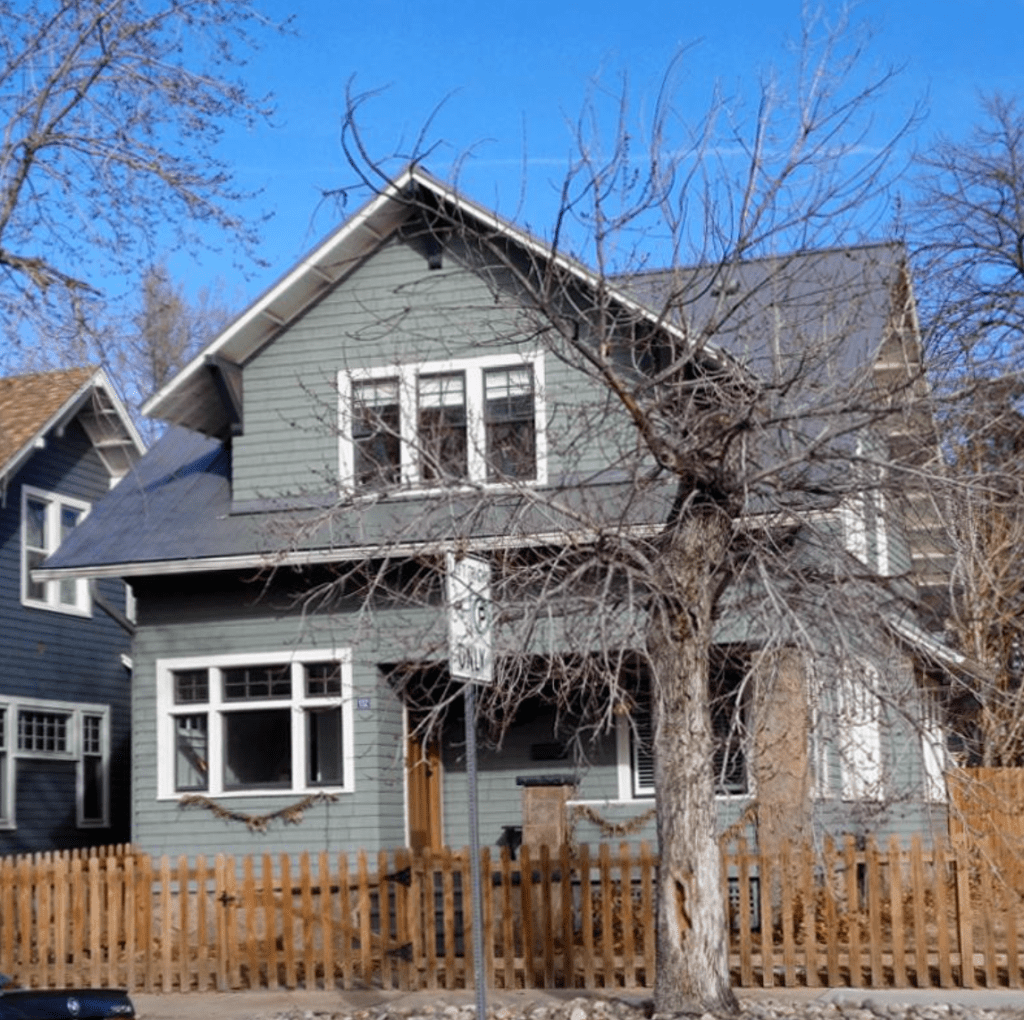
The four well-preserved houses from 124 East Willamette Street to 132 East Willamette Street illustrate another type of residential development in Colorado Springs in the early 1900s. They are an example of increasing the housing development (density) by building several smaller dwellings oriented toward an east-west cross-street rather than one larger dwelling facing a principal north-south street.
Built 1909-1910, probably by local contractor James F. Crawford, these homes are an example of Craftsman style. They have gable front roofs, overhanging eaves, exposed rafters, off-center gable roof porches, and short tapered wood piers atop a shingled balustrade.
James Crawford and his wife, Ella, lived at 132 E. Willamette as of 1917. He was described in the 1920 census as a native of Canada, a contractor, and fifty-five years old. Ella Crawford was a native of Missouri. The first occupants of these homes included a watchmaker, a railway employee, a confectionery operator, and retailers of the Wilber Suit Company.
The houses are locally significant.

No. 28: Bernard-Sill Residence
601 North Tejon Street
Built 1899
Architect A J Smith
Website
This lovely house was erected in approximately 1899 by Mr. and Mrs. George Bernard. He operated a brick livery stable in Colorado Springs. The reported price for the home was $40,000, making it one of the more expensive residences of the era.
In 1900 the Bernards sold the house to J. A. Sill, who was described as “a prominent mining man” and a member of the Colorado Springs Mining Exchange. He had come to Colorado Springs in 1882 and had mining property in Cripple Creek. J. A. Sill divided his time between this city and Goldfield, Nevada, where he had mining interests.
This building is significant as a highly decorative frame example of the Queen Anne style, including the asymmetrical composition, bays with octagonal, flat, and hipped roofs, a variety of porches and dormers, decorative shingles, and decorative glass.
Classical Revival features are also present, represented by the porch columns, cornice with dentil molding, modillions (an ornamented bracket), and elaborated entrance. The wrought iron fence was manufactured by the Hassell Iron Works (established 1895) of Colorado Springs.
The building was used for apartments by 1941. Then it became offices for Grace Episcopal Church.
The house is National Register eligible, locally designated.
No. 29: Grace Episcopal Church
631 North Tejon Street
Built 1924-1925
Architect W. Donald Robb
Website
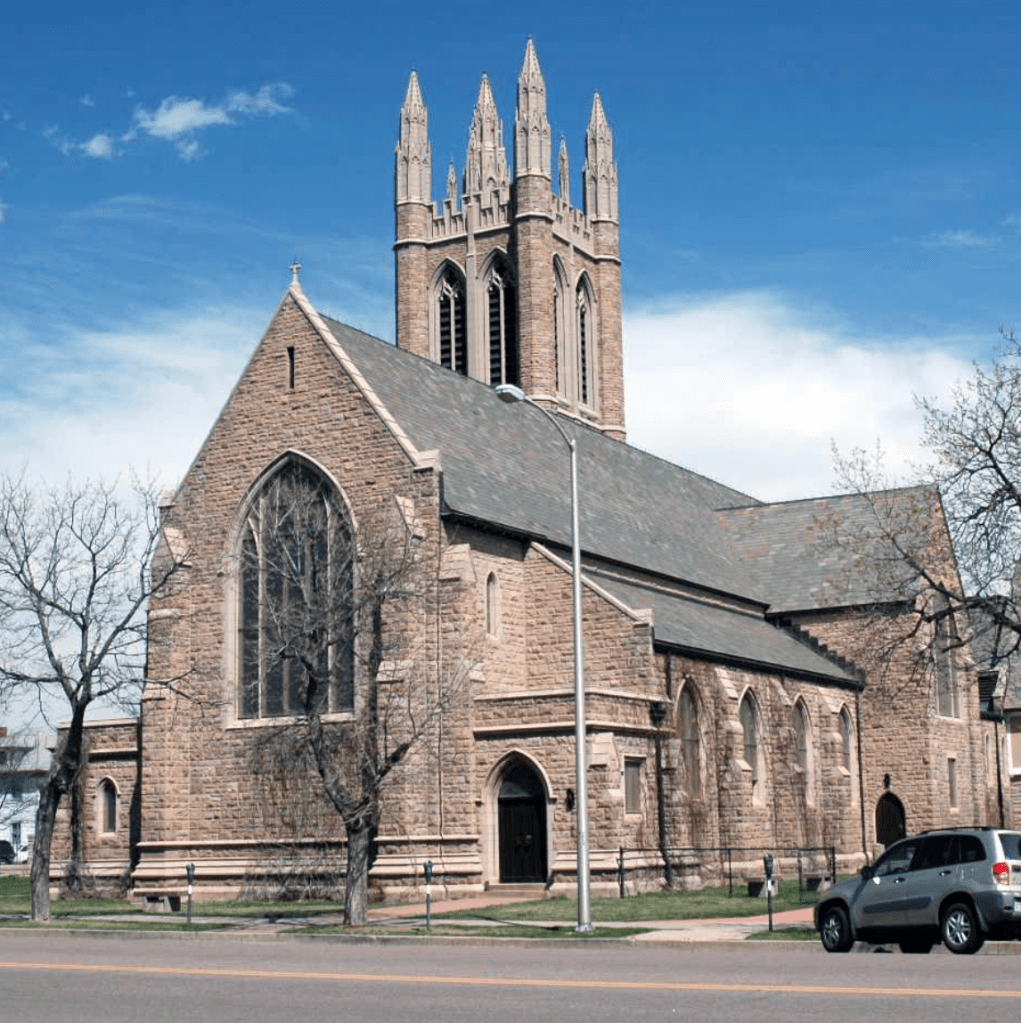
The first Episcopal service in Colorado Springs was held by Rev. Samuel Edwards of Pueblo on January 13, 1872. In 1873 Grace Episcopal Church was organized, and Grace Church was erected on lots donated by General Palmer, the founder of Colorado Springs. The building was completed in 1874 and remains at 215 E. Pikes Peak Ave., although it is no longer used as a church.
Grace and St. Stephens Episcopal church is a large stone church consisting of three components erected at different times. It includes an 1895 gable roof rectangular wing to the north (the old St. Stephens), an intersecting east-west basilica form component with a tower completed in 1925, and a two-story rectangular wing to the south built in 1949.
Grace Episcopal was designed by E. Donald Robb, of the Boston firm Frohman, Robb & Little. Robb also designed the National Episcopal Cathedral in Washington, D.C. The design employed is English Gothic Revival, and the plans incorporated the existing St. Stephens as the Parish Hall. All but the tower was completed in 1925. A special fund-raising drive to pay for the tower allowed it to be completed in 1929.
The church is known for its musical programs and its fine organ donated by Alice Bemis Taylor in memory of her husband, Frederick Pike Taylor. In 1927 Frederick Boothroyd became the organist. The following year he was influential in organizing the Colorado Springs Symphony.
This building is National Register eligible.
No. 30: St. Stephens Church
631 North Tejon Street
Built 1895
Architect Thomas MacLaren
Website
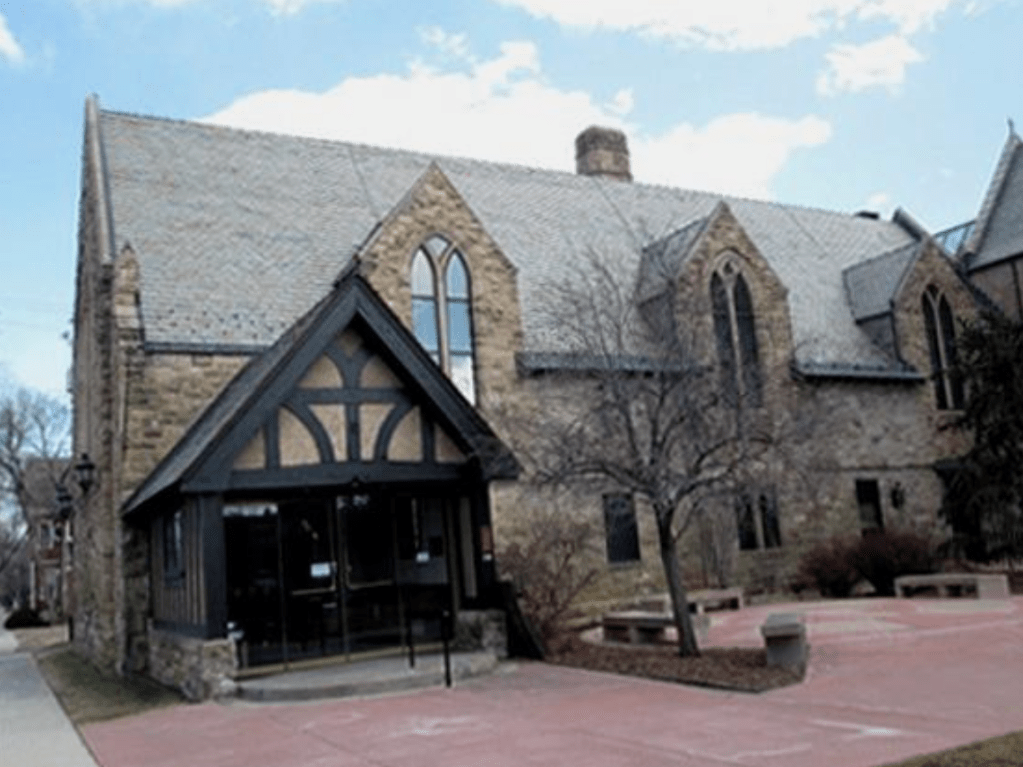
St. Stephens Church, a Late Victorian-Gothic Revival design, was constructed in 1894-1895 on lots donated by J. J. Hagerman. It was the second Episcopal Church in Colorado Springs, after Grace Episcopal.
In 1893 St. Stephens had withdrawn from the Grace Church congregation and was known as Trinity Union Church. It could not afford to build a big church, so the congregation erected a chapel seating 250 people. The first rector of the newly constructed church was Rev. Arthur N. Taft.
Reverend Taft was also appointed rector when the two congregations combined and Grace Episcopal Church was constructed next to St. Stephens. Reverend Chauncey H. Bodgett, the former rector of Grace Church, was the co-rector.
The architect was Thomas MacLaren, who was born in Scotland in 1863 and attended the Kensington School of Art in Edinburgh and the Architectural Department at the Royal College of Art. He moved to Denver, Colorado for his health in the 1890s. He practiced architecture in Colorado Springs from 1894 to 1928. His commissions included numerous private dwellings, schools, churches, libraries, medical facilities and public buildings. Among his important designs (some in partnership) were the Woodman Sanitarium, the City Auditorium and the City Hall.
This building is eligible for listing in the National Register.
No. 31: Bunts Building
21 East Monument Street
Built 1949
Architect Edward L. Bunts
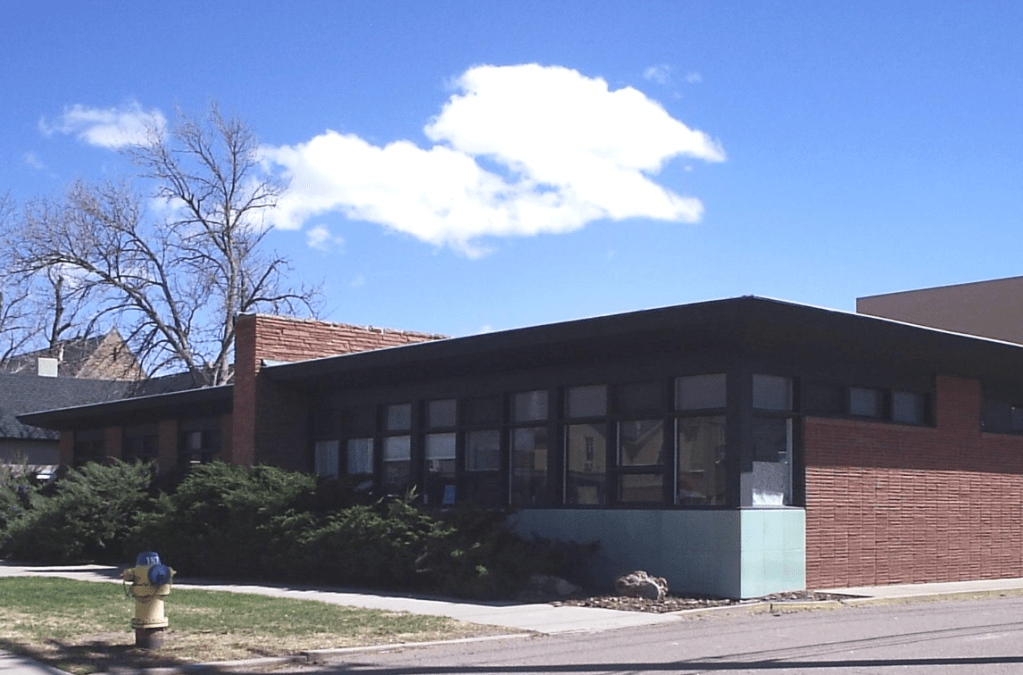
This is a one-story flat-roof office building constructed with a University of Colorado-style flagstone wall, which divides the east and west components of the building. It is significant for its representation of the Modern-style buildings erected following World War II.
The building reflects the style in its asymmetrical design, minimal ornamentation, flat roof with wide eave overhang, horizontal bands of windows, and clerestory windows. It is also unique in its combination of Roman and wire-drawn brick, flagstone, and turquoise tiles.
The building was designed by Edward L. Bunts, a prominent local architect, to serve as his office. Edward Bunts was Philadelphia-born in 1901 and came to Colorado Springs in 1918 to recover from tuberculosis.
He worked as a draftsman for the firm of MacLaren & Hetherington and then began his own practice in 1932. He designed several important buildings in the city, including Palmer High School, the First United Methodist Church, the Colorado Springs Boys Club façade, and the El Paso County Judicial Building.
Edward Bunts was active in the community, was a director of the Chamber of Commerce, and served on the City Planning Commission.
This building is National Register eligible.
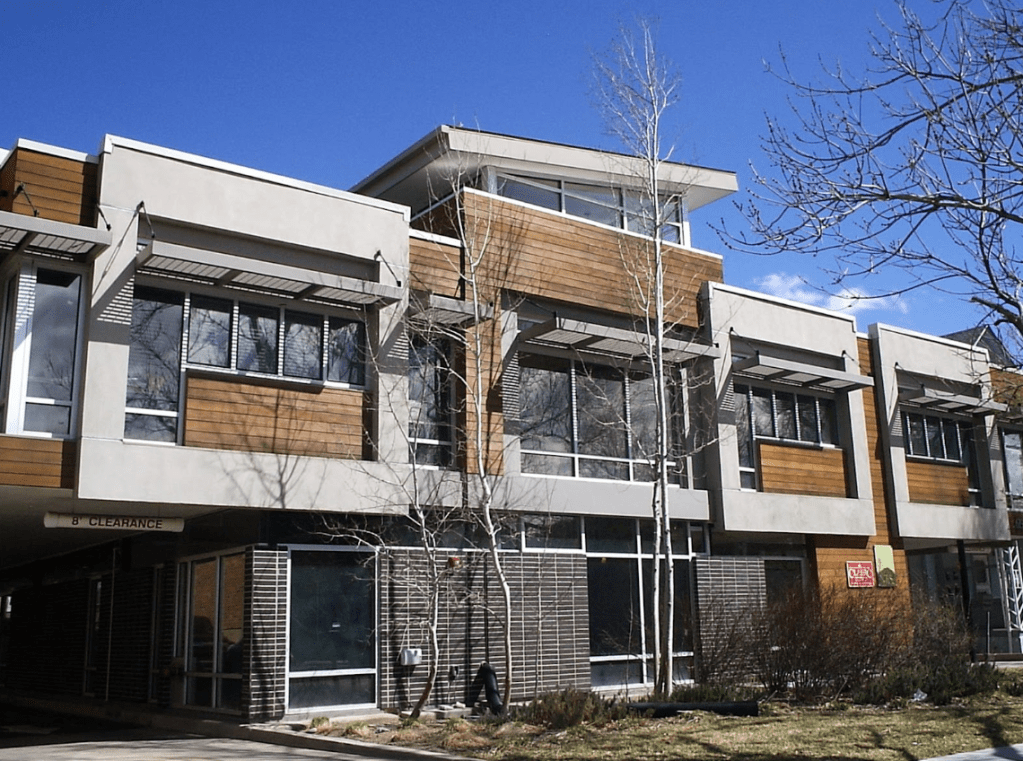
No. 32: Columbine Building
619 North Cascade Avenue
Built 1960 | Remodeled 2009
Architect Unknown
Colorado Springs Business Journal Article
The exterior of this building, which is not yet 50 years old, was replaced in 2009. It is included because it is an example of the architectural style popular in the early years of the 21st Century.
This building is locally significant.
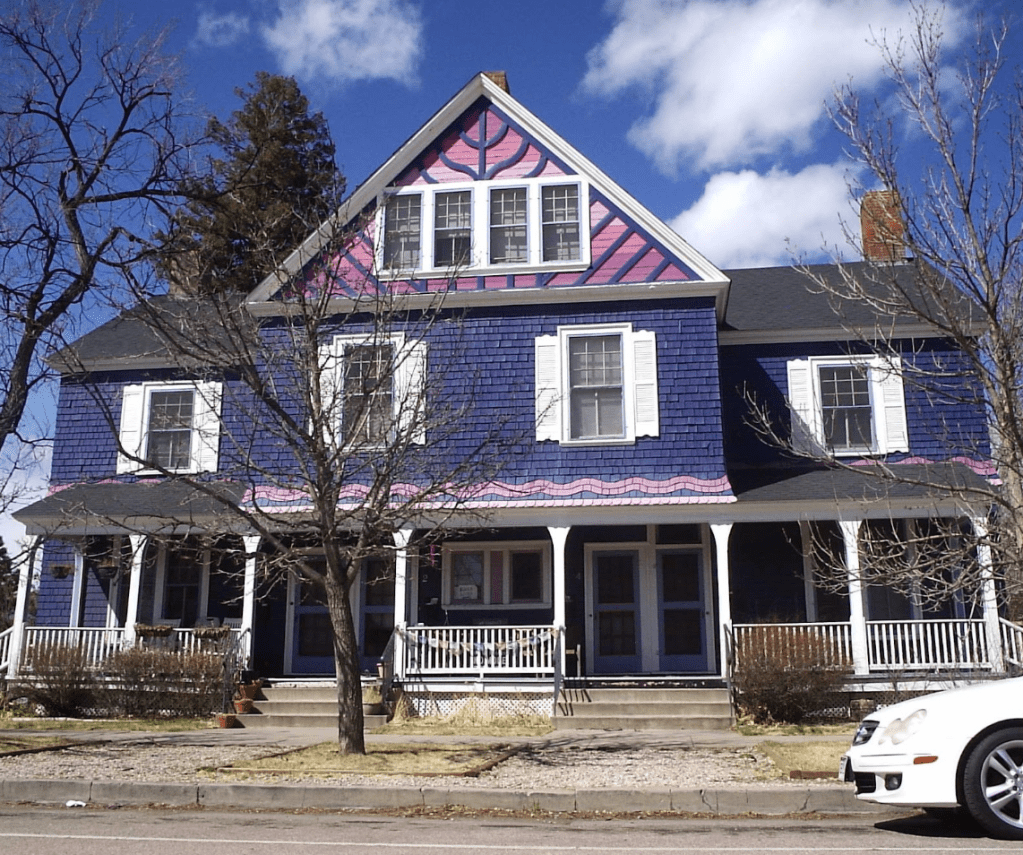
No. 33: Hazlehurst Residence
601 North Cascade Avenue
Built 1885
Architect L. A. Pease | Contractor R. W. Anderson
This very symmetrical structure is notable for having been a double house – perhaps the earliest known first duplex in the city. It was erected by Dr. Samuel Hazlehurst in 1888, and it was built to house the Hazlehurst family as well as a second-generation family.
Dr. Hazlehurst was described as a prominent physician and surgeon of the early days of the city. He served as an attending physician to the National Guard troops stationed in Cripple Creek when mining strikes occurred in the 1890s. Afterward, he spent several years in Mexico attending to his mining interests, returning to the city around 1910.
The home is representative of the Shingle style, popular in the United States during 1880-1900. Features of this style are the extensive use of wood shingles, the front gable that dominates the façade, the subordinate cross gables, and the almost full-size porch across the front. The strapwork gable face on the façade is rarely seen on a Shingle-style house. It represents an important variation.
According to the 1960 city directory, the home included six apartment units. It remains an apartment house.
This building is locally significant.
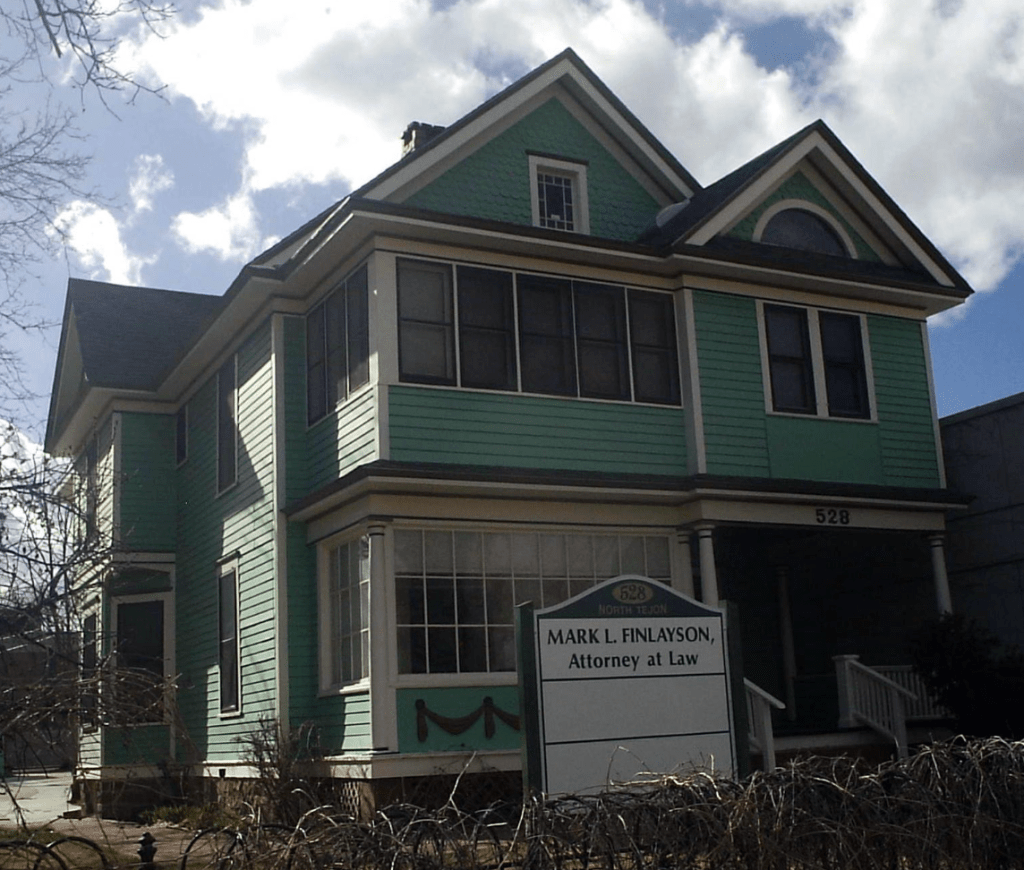
No. 34: Rice Residence
528 North Tejon Street
Built 1902
Architect Unknown
Colorado College
Colorado Springs saw rapid growth in the late 1890s and early 1900s. The most popular residential style during that period was Queen Anne. This home was built in that style sometime between 1900 and 1907.
The earliest known residents were Dr. David and Mrs. Ida M. Rice. Dr. Rice served as personal physician to W. S. Stratton, a local mining millionaire and streetcar company owner. Dr. Rice later helped to manage the Stratton estate after Stratton’s death.
David Rice served as managing director of the Stratton Home, a facility for orphans, as well as president of the Colorado Springs and Interurban Street Railway Company. Dr. Rice was also a member of the El Paso Club, the Masons, the Elks, and the Broadmoor Golf Club. He was described as “a man of dynamic force” and one of the city’s most popular citizens
The home reflects popular elements of later Queen Anne style houses, including the multiple gables, decorative shingles, numerous windows including decorative windows, and a prominent porch with classical columns.
By 1931, the structure was converted to a rooming house, as were many of the large, older houses during the Great Depression. John and Edith Pearson owned the house by 1941. The Pearsons were affiliated with the Pearson Pharmacy.
The house is locally significant.
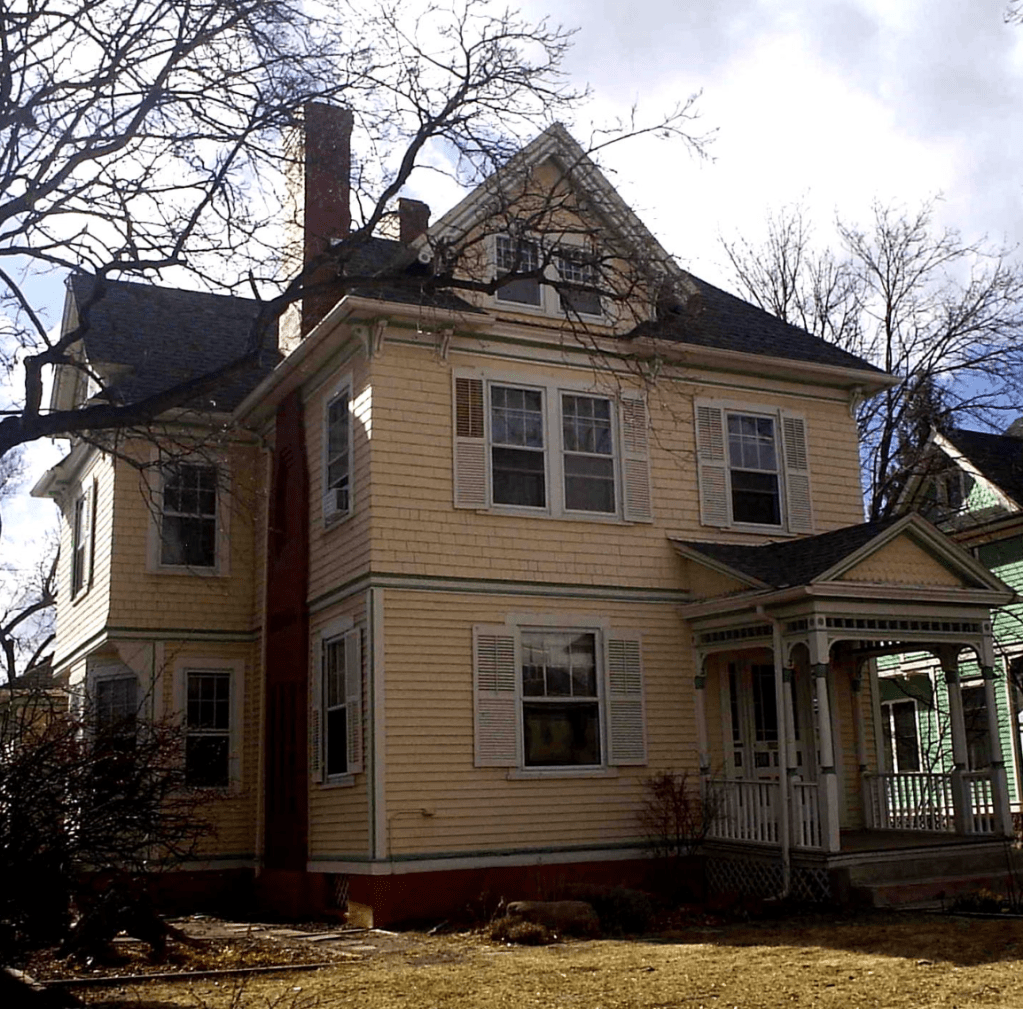
No. 35: Stubbs-Proctor Residence
524 North Tejon Street
Built 1882
Architect Unknown | Contractor W. S. Stratton
This is a 2½ story wood frame structure originally built as a residence and now used as a medical offices. It was constructed in 1882 for C. E. Stubbs, a Colorado Springs City Council member. He was later identified in the 1886 City Directory as a wool grower.
The style is Victorian Eclectic. Typical of the era, the building fronts on the street and presents a tall, narrow appearance. The front porch, which has a classical pediment over it, originally extended across the front of the house. There are two chimneys. One, located on the south side of the building, is very ornate with indented brickwork. Scrolled brackets support the cornice below the roof.
It was reported by the third owner of the home, Ms. Viola Procter, that the builder was W. S. Stratton. He was a skilled carpenter and woodworker who alternated between mining and carpentry at that time.
Stratton figured prominently in the history of Colorado Springs when he became fabulously wealthy in 1893 through the discovery of gold at his Independence Mine in the Cripple Creek Mining District. He used his wealth for many civic projects. His will created the Myron Stratton Home, established for needy children and old people.
This home is locally designated.
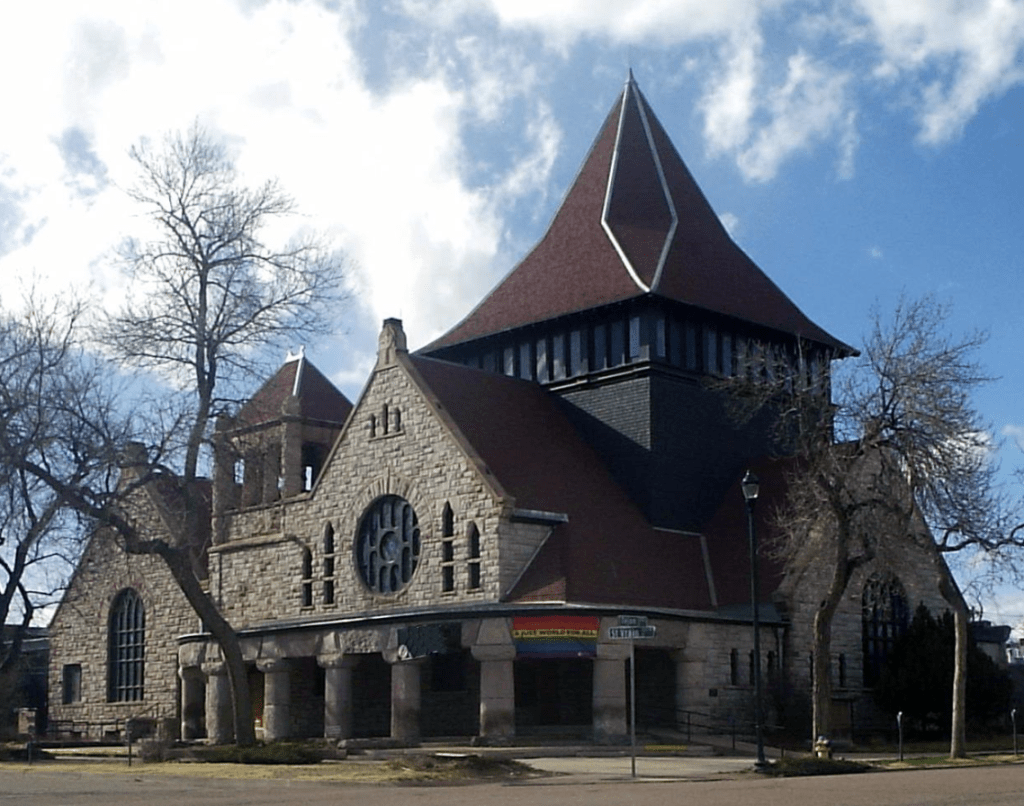
No. 36: First Congregational Church
20 East St. Vrain Street
Built 1888-1889
Architect Henry Rutgers Marshall | Contractor S. E. Sessions
Website | Wikipedia | National Registrar
The establishment and early history of the First Congregational Church were closely associated with the creation and development of Colorado College, a small church-sponsored liberal arts institution a few blocks north of this church.
Reverend Jonathan Edwards was charged with establishing both the school and the church in 1874. The church and college continued to be closely linked through leadership and membership, and both contributed to city founder William J. Palmer’s vision of attracting a refined and educated populace.
The church is significant as one of the foremost representatives of Richardsonian Romanesque architecture in Colorado Springs. The quintessential features of the style are reflected in its monumental massing, projecting towers, rock-faced ashlar walls, and dominant gables. The church is one of many throughout the country influenced by Richardson’s Trinity Church in Boston.
The church is one of only two known churches designed by New York architect Henry Rutgers Marshall. It is also significant as a representative work of local builder Joseph Dozier and local stonemason Frank Finegan.
The interior of the church is well-preserved and includes a huge Hook and Hastings pipe organ, which is the oldest in continuous use in Colorado Springs.
Listed in the National Register.
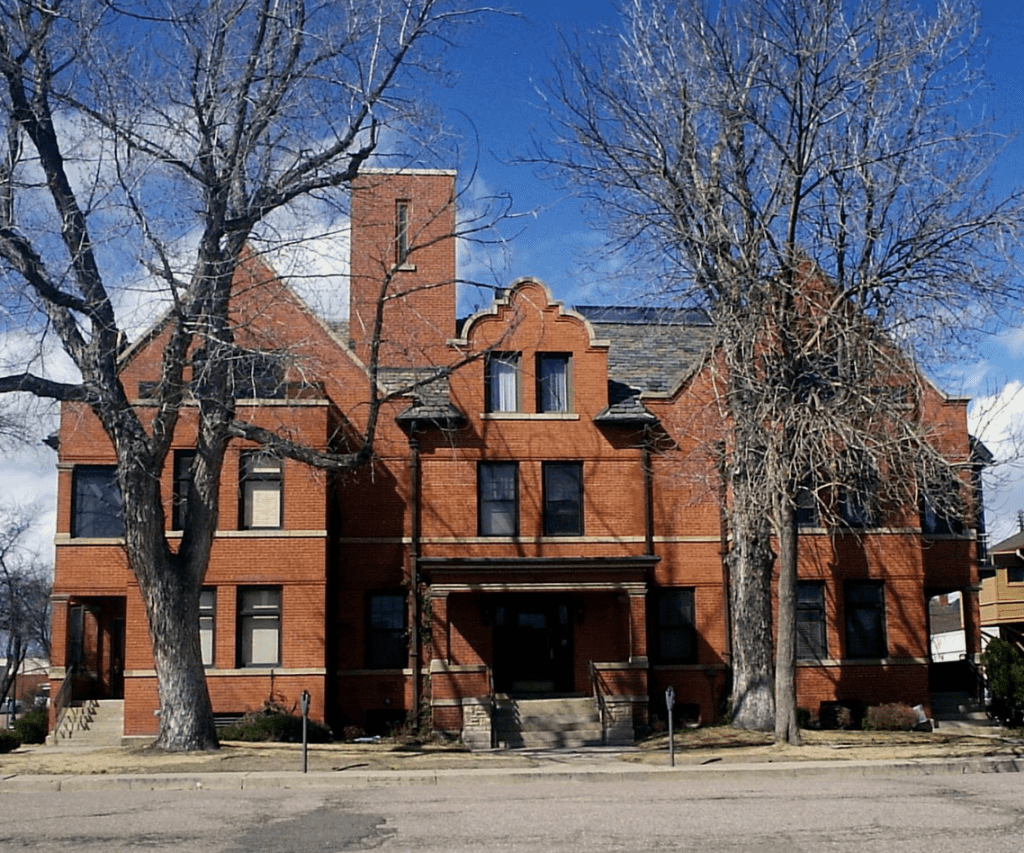
No. 37: Colchester Flats Apartments
501 North Tejon Street
Built 1905
Architect Unknown
This building was developed as five residential flats and is designed to look like a large residence. The 2½ story red-brick building is an example of Mission Revival architectural style, with its central curved parapet on the front and side façades. These facades also feature two-story bay windows and two-story porches topped with balconies.
The slate for the roof was obtained from the Day Nursery, 104 E. Rio Grande Street when its roof was being replaced.
The building, along with the adjacent St. Vrain Court Apartments, was converted to medical offices in the late 1940s. Alterations include the projecting tower, window replacements, enclosed second-story balconies, and porch enclosures on the rear. Even with the alterations, the building retains much of its original character.
It is locally significant.
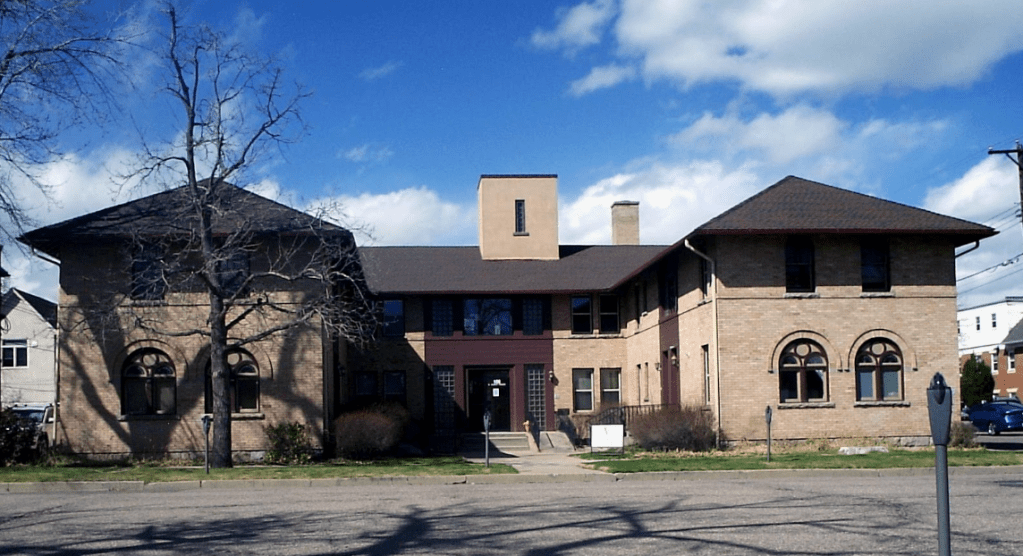
No. 38: St. Vrain Court Apartments
104-108 East St. Vrain Street
Built 1900
Architect Thomas P. Barber
This building is a good example of an early apartment building. The trend toward these early tenements (as they were called at the time) alarmed some residents of established neighborhoods, who worried about privacy and appearance. They eventually gained acceptance due to their design, affordability, and convenience.
This building was designed and owned by noted local architect, Thomas P. Barber, who was born in England around 1862. He came to the United States as a boy, first to Illinois and then to Colorado Springs. He practiced architecture for many years in Colorado Springs. He has to his credit the Hibbard’s Department Store (17 S. Tejon Street) and the City Hall (107 N. Nevada Avenue). He often worked with local architect Thomas MacLaren.
St. Vrain Court Apartments underwent alterations in 1948 during its conversion to medical offices. It received further alterations in the 1950s.
The building is locally significant.
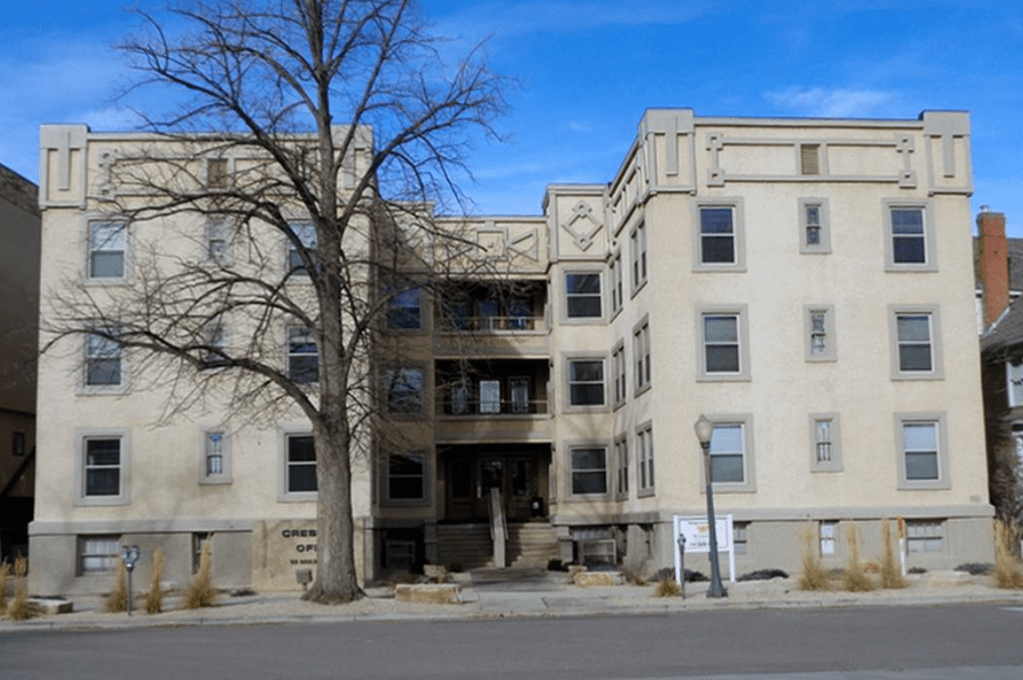
No. 39: Gladstone Apartments
10 Boulder Crescent Street
Built 1909
Architect and Contractor Frank E. Johnson
This building is significant for its representation of the rarely built Prairie style in Colorado Springs. The building may also be a precursor of Pueblo Deco-style buildings, which featured ornamentation from Pueblo and Navajo tribal motifs used in Native American artwork, as well as angular forms in construction.
Built in 1909, this is the largest of two apartment buildings erected in this style on Boulder Crescent by Frank E. Johnson, a prominent real estate developer in the city. In 1913 Johnson built a nearby apartment building known as the Crescent Apartments at 2 Boulder Crescent (No. 41).
This building is National Register eligible.
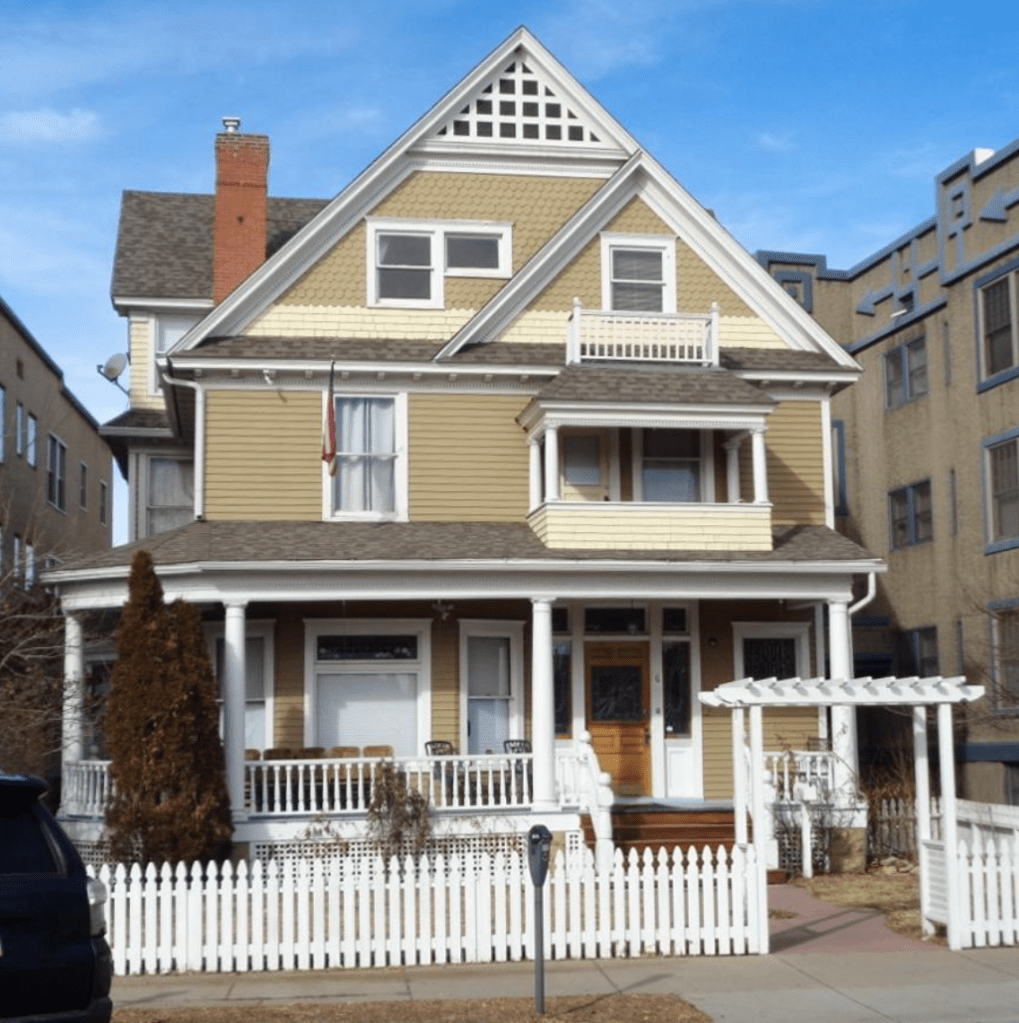
No. 40: Waugh Residence
6 Boulder Crescent Street
Built 1898
Architect Unknown
Video Tour
Major Robert S. Waugh was a Civil War veteran who participated in the creation of a provisional government for West Virginia in 1861. Later, President Benjamin Harrison appointed him as Indian Agent in Utah.
In 1910, the Waugh family shared this building with five roomers, indicating that the residence was probably originally designed to serve as a rooming house as well as a residence. Daughter Clara Waugh eventually became the owner of the property and offered furnished rooms. She lived here until her death in 1971.
There were several subsequent owners, and the building was used as apartments, attorneys’ offices, and as a private residence. In 1995 the property was converted to a bed and breakfast inn.
This house is significant for its representation of the later Queen Anne-style dwellings erected in Colorado Springs.
This house is National Register eligible.
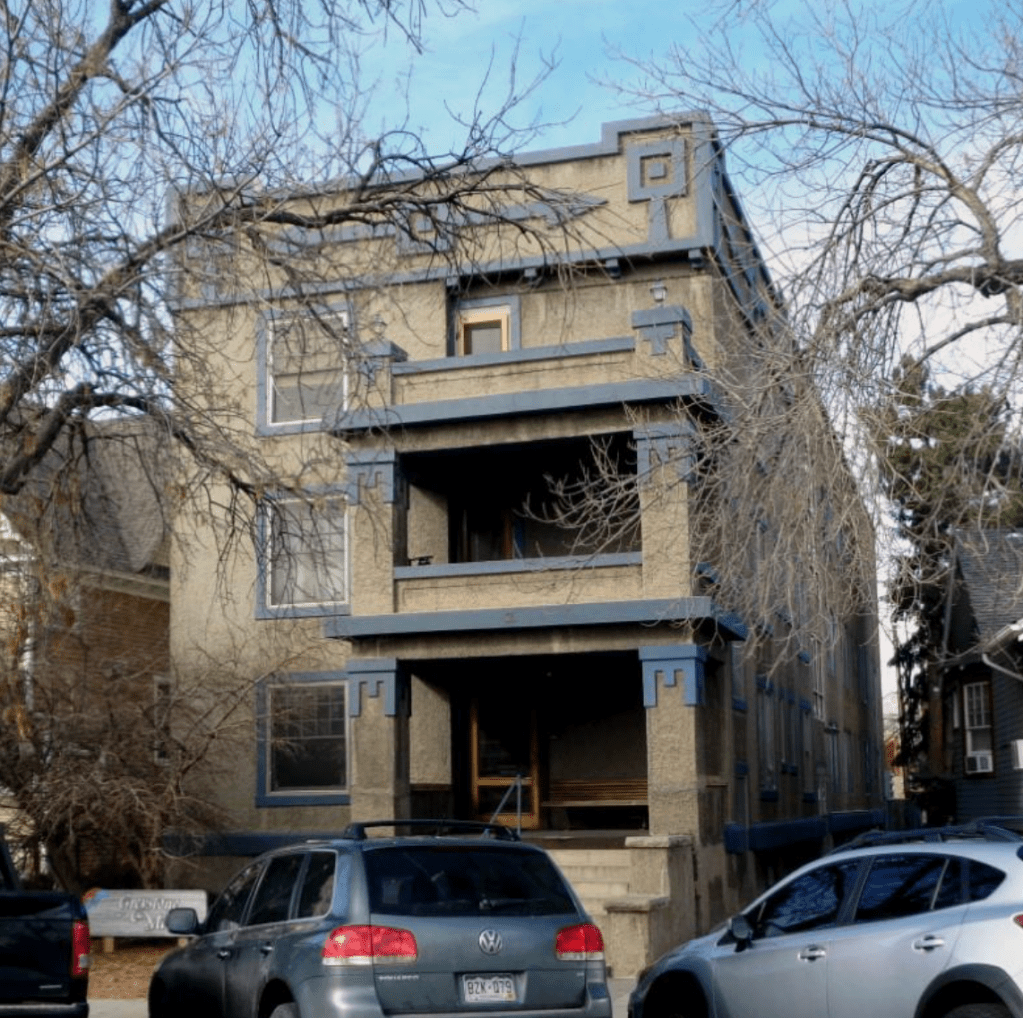
No. 41: The Crescent
2 Boulder Crescent Street
Built 1913
Architect and Contractor Frank E. Johnson
Similar to its neighbor, the Gladstone Apartments, The Crescent is a long, rectangular apartment building significant for its representation of the rare Prairie style in Colorado Springs. The building’s design anticipates the Pueblo Deco style, which features Native American ornamental motifs and angular construction.
Owner and builder Frank E. Johnson was the designer. Johnson was the president and manager of the Newton Lumber and Manufacturing Company, serving area residents from 1887 to 1915. Johnson also built the Gladstone Apartments (No. 39), and the Victoria Apartments at 210 S. Weber Street, along with about fifty houses.
This building is National Register eligible.
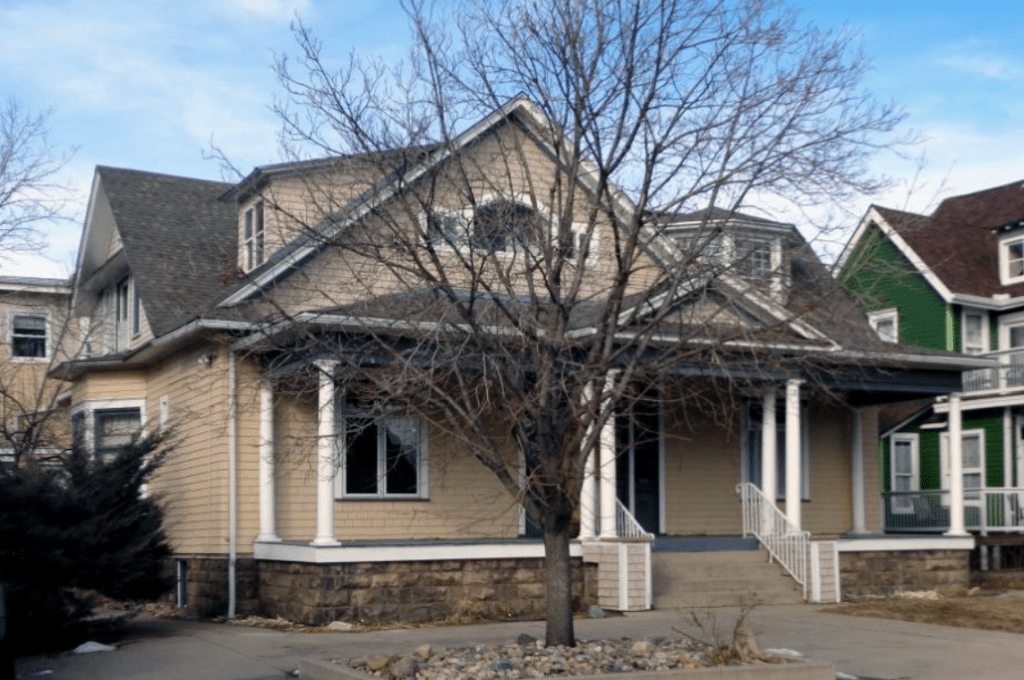
No. 42: Salisch Residence
306 North Cascade Avenue
Built 1902
Architect Unknown
David S. and Elizabeth Salisch, occupants in 1910, earned their living as tailors with their own shop. By 1931 the building was being used as a rooming house. It was later converted to apartments. By 1965 it contained 19 apartment units. The house has a large two-story addition at the rear, as well as a one-story addition. The exact date of these additions is unknown, but they were completed before 1962.
This building is one of the early 20th-century dwellings in the Boulder Crescent Park neighborhood that quickly converted to multi-family uses, serving first as a rooming house and then as apartments. The house, although altered, displays features of Edwardian design.
The house is locally significant.
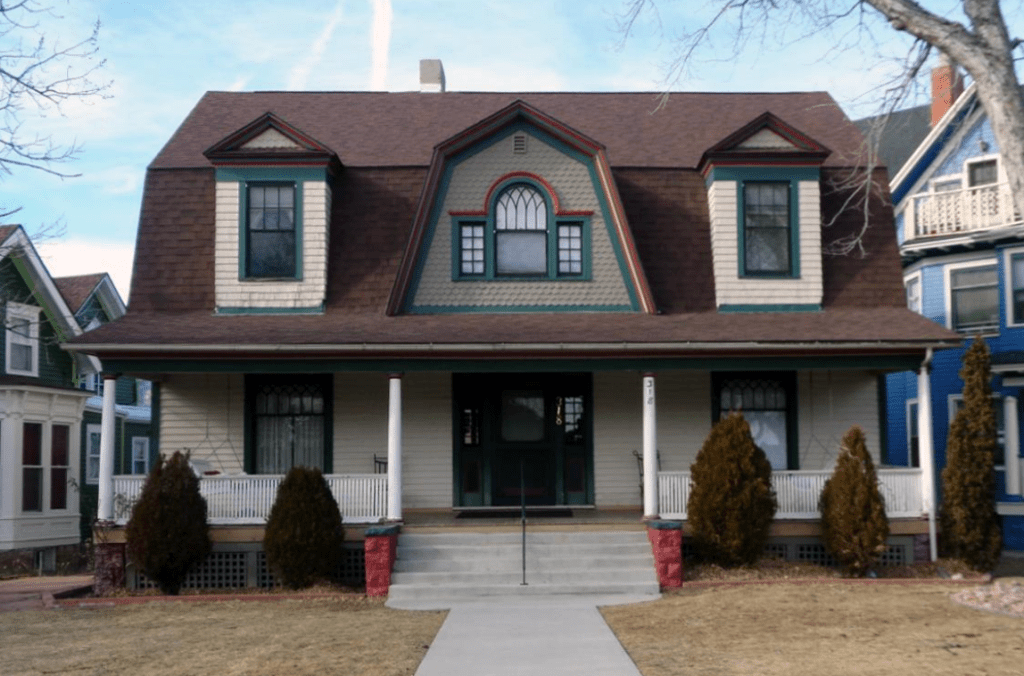
No. 43: Hudson Boarding House
318 North Cascade Avenue
Built 1901
Architect E. M. Cole | Contractor G. M. Dynes
This house is an excellent example of the Dutch Colonial Revival style with a side gambrel roof, dormers with pediments, and classical detailing. Built-in 1901, the initial occupant of the house was Mrs. Caroline Hudson.
This house is listed in the National Register.
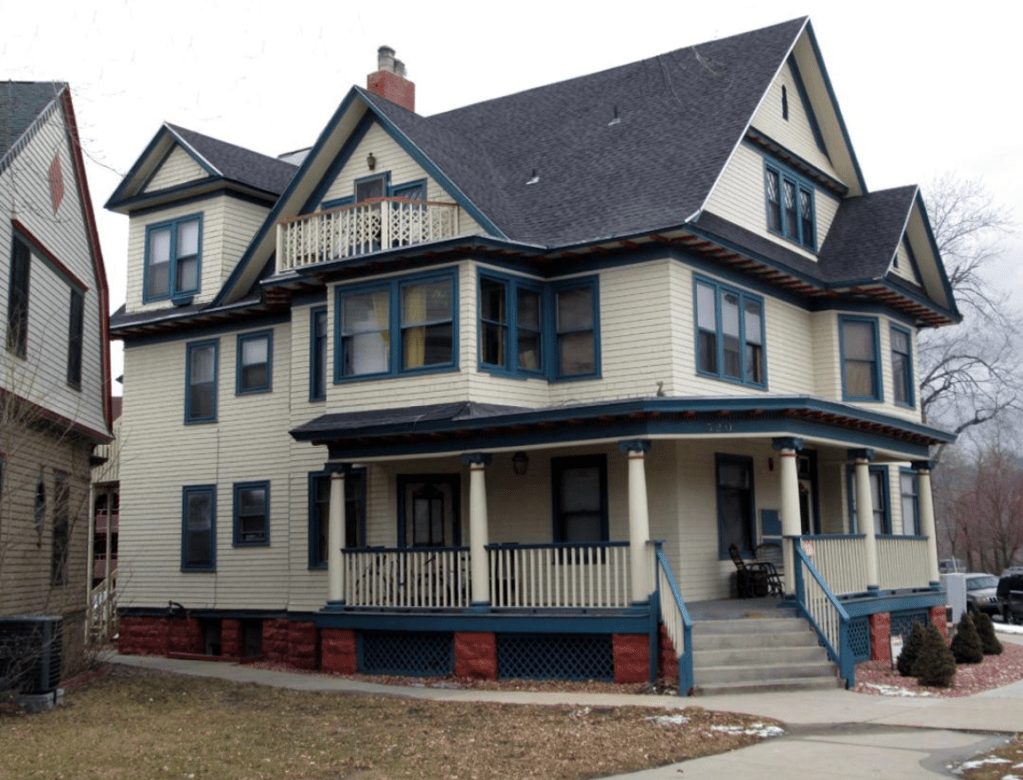
No. 44: Mathewson Boarding House
320 North Cascade Avenue
Built 1894
Architect and Contractor Frank E. Johnson
Set diagonally on the lot, the placement of this dwelling enhances its imposing size and character. Built-in 1894, this is the oldest property in the Boulder Crescent Historic District.
In use as a boarding house by 1900 under the management of Miss Sarah Mathewson, the property was later owned by Billy Nations, who also owned and operated the Nation’s Hotel for many years.
The house narrowly survived a deadly fire in 1982, which led to the placement of the fire escapes. It was subsequently restored as an apartment building.
The house is listed in the National Register.
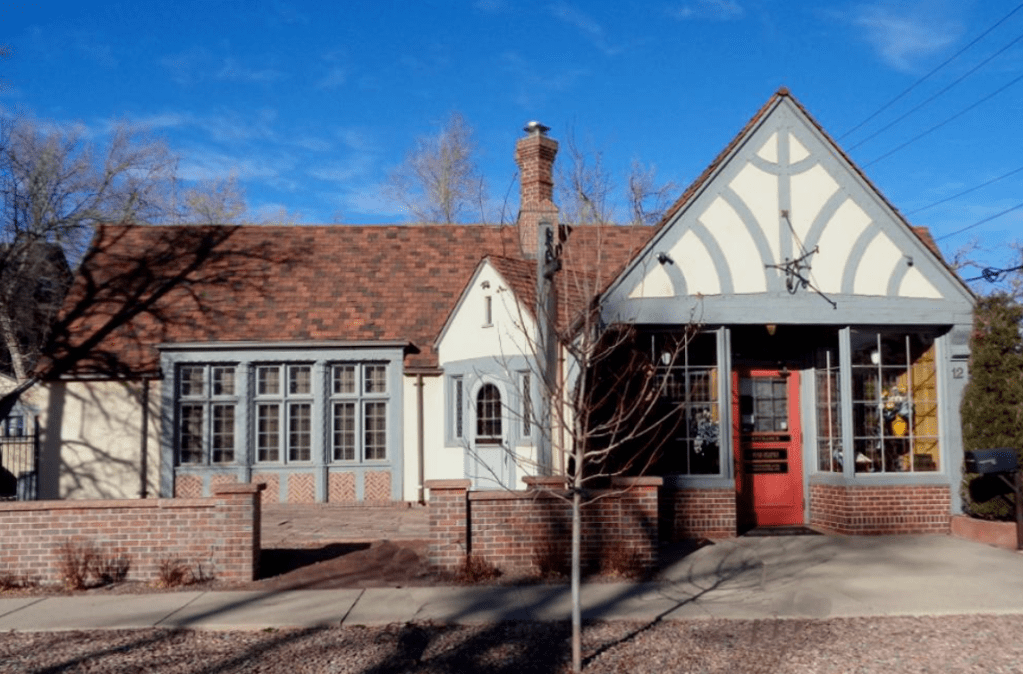
No. 45: Half Way House
12 East Boulder Street
Built 1929
Architect E. E. Nieman | Contractor C. H. Blood
This building is significant for its association with the history of health care in Colorado Springs. After World War I, many veterans suffering from respiratory afflictions arrived “chasing the cure.” During the early decades of the 20th century, occupational therapy was considered a major component of treatment, particularly for those suffering from tuberculosis. The Half Way House was established to provide this therapy for those “halfway” back to health.
The Half Way house was donated by Mrs. Augusta B. Evans to the Community Chest (now the United Way) in memory of her husband, William, for use as a rehabilitation center. Mrs. Evans also provided a sizeable endowment. It remained in this use until 1960 when it was sold for use as offices.
The building exhibits the English Norman Cottage style.
It is National Register eligible.
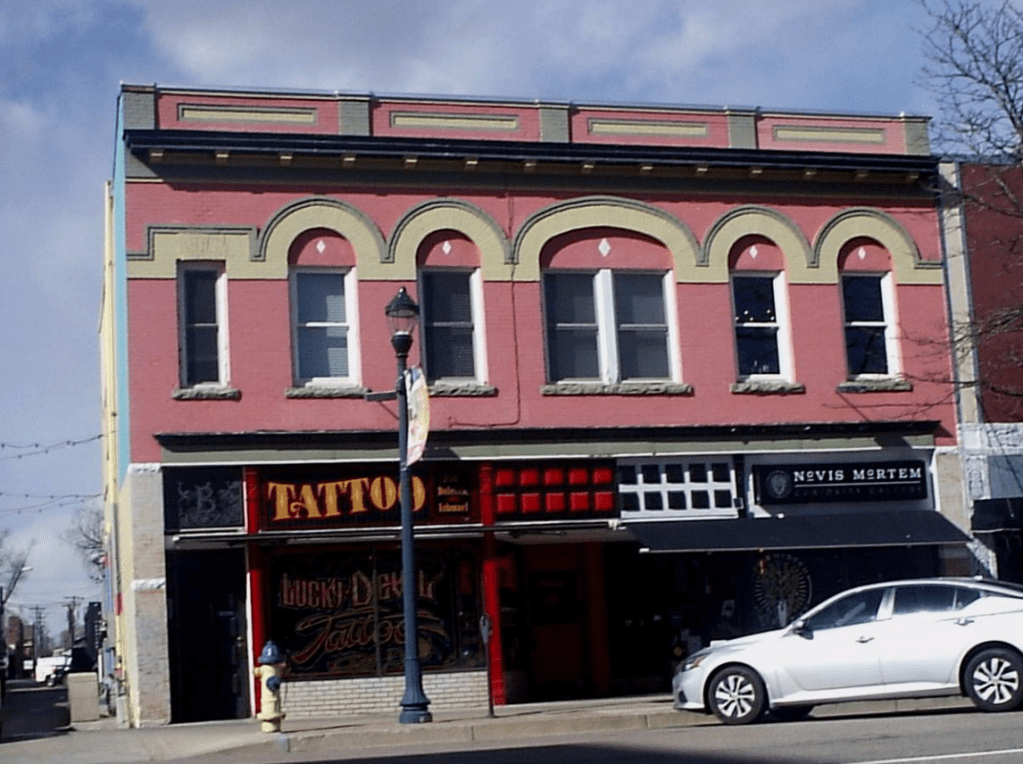
No. 46: Caledonian Hall
20 East Bijou Street
Built 1902 | East Addition late 1930s
Architect Unknown | Contractor George Wright
This is a two-part, two-story Late Victorian commercial building.
It consists of a circa 1902 brick façade to the west built by George W Thornton. A narrower stucco section to the east was constructed perhaps in the late 1930s.
The first recorded use of the building was as a Caledonian Hall, organized to promote camaraderie “among persons of Scottish birth and descent, and propagate love for the music, literature and ancient games of Scotland.”
Other fraternal societies, including the Soldiers and Sailors Club, also used this hall.
George Wright, a local contractor and proprietor of the hall, may have been the builder, but the name of the architect is undiscovered. Artists, carpenters, and contractors rented space here. The eastern portion of the building provided residential apartments upstairs. It also had retail space and offices for a variety of tenants on the ground floor.
This building is locally significant.
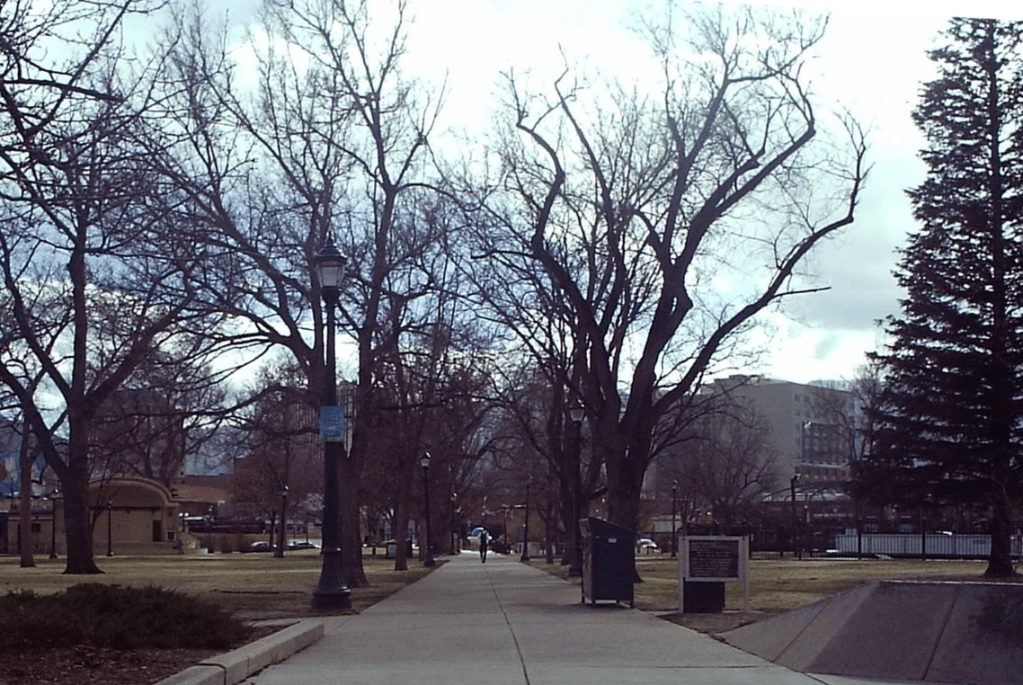
No. 47: North Park, now Acacia Park
120 East Bijou Street
Platted 1871
Original Landscaper John Blair
Website
North Park was the first of two platted parks in the original town site of Colorado Springs. Reflecting a formal, symmetrical pattern, it measures 400 feet on each side. It was initially landscaped by John Blair, who came from Scotland. Blair also designed the grounds for General Palmer’s home, Glen Eyrie.
One of the early buildings of Colorado College was located on N. Tejon Street across from North Park. As a result, the first athletic playing fields of Colorado College were in North Park.
By 1901, the park’s name had changed to Acacia Park. Close by was South Park, which was renamed Alamo Park and by 1903 contained the El Paso County Courthouse.
The band shell, located at the southern side of the park, was added in 1914. It replaced a wood frame bandstand constructed in 1888. Thomas P. Barber, associated with several downtown buildings, designed the new band shell, which by itself is eligible for listing in the State Register.
At the northern end of the park, the concrete shuffleboard courts and horseshoe pits were added in 1940. Those improvements transformed the park into an area popular with GIs (soldiers) from Camp Carson during World War II. The shuffleboard shelter is now used as a police service center, but shuffleboard courts are available during the summer months.
Acacia Park is locally significant.
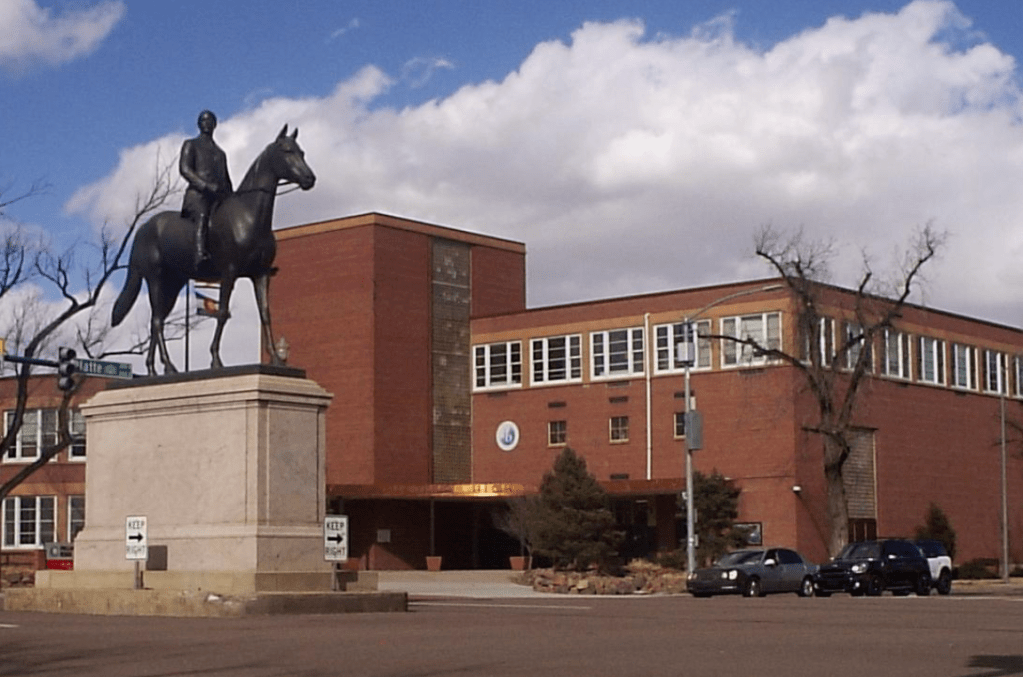
No. 48: Colorado Springs High School, now Palmer High School
301 North Nevada Avenue
Built 1939-1940
Architect Edward Bunts
Website
The Colorado Springs High School, now known as Palmer High School, replaced an unsound 1892 school building on the same site. It was financed in part by a Public Works Administration (PWA) grant. The building’s construction provided needed jobs and is representative of Depression-era public works spending.
The building opened in September of 1940 as the city’s only high school. After a second high school was completed in 1959, this building’s name was changed to Palmer High School in honor of the city’s founder, General William Jackson Palmer.
The school is a good example of the Modern style. When built, the magazine Architectural Forum praised the building for its lack of ornamentation. Burnham Hoyt, of Denver, served as consulting architect. He played a significant, perhaps predominant, role in the design.
There have been several additions. In 1954, four classrooms were added east of the Nevada Avenue wing. A detached Vocational and Industrial Arts Building was built in the northeast corner of the block in 1955. A new library wing was opened in 1999-2000.
Palmer High School is National Register eligible.
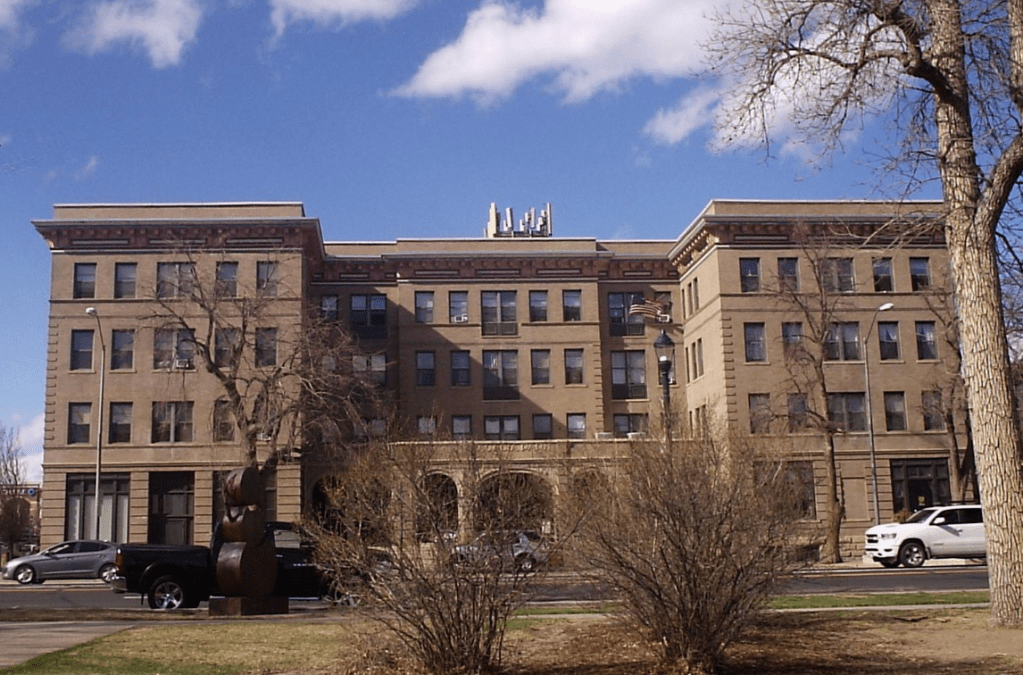
No. 49: Acacia Park Hotel
104 East Platte Avenue
Built 1907
Architect Thomas MacLaren | Contractor J. W. Atkinson & R. P. Davie
CS Daily Photo Article | Antique Balcony Sale | NYPL Photo | History Colorado | Website
The Acacia Park Hotel was built to cater to tourists and business travelers visiting the Pike Peak region. When a fourth story was added in 1910, the 150-room building was called “one of few stylish hotels” in Colorado Springs.
The upscale Acacia, with its roughly H-shaped design on the upper stories, boasted “all outside rooms,” as well as electric lights, steam heat, telephones, music in the evenings, a café, ballroom, beautiful furnishings, and sample rooms for traveling salesmen.
The building is an example of the Renaissance Revival architectural style. The hotel was acquired by the Colorado Springs Housing Authority in 1973 and converted into a senior center and apartments. In 1989 a $1.6 million renovation of the building was undertaken, resulting in a total of 61 living units for senior citizens.
This building is National Register eligible.
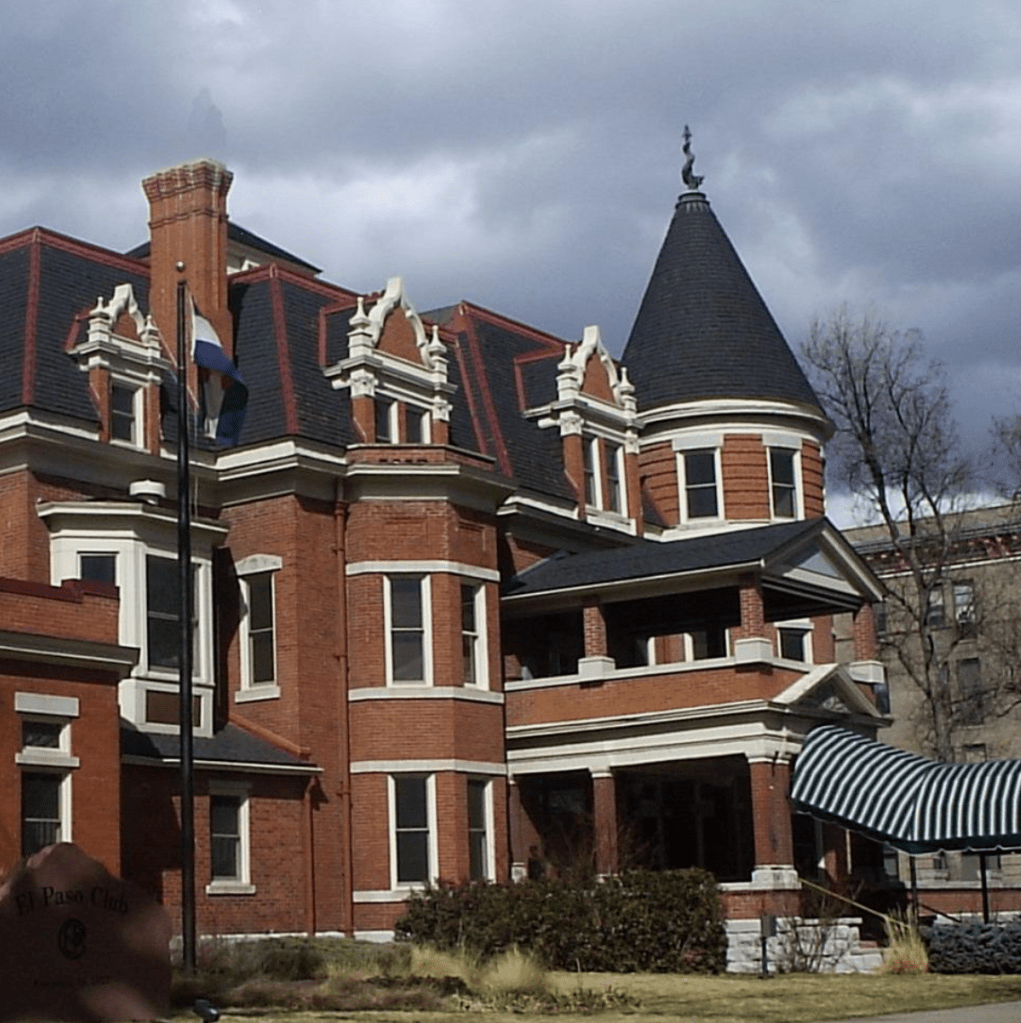
No. 50: El Paso Club
30 East Platte Avenue
Built 1883 | Rehabilitated 1890-1891
Architect James E. Ellis, Jr. | Contractor S. E. Sessions
Rehabbed by Barber and Hastings
Website | IAC | VisitCOS | CBS | Gazette | CSBJ | Video Tour | Matchbook Auction
This house was originally built for Colorado College professor James H. Kerr. In 1890, the El Paso Club purchased the house and began remodeling it for its clubhouse. By January of 1891, the new clubhouse was ready for members, and a large ball the following month celebrated its opening.
The El Paso Club, purportedly the oldest men’s social club west of Chicago, was organized in Colorado Springs in 1877 and incorporated in 1880. The club quickly attracted a powerful group of prominent business and professional men. Ranchers from the surrounding area also were members. The club achieved a national reputation by 1890.
A bowling alley was added in 1900. Thomas MacLaren, another prominent local architect, designed the last major addition in 1910, which replaced the bowling alley with a dining room.
The building is notable for its Queen Anne-style features. The dragon design of the final topping of the round tower was produced by the local Hassell Ironworks.
This building is National Register eligible.
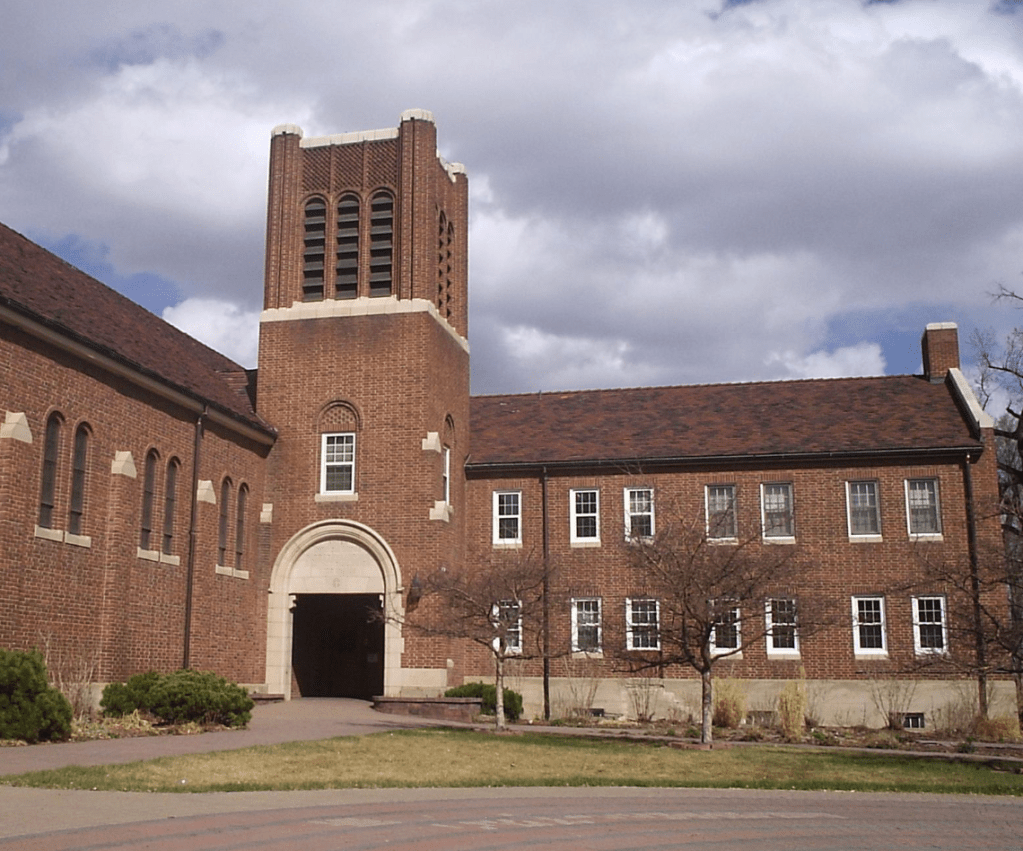
No. 51: First Christian Church
16 East Platte Avenue
Built 1935
Architect A. F. Wickes | Supervising Architect Edward Bunts
Website | Gazette
This building has served the congregation of the First Christian Church since its construction in 1935. This Colorado Springs church, founded in 1878, met in various homes and other churches until it built its first structure in 1891 on North Nevada Avenue across from Acacia Park. The growing congregation purchased this site in 1926 and erected this church after the earlier building was damaged by fire.
The building was one of the largest construction projects of the Great Depression era. Despite undertaking the project during the economic downturn, the congregation was able to hold its mortgage-burning ceremony in 1943.
The 1929 Alden Manor Apartments, attached to the north, was designed by architect E. E. Nieman. The church acquired that property in 1953 to serve as an education building.
Appropriate for a town once known as “Little London,” the church displays an English Gothic style.
This church building is State Register eligible.
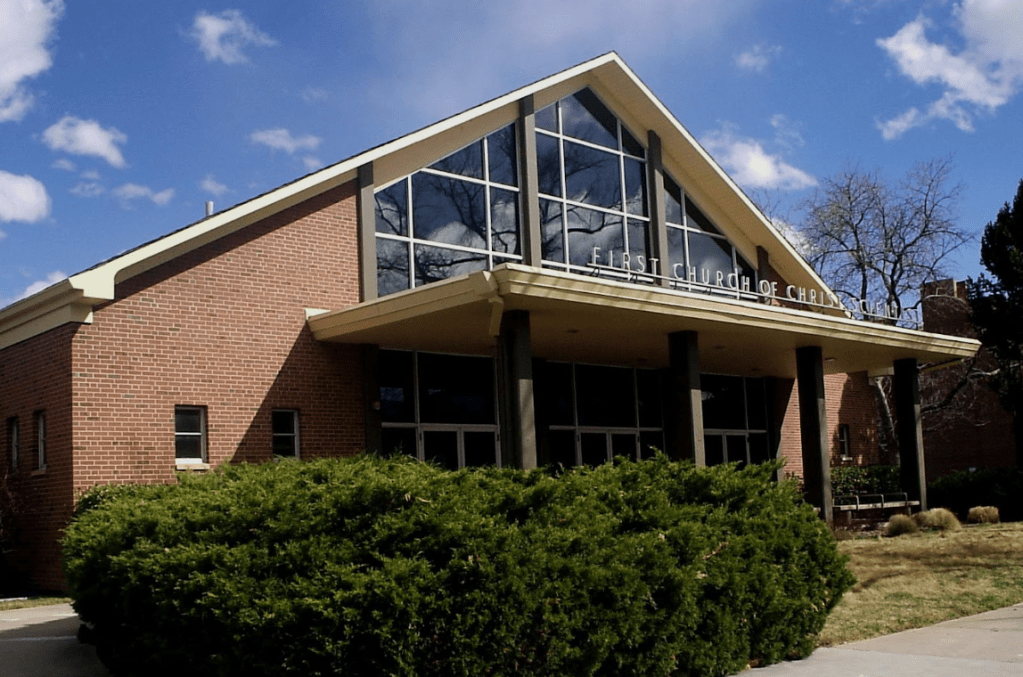
No. 52: First Church of Christ Scientist
325 North Cascade Avenue
Built 1908 | Addition 1959
Architect Solon Spencer Beman | Addition Architect Campbell Alden Scott
Website
This brick church was built in two stages. The first section, facing Boulder Street, was constructed in 1908. A second wing facing Cascade Avenue was added in 1959. Although the Christian Science Church in Colorado Springs began in 1887 and was formally organized in 1892, it was not until 1907-08 that the congregation constructed its own church building.
The 1908 section was designed in the then-popular Classical Revival style. The 1959 addition, with its glass front providing a panorama of Pikes Peak, is in the Modern style. The original building was remodeled at the same time to create a separate Sunday school.
At the time of completion of the new wing, this church was one of more than 3,200 branch churches of the First Church of Christ, Scientist. The mother church is in Boston.
This church building is locally significant.

No. 53: Pearl Laundry
333 North Tejon Street
Built 1914
Architect T. P. Barber | Contractor J. B. Harner
CSBJ
Constructed in 1914, this building was the longtime home of the Pearl Laundry Company, a steam cleaning business. In 1972, the building was converted into retail shops and restaurant spaces and became known as the Agora Mall. It continues to house restaurants, retail shops, and offices.
The building’s original use is reflected in its large footprint and the north wall windows that provide light to the spacious interior. The building is an example of the early 20th-century commercial style.
The building is locally significant.
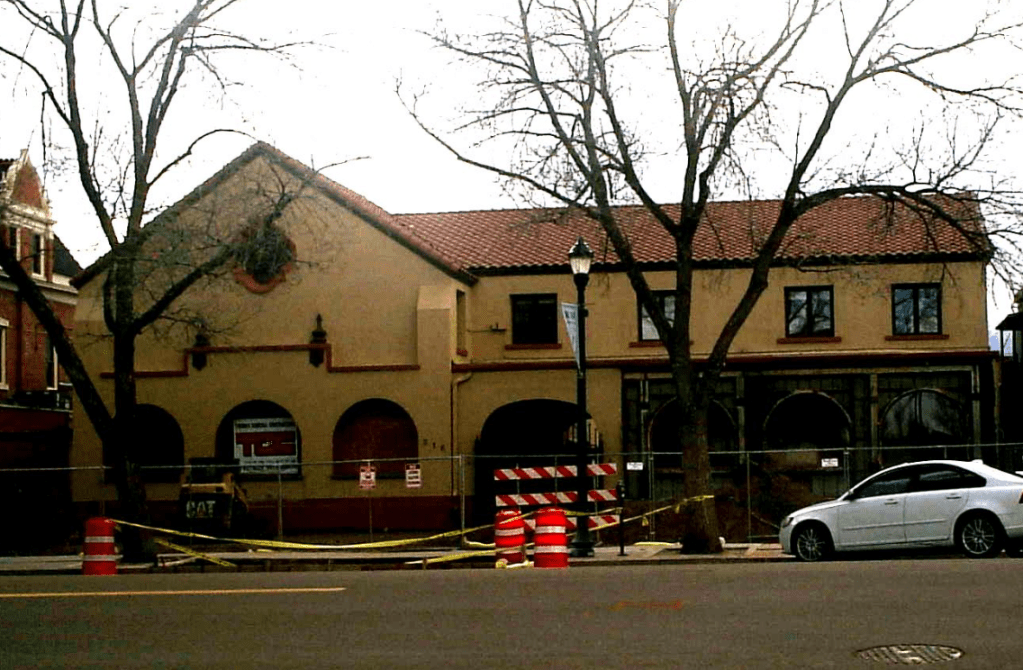
No. 54: Swan Mortuary
316 North Tejon Street
Built 1880
Architect Unknown
1962 Ad
This building was the longtime site of the Swan Mortuary, one of the city’s oldest funeral houses. The structure is designed in the Mediterranean Revival style with a central arched entrance that serves as a pass-through for funeral vehicles.
In 1895, a pair of two-story houses was located on this site. The local newspaper listed the homes as belonging to Edward L. Bennett and W. R. Roby. Edwin Bennett, of Bennett Brothers, changed his profession from groceries to real estate. Roby began as a merchant in hay, grain, and feed. Years later, he was a popular contractor in the region. Fragments of Roby’s home are still visible on the north façade.
When the Swan family converted the property to a mortuary in 1919, one of the houses was incorporated into the funeral building, and a new unifying front was added. The roof of the old house is still visible in the north. In 1932 a new chapel was added to the south.
The Swan Funeral Home remained in this building until its 1970 merger with Law Mortuary and its subsequent relocation to a building on North Cascade Avenue.
This structure is locally significant.
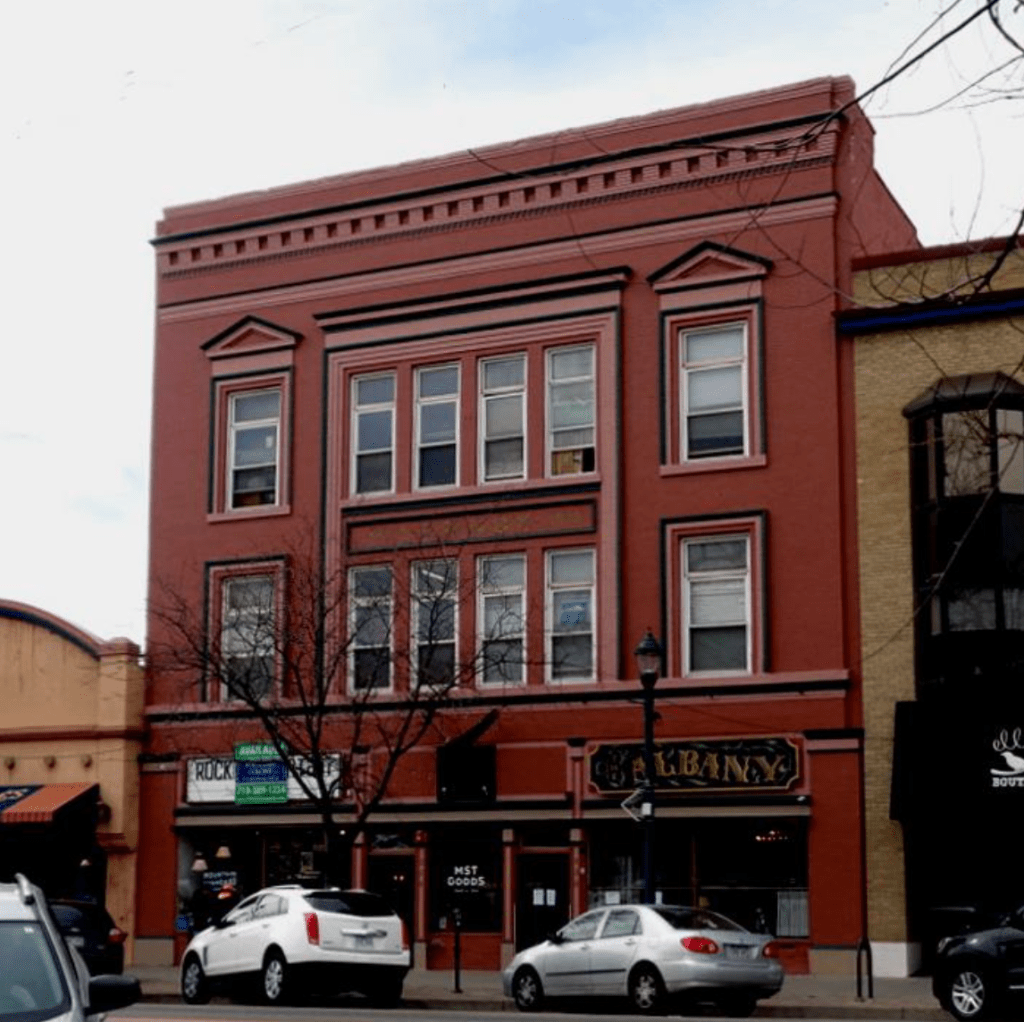
No. 55: The Lennox
226 North Tejon Street
Built 1902
Architect Thomas MacLaren
CO Earth Science | Gazette
This 1902 building is a very good example of a non-public variation of the Classical Revival style. The building is also associated with the commercial growth of downtown Colorado Springs in the first years of the 20th century. It was erected by William Lennox to provide furnished rooms on the upper floors and storefronts on the first story. Lennox was one of the many millionaires created by the Cripple Creek gold mining bonanza.
The lodging aspect of the building was intended to cater to tourists. By 1921 the upper stories of the building were known as the Albany Hotel. The upper floors remain in use as single-room occupancy (SRO) apartment units, and the ground floor houses retail storefronts.
This property is National Register eligible.
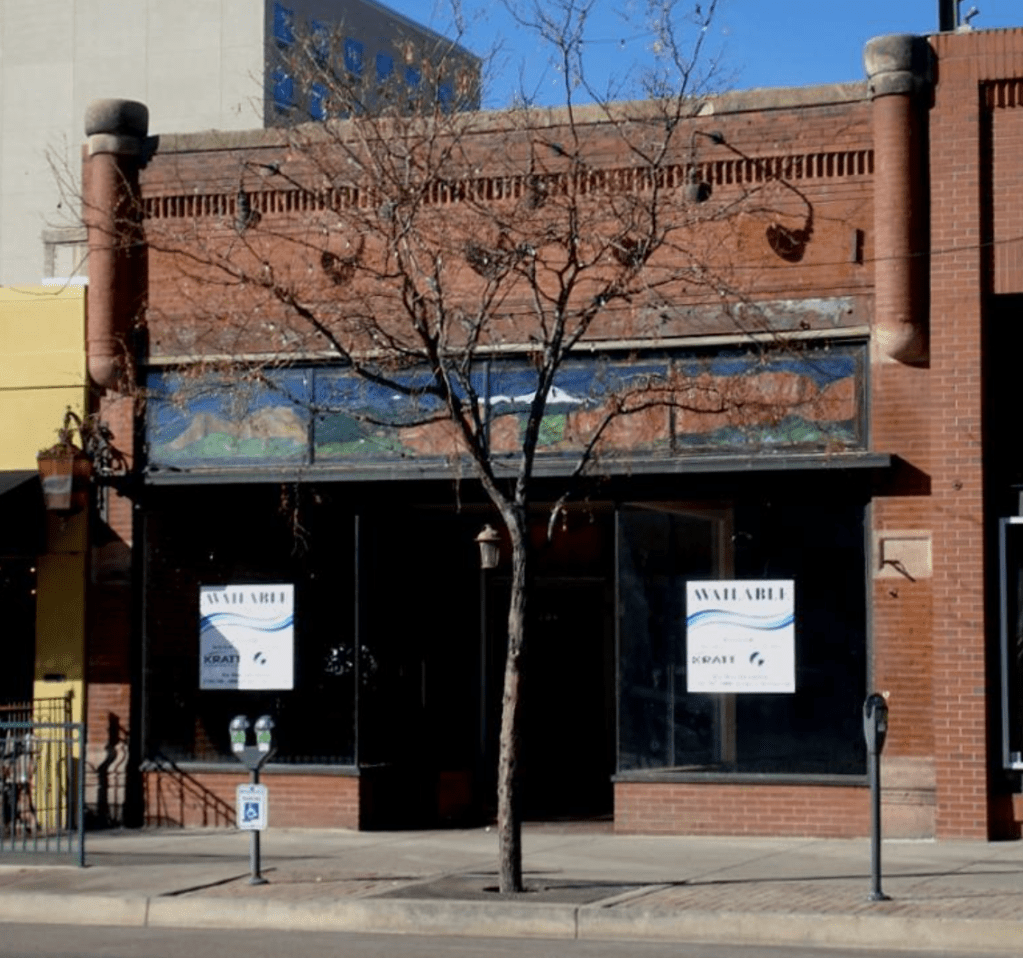
No. 56: St. John Brothers Plumbing
206 North Tejon Street
Built between 1895 and 1899
Architect Unknown | Contractor Lynn Atkinson
CSBJ | 1900 Ad | 1899 Ad | Gazette
The origin of this building is uncertain. The earliest known occupant was St. John Brothers Plumbing in 1899.
Since that time, this small one-story commercial building has been used by a succession of plumbing companies and various retail concerns. It is representative of the many small retail buildings constructed along Tejon Street and retains a number of its historic features.
On the south end of the building, next to the cloth awning, sits an antique lamp that displays the name “Handy’s,” a longtime candy store that once occupied this location.
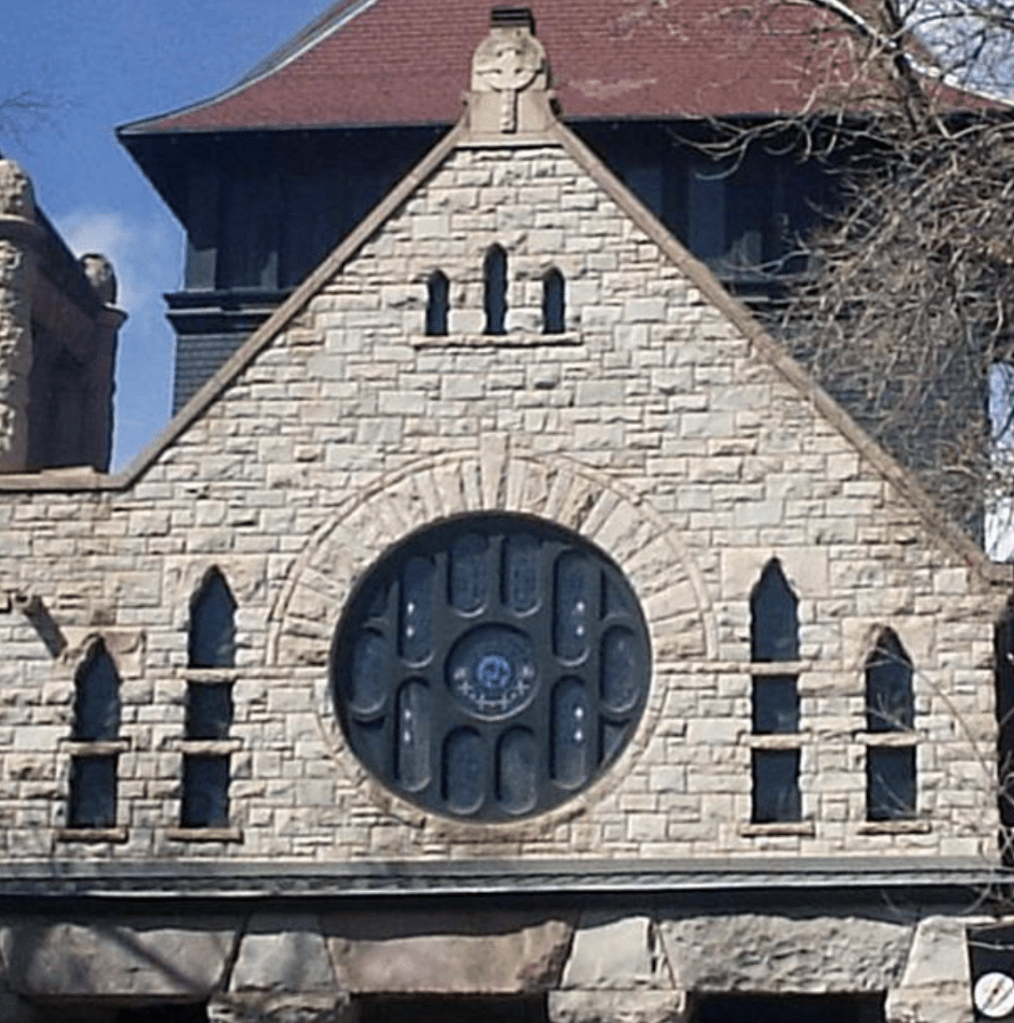
No. 57: Stonework
Monument Valley Park Stonework Repairs | Gazette Article
In Historic Uptown, stone masonry work was used artistically for homes and churches and walls of all sorts. The designs of the day made extensive use of natural materials and sought to reflect the stunning natural environment. The stone masons’ names may be lost to us today, but their legacy of beautiful stone homes, churches, and walls lives on.
The Rocky Mountains provided ample opportunity to collect or quarry stone, and numerous quarries operated locally or nearby. Several were located in the Castle Rock area north of Colorado Springs. It was the source of Rhyolite, which is known to geologists as Wall Mountain Tuff. It was quarried for more than 125 years at the Castle Rock quarries.
Lyons sandstone is a red sandstone that was quarried locally from Red Rock Canyon, which is now a city park. This stone was often used as flat-lying flagstones in sidewalks and as thick slabs for curbs. Locally, it is called Manitou sandstone and is a distinct red-orange stone.
Another sandstone sometimes seen here is peachblow sandstone, which was from a quarry in Eagle County, Colorado, near Basalt. It is thought to be named after an early American glassware of a unique peach color. Besides being used in Colorado Springs, this stone was also used in many historic buildings in Glenwood Springs and Aspen.
There is also a sandstone used locally that is known as Manitou greenstone. It was quarried at the entrance to Ute Pass and has unique greenish patches. This stone was used by the Works Progress Administration (WPA) to line the Monument Creek channel after the 1935 flood.
Walking Tour Credits
Reformatted 2022 from:
NORTH DOWNTOWN HISTORIC RESOURCES
Copyright 2006, City of Colorado Springs
Prepared by R. Laurie Simmons and Thomas H. Simmons, Front Range Research Associates, Denver.
Photography by Janice Prowell and Tim Scanlon.
Historic updating 2022 by Tim Scanlon. Additional photographs 2022 by Robert D. Loevy.


Leave a comment