Russ-Amer Apartments
624 N Cascade Avenue
Built 1939
Architect Charles E. Thomas
Do you have stories, documents, or pictures of the Russ-Amer Apartments?
About
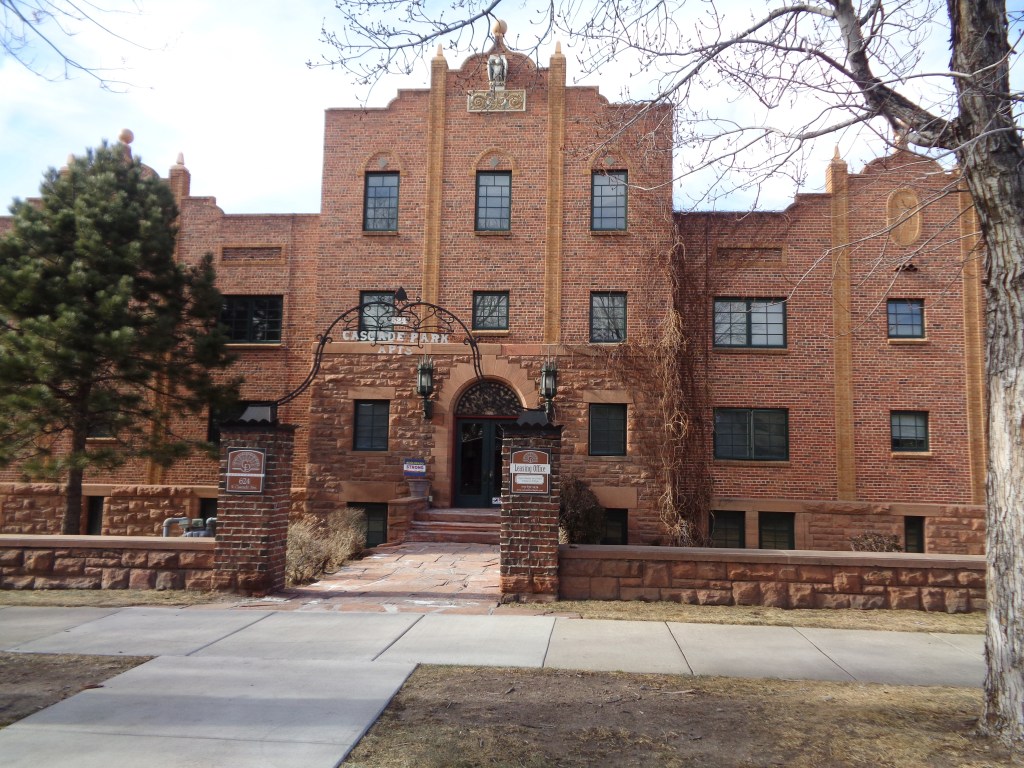
Step back in time to 1939, and you’ll find yourself amid a bustling era of architectural innovation in Colorado Springs. Enter the scene: a grand apartment building, a symbol of the flourishing multi-family housing trend of the 1930s. This building isn’t just bricks and mortar; it carries the mark of Benjamin Lefkowsky, a Russian émigré who made his mark on Colorado Springs from the 1920s to the 1940s, not just as a resident, but as a force in the construction and operation of apartment buildings and single-family homes. The intriguing mix of Russian and American motifs adorning this structure was a vision brought to life by Lefkowsky and realized by the skilled hands of architect Charles Thomas.
But let’s not just admire its historical significance. Picture a rectangular, two- and three-story masterpiece in variegated reddish brick, standing proudly on a raised stone foundation. As your eyes traverse the facade, you’ll notice casement windows with flat arches and brick sills, giving a sense of timeless elegance.
As you approach the entrance, a round arch beckons, framed by sawn sandstone and adorned with double wood glazed doors flanked by majestic lanterns. The ogee-shaped parapet above the entrance is crowned with a ball ornament, flanked by orange brick piers that reach for the sky, topped with short obelisk ornaments.
Now, let’s dive into the details. The third story boasts tall casement windows with orange brick blind arches, while the second story features shorter casement windows. The lower part of the center section is adorned in rock-face red sandstone, adding a touch of intricate design.
Venturing to the north and south sections, you’ll notice ogee-shaped parapets mirroring each other, adorned with ball and obelisk decorations. Oval orange brick panels with clay tiles and casement windows add a touch of flair. Wider casement windows on each story flank the center section, showcasing an inset rectangular area near the roofline.
Moving around to the north wall, a projecting flat roof open porch steals the show, adorned with rock-face red sandstone piers and sidewalls. The rear (west wall) unveils a U-shaped structure, with a hipped roof component and clerestory windows facing west. The south wall echoes the ogee parapet, hosting a projecting fabric canopy with a curved roof.
Not just a standalone structure, the building is accompanied by garages to the west, including a rectangular garage with wood overhead doors, brick walls, and decorative brick piers. Picture a low stone retaining wall with brick piers at the entrance, each capped with decorative metal, inviting you into this architectural marvel.
The tale of this building unfolds over the years. The foundation was laid in 1931, but the Great Depression interrupted construction until 1938-39. Fast forward to 1962, and the building maintains its footprint, standing as a testament to the resilience of architectural vision.
Timeline
1927
On February 6, 1927, the Telegraph Gazette published an article regarding Lefkowsky starting the Russ-Amer Apartments project that reads:
Apartment Hotel for Cascade Ave.
Lefkowsky Spends $120,000 on Improvement; Work to Start in Spring
Promising Colorado Springs one of the most modern apartment hotels in the entire west, Benjamin Lefkowsky will leave tomorrow morning on an inspection trip thru the eastern centers where he will gather ideas for the venture which will comprise a large addition to his present property, the fine old Hagerman home at 610 North Cascade avenue. Mr. Lefkowsky, who has completed his architects drawings of the proposed hotel, is planning an apartment building of 32 apartments and the additional construction will entail an investment of at least $120,000.
Stops on his eastern trip will be made by Mr. Lefkowsky at Kansas City, St. Louis, Chicago and other large cities on route to New York city. He will be away for the next six weeks and expects to return to Colorado Springs with the latest ideas in apartment building, paying particular attention to the unique in features to incorporate in his building. The same beautiful type of architecture in the old Hagerman home will be maintained in the addition with exquisite interior finish with the exterior of the same stone as the present structure.
On the first floor of the building, Mr. Lefkowsky plans modern hotel facilities with several dining rooms. A famous Hungarian chef will be employed and musicians and waiters will be Russians. The entire atmosphere of the place will be designed to provide privacy when desired and at the same time have metropolitan activities near at hand.
Building operations are expected to begin soon after the return of Mr. Lefkowsky from the east and the construction work is expected to be completed within five months. The builder has lived in Colorado Springs the past five years and in that time developed Zuyder Zee and Park View Terrace additions carved out of the original Hagerman estate on which he has built nine modern residences as well as selling off several other lots on which homes have been built by private individuals. The Park View apartments in the rear of the Lefkowsky home now contain seven apartments.
1931
In 1931, a $10,000 building permit was issued to Benjamin Lefkowsky for the red sandstone foundation of this apartment building.
On February 11, 1931, the Telegraph Gazette wrote an article about the building permit being acquired that reads:
Lefkowsky to Get Permit for His New Apartment
Work will be started shortly on razing the old Lowe property in the 600 block on North Cascade avenue to make way for the $150,000 apartment project of Benjamin Lefkowsky, following passage by the city council yesterday of an ordinance placing the block in the apartment house zone.
Charles E. Thomas, architect for Lefkowsky, was instructed to secure a permit to raze the old Lowe property and begin excavation on the basement of the new building.
Mr. Thomas submitted to the council architect’s plans of the new building, which will be of brick construction, four stories high. A fifth story includes provision for a studio suite for the owner, which could be converted into an apartment.
Plans call for 48 apartments, with 10 on each floor and eight in the basement. A recreation hall, dining room and kitchens would also be included in the basement. Apartments will be one, two and three-room sizes, with kitchenettes and baths.
On February 13, 1931 the Gazette & Telegraph published an article about the apartment project that reads:
Lefkowsky Apartment Hotel Project is the Largest So Far Announced in 1931 for C.S.
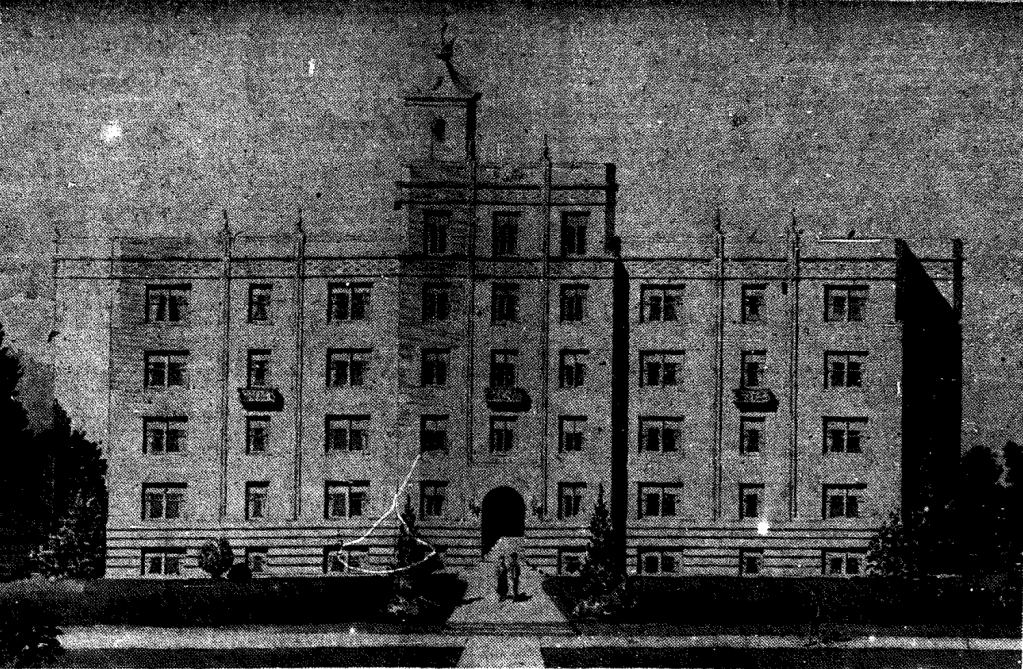
Architects drawing by C.E. Thomas of the new $150,000 apartments to be built in the 600 block on North Cascade avenue by Benjamin Lefkowsky. The building will be the largest project announced for Colorado Springs this year.
Benjamin Lefkowsky, who has been issued a permit for the construction of a $150,000 hotel apartment building just north of Russ-Amer apartment building on North Cascade avenue of which he is the proprietor, said yesterday that construction work would be begun as soon as the ground is cleared. To make room for the new building the old stone Lowe residence is being razed, the Hagen Fuel company doing the work. It is Mr. Lefkowsky’s expectation that the new apartment building will be completed and ready for occupancy late in the summer or early next fall. It will be of tapestry brick, with stone trim, and will be four stories and a half high. It is to be fireproof and stoneproof thruout and there will be apartments of from one to six rooms. There will also be a dining room of 125 seat seating capacity in which dinners will be served for residents of the building and of the Russ-Amer apartments. There will be 150 rooms in all in the building, which will be 90 by 120 feet in dimensions. It is to be surmounted by the Russian crown underneath the American eagle. Plans have been prepared by Charles E. Thomas, a well known Colorado Springs architect. Mr. Lefkowsky, who is an artist and photographer is also to have a studio in the building. Mr. and Mrs. Lefkowsky, since they acquired the old Hagerman property eight years ago, have expended $175,000 in improvements on the building, which with additions on each side, they made into the Russ-Amer apartments and on other buildings they have constructed near by. Mr. Lefkowsky came to this country from Russia. Mr. and Mrs. Lefkowsky formally lived in Texas.
On July 12, 1931, the Gazette Telegraph published an article about Lefkowsky’s new ideas for the apartments that reads:
Lefkowsky to Incorporate Many New Ideas in 56-Unit Structure
Benjamin Lefkowsky, who is erecting the city’s largest apartment house building at 630 North Cascade avenue, has asked for sub-ds on plumbing and heating, painting, brick work, electricle equipment, etc., with the idea of pushing progress on the structure finish it by January 1. Mr. Lefkowsky will go east this week to inspect new apartment house structures for the latest ideas in finishing and equipment and when he returns in two weeks the contractors will be ready to start immediately and rush the job thru at the rate of one floor every 10 days. The easement and foundation work were done at Mr. Lefkowsky’s direction, has been practically completed.
The new apartment building will contain 56 apartments, ranging from one room to size rooms. It will be five stories high, built of tapestry brick and stone and will be modern in every particular with the newest in electrical devices for comfort and convenient. Charles E. Thomas is the architect.
Of considerable interest will be the collective control passenger elevator for which contracts have been leet to the Otis Elevator company. This will be the first of its kind in Colorado Springs and one of the first in the state. The operation of the elevator is automatic by the passengers, stopping at all floors signalled and does not have to make round trips. If after having been signalled the hatch door at the required floor is not opened within a certain time the car goes on and responds to other calls, all automatically done.
Mr. Lefkowsky declared that he had more than 100 inquiries already relative to leases on the apartments.
1933
On May 3, 1933, the Gazette Telegraph published an article about work on the apartments restarting which reads:
Lefkowsky to Resume Work On Apartment
Julius Lynch Piland of New York city has arrived to be associated with Benjamin Lefkowsky, and within a short time will resume building operations on the new apartment project adjoining the Russ-Amer, in the 600 block on North Cascade, Mr. Piland and Mr. Lefkowsky intend to take up other developments later.
Mr. Piland is a graduate of the United States Military academy, and also was graduated from the Massachusetts Institute of Technology. For a number of years he has been head of the J.L. Piland company of engineers, New York city. He is an associate member of the American Society of Civil Engineers and captain of the Engineers Reserve corps, United States army. Among his former connections was that of general manager of the construction for Proctor’s theater circuit, New York.
Mr. Piland who is a brother of Mrs. Lefkowsky, has been a close friend of Benjamin Lefkowsky since childhood and it has been the dream of the two men to some day become associated in business.
Mr. Piland is optimistic over business recovery thruout the country, saying that there is noticeable improvement already in the east.
1938
The economic downturn of the Great Depression disrupted construction, and it was not until 1938 that Lefkowsky received a $46,500 permit for the completion of the building.
A native of Russia, Mr. Lefkowsky served as an officer in the Hussars of the Russian army. He left the country in January 1917 (before the Bolshevik Revolution) and came to Colorado Springs in 1922. His wife was a concert pianist. Lefkowsky purchased the James J. Hagerman mansion immediately south of this building (610 N. Cascade) in 1922, with plans to make it into an international art studio. This plan did not transpire and Lefkowsky converted the house into “exquisitely ornate apartments and added two new wings to the old structure.” He called the resulting building the Russ-Amer Apartments, reflecting his Russian birth and his later naturalization as an American citizen. According to the previous survey form for 624 N. Cascade, Lefkowsky “built a variety of housing in the area. These buildings are distinguished by eclectic architecture and the use of somewhat exotic European forms and motifs. Heavily landscaped yards set off with stone fences and other decorative elements combine with the distinct buildings to give the area a picturesque quality.”
The architect for this building was Charles E. Thomas. Mr. Lefkowsky served as general contractor and F.J. Schmidt of Denver acted as carpenter contractor and construction superintendent. Lefkowsky pledged to use local labor for all crafts employed on the project.
1939
The Russ-Amer Arms opened in April 1939 and had thirty apartments, “furnished and unfurnished, ranging in size from two to six rooms with bath and kitchenette,” with all of the units having outside exposure. Construction details included large steel sash windows with terra cotta sills, “Rezo doors in natural gum finish,” hardwood floors, tile showers, and bath, incinerator service doors on each floor, and wrought iron lighting fixtures, stair railings, and arches in unusual designs reflecting the building’s Russian-American motif. The recreation room on the ground floor was planned to be “very typical of a village inn of Russia.” The building had a heating plant with an automatic stoker which also supplied heat to the Russ-Amer Apartments to the south.
1956
On November 25, 1956, the Gazette Telegraph published an article detailing the antique collection in the apartments which reads:
Lefkowskys Design Regal Setting For Art and Antique Collection
One of the largest and most comprehensive collections of antiques and art treasures in the Pikes Peak Region is that belonging to Mr. and Mrs. Benjamin Lefkowsky of 624 N. Cascade Ave.
The beautiful life size paintings in the hallway, and the unique iron grating in the passage to the front door of the Lefkowskys’ apartment only partially prepares the visitor for the breathtaking surprise which greets him when the door is opened and he finds himself in a room which resembles the spacious drawing room of an old world palace. The newly decorated room is 45 by 48 feet in dimensions.
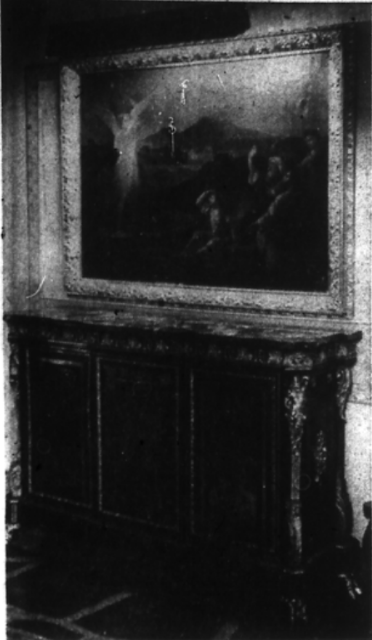
The beautiful painting, “Star of Bethlehem,” is a Thomas A. Read original, painted about 1871. It hangs over a Boulle Credenza from the palace of the Prince of Talleyrand. Boulle creations are all ornamented with intricate overlay of tortoise shell, ebony, copper and brass, as seen on this cabinet.
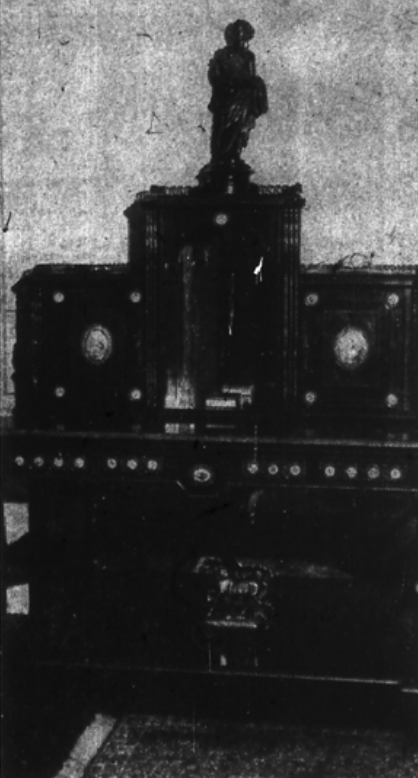
The Louis XVI writing desk from the A. Petrone collection, Paris, France, is of ebony wood tuja wood and palissandre wood, decorated with Se’vres porcelain plaques and gilt bronzes.
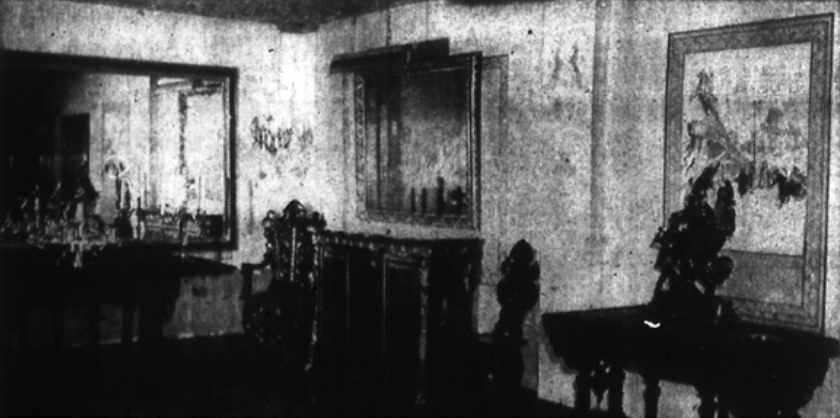
This is the dining area of the Lefkowsky apartment. The long refectory table at left is identical with the one at right, which is folded. They are 17th century dining tables form the Ambrose Monell collection. At center is a handsome Boulle Credenza with rare African marble top, from the palace of the Prince of Talleyrand, France. The unusual lazy Susan on the table is Sheffield.
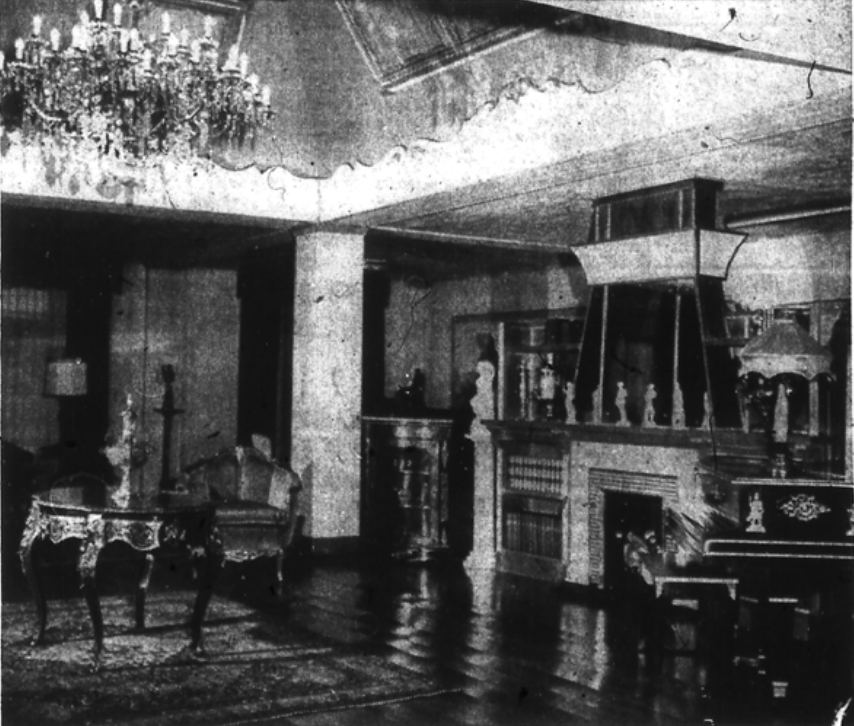
On either side of the fireplace is a Russian samovar, from Lefkowsky’s home in Russia. One is of silver and the other of brass. On the piano is a Chinese jade lamp which is more than 175 years old. At the left of the fireplace is a Boulle corner cabinet of the same period as the table at the left. Both are from the collection of Countess Rucellai of Florance, Italy. The rug is an antique Kermanshah; and on the table is a Russian silver flower vase made in the Royal art-silver shop of Alexander I, (1800-1825). The imperial coat of arms on the vase is inlaid with enamel. The large center chandelier and four sconces in the room-epoch 1765 – are Baccarat crystals and bronze. The group hung in the large salon of the palace of Trabia, in Palermo.
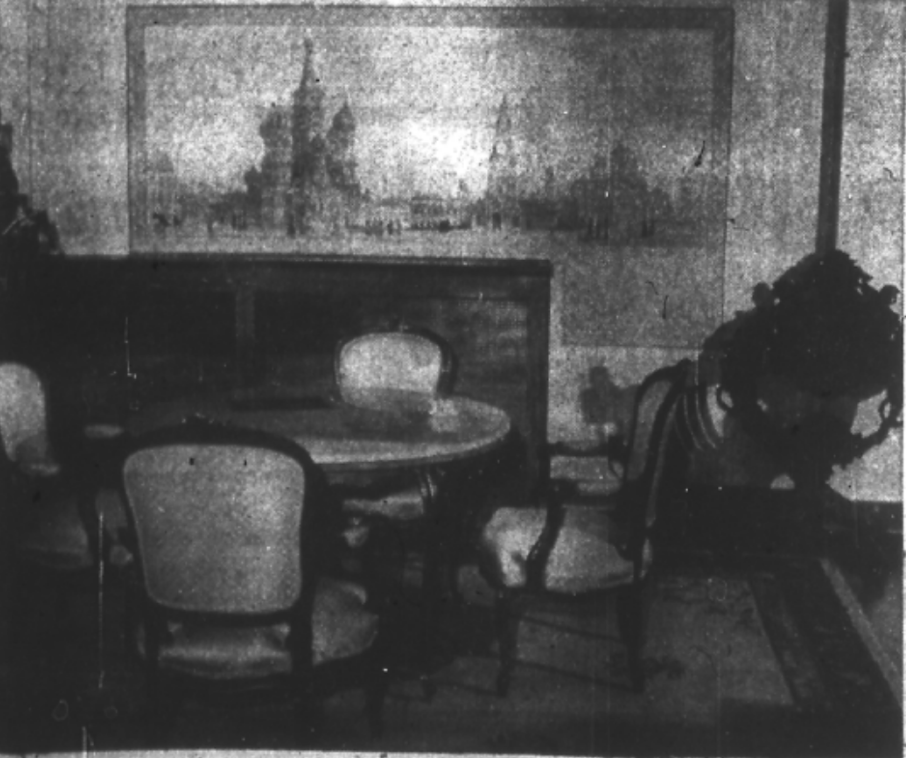
One corner of the salon could be called a game room, having an inlaid marble card table by F. Martelli of Florence, Italy. The four chairs are Louis XV and the Italian antique chair at right is identical with the original which is in the Vatican. The mural is a sketch of the old Kremlin and St. Basil’s Cathedral, by Mr. Lefkowsky.
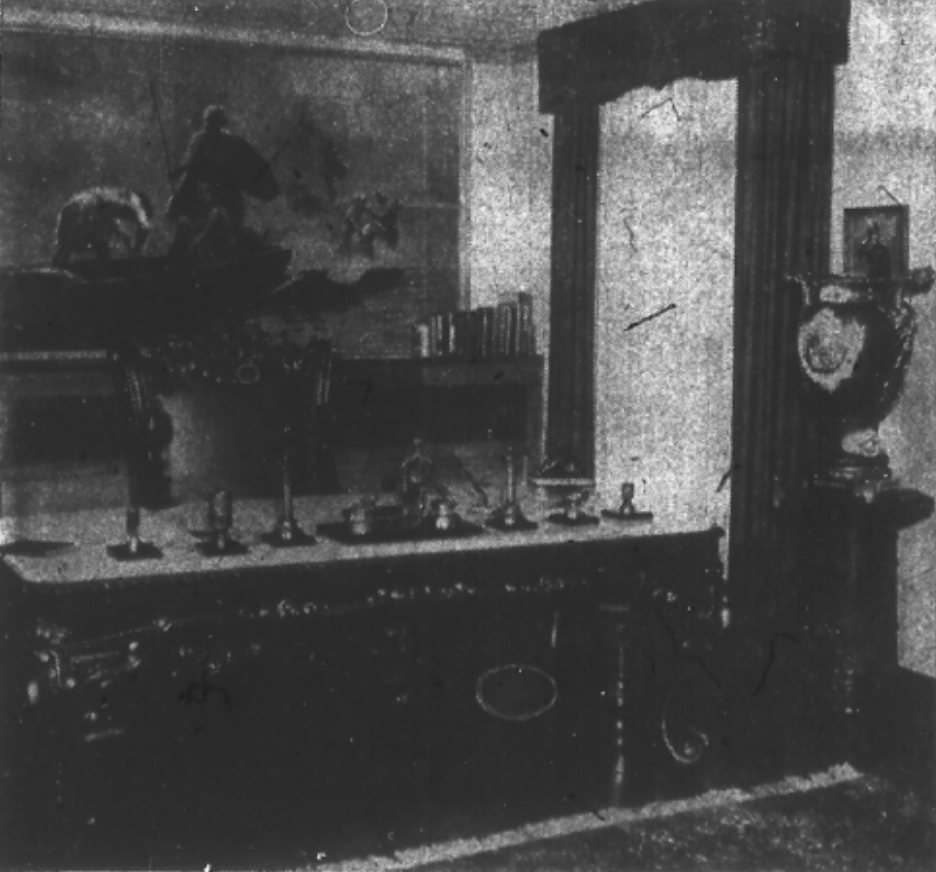
In the “study” portion of the room is this huge rosewood desk trimmed with gold leaf, as is the mahogany chair. The bronze desk set is from Mr. Lefkowsky’s home in Russia. The painting, “Gauls Feeling from Caesar,” is by E. Haussler; and the large vase on the pedestal is one of a pair of Se’vres porcelain, decorated with medallions, with massive bronze base and handles. Made in Se’vres, France in 1810, the vases are from the collection of Monsieur A. Petrone, Paris.
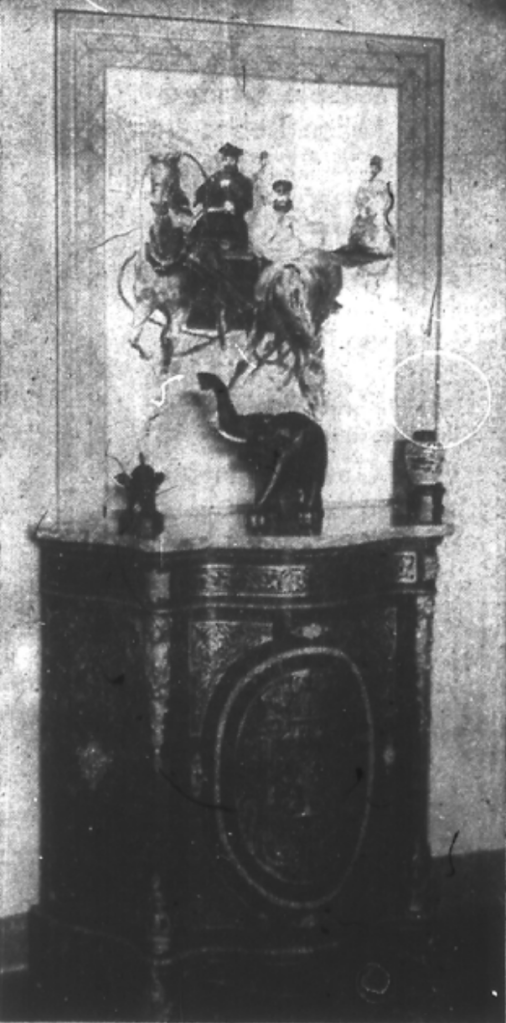
The cabinet is a small French Boulle Credenza, (1810-1820), from the palace of Piedmont of Moncogheri. The picture above the cabinet is a sketch of Czar Nicholas II of Russia, by Mr. Lefkowsky.
Mr. Lefkowsky, who has long collected famous paintings and antiques, is also an artist. He has acquired this large collection during various trips abroad to Western Europe and the Middle East-completing the present collection with Mrs. Lefkowsky when they were in Europe in 1954. Many of the acquisitions are still en route, and some, purchased from European nobility in their royal settings, are being restored.
The predominant style of the salon is of the period of Louis Quince, (XV), with antiques of the periods of Louis Quatorize, (XIV) and Louis Seize, (XVI) which smooth the asymmetrical lines of the Louis XV pieces.
Persian rugs cover most of the floor and the walls are entirely covered with paintings and murals artistically arranged to avoid the appearance of crowding. The center of the floor is of highly polished oak plank, put together with wooden pegs, and provides an ideal dance area.
Mr. Lefkowsky has been a resident of Colorado Springs most of his adult life, coming here in 1922. A native of Russia, he served as an officer-the equivalent of a lieutenant in our own army-with the Hussars, at the age of 18, under Czar Nicholas II. As all boys of that time were required to do, he attended military school at an early age, and still has his colorful Hussar uniform with blue coat, red trousers and gold braid. He left Russia in January of 1917, shortly before the Bolshevik resolution, which came late that same year. Many of his relatives lost their lives in the bloody conflict. Mrs. Lefkowsky is of Austrian descent.
1960
The Lefkowskys lived in this building and they continued to operate the apartment building until September 1960, when it and the Russ-Amer Apartments were sold to Norman Smith, the former owner of the Norm Smith Angus Ranch in Larkspur, Colorado, for an amount over half a million dollars. The building is now known as the Cascade Park Apartments. The Gazette published an article on September 18, 1969 that read:
Russ-Amer Property Sold to Norm Smith for $500,000
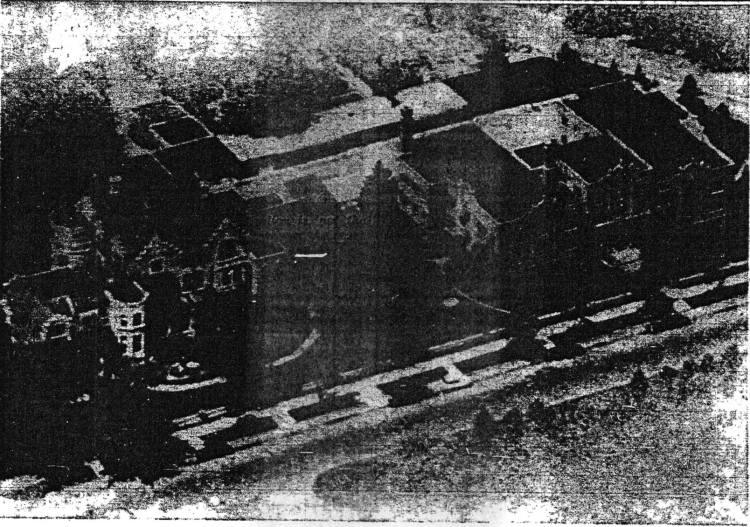
SOLD BY LEFKOWSKYS – Seen in this photo, taken from the air, Russ-Amer Apartments, left, and Russ-Amer Arms, sold by Mr. and Mrs. Benjamin Lefkowsky to Norman Smith, former owner of the Norm Smith Angus Ranch at Larkspur. Russ-Amer Apartments is the one-time home of James J. Hagerman railroad builder and mining man, and was bought in 1922 by Lefkowsky.
A beautifully maintained objet d’art familiar to Colorado Springs residents has been sold for an amount in excess of $500,000.
Mr. and Mrs. Benjamin Lefkowsky have sold the Russ-Amer Arms and Apartments to Norman Smith, former owner of Norm Smith Angus Ranch in Larkspur. The price does not include, however, the furniture and furnishings, which Smith has purchased in a separate transaction. Nor is the Lefkowsky’s private collection of antiques included in either transaction.
The entire Russ-Amer establishment includes 60 apartment units.
The property and buildings are located in the entire 600 block of North Cascade Avenue on the west side of the street. The older original structure known as Russ-Amer Apartments was built as a home by James J. Hagerman in 1885.
Hagerman came to Colorado in October 1884, after making a fortune in Michigan iron. He and his associates built the Colorado Midland Railroad, which operated from Colorado Springs into western Colorado from 1888 to 1918. He also became active in gold mining in the Cripple Creek and Aspen districts.
The structure, which is one of the leading show places in Colorado Springs, was purchased by Benjamin Lefkowsky in 1922 for the purpose of creating an international art studio. When his plans did not materialize Lefkowsky converted the home into exquisitely ornate apartments and added two new wings to the old structure.
Also at that time, the carriage house was converted into apartments. The carriage house has since been sold and is now known as Park Terrace Apartments.
The original wood work and cabinetry which was created for Hagerman by Winfield Scott Stratton is still maintained at Russ-Amer. The old structure, an antique in its own right, boasts 18 original fireplaces, wrought iron chandeliers, parquet inlaid floor and numerous other furnishings designed especially for Hagerman in 1885.
A most outstanding feature of the older building is the stained glass window on the second floor landing.
The exterior of the building is of Larimar stone and sand stone.
Lefkowsky was born in Russia and since coming to the United States in 1929 has become a naturalized American citizen, thus the name, “Russ-Amer.”
“Mr. Smith plans to carry on the outstanding reputation Russ-Amer has developed over the years,” said Mrs. Lefkowsky.
In 1939, Lefkowsky designed and built the newer building north of the old Hagerman residence, Russ-Amer Arms. The decor of the second building is in accordance with the old English style of its predecessor next door.
Fred Tarbell of Van Schaack Co. Denver handled the Smith-Lefkowsky transaction. Smith bought the “internationally known” Norm Smith Angus Ranch in 1934.
The former owners of Russ-Amer plan to spend a year in Europe before returning to Colorado Springs, according to Mrs. Lefkowsky.
Additional Resources
- 624 N Cascade Ave Research – a collection of documents compiled during the Historic Uptown Neighborhood’s historic preservation efforts.
- Cascade Park Apartments
- Hagerman Mansion – mansion also owned by the Lefkowskys

Leave a comment