Robson Arena
The Historic Uptown Board represented the interests of the Historic Uptown Neighborhood during the planning of the Robson Arena. Read below for a summary of the Board’s efforts.
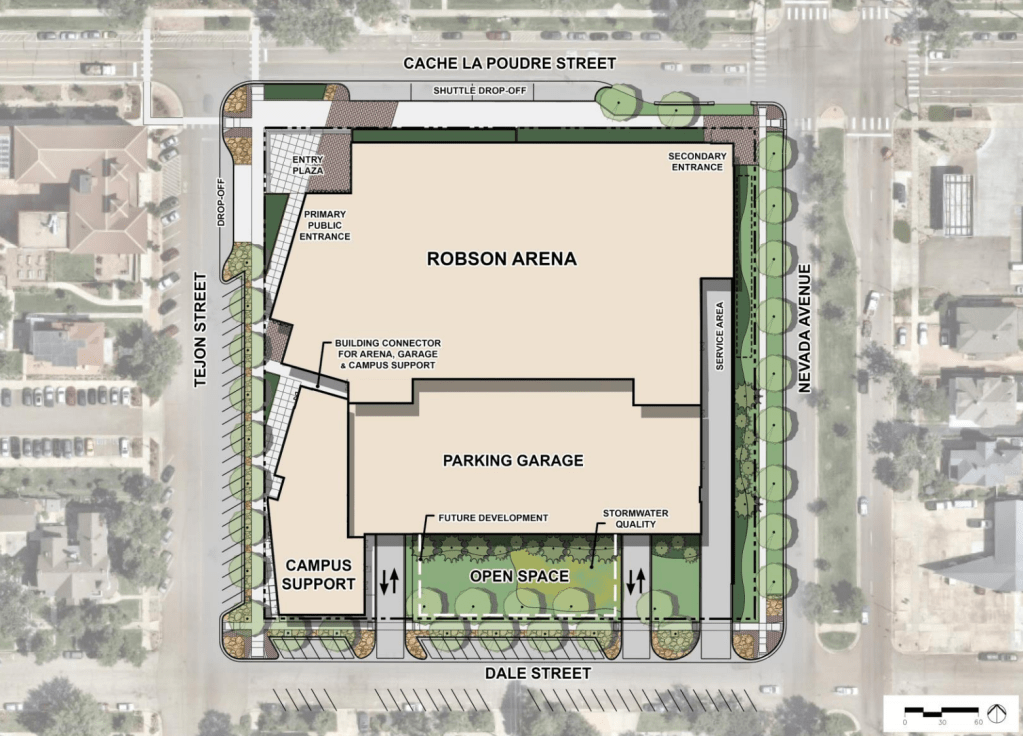
Robson Arena
Colorado College with the help of the City of Colorado Springs secured $9M Regional Tourism Act (RTA) funding to build a $40M 3,407-seat arena and events center in our historic neighborhood on the block between Tejon and Nevada, Cache La Poudre and Dale. The arena was originally proposed in the college’s 2008 Long Range Development Plan as an 800-seat practice arena. The arena is now proposed to be more than 4x larger due to the $9M RTA funding and $10M donation from Mr Robson. Links to Robson Arena-related documents:
- Final Public CC Robson Arena meeting documents
- CC Robson Arena Final Public Presentation
- Colorado Springs C4C Presentation to the Economic Development Council for RTA funding
- The Robson Arena is in Form Based Code zone
Historic Uptown Neighborhood Concerns
With the Robson Arena size, several Colorado College and City for Champions events, and related infrastructure, the Historic Uptown Neighborhood board is concerned about the impact that will be detrimental to the surrounding historic neighborhood.
The arena size, number of Colorado College (CC) and City for Champion (C4C) events, and related infrastructure demands, including parking, are detrimental to the surrounding neighborhoods (Historic Uptown, Mid-Shooks Run, and the Old North End). To protect the interests of our neighborhood and directly represent the neighbors, businesses, and citizens that are directly impacted by Colorado College’s proposed arena, we are retaining a law firm that specializes in land use and zoning law.
Donations are needed to help support this important work. Your contribution to our Neighbors for Responsible Growth fundraiser will support our efforts to ensure that future growth in our community is responsible growth that meets the needs of all parties.
Impacts on the Historical Integrity of the Neighborhood
- The proposed arena will impact the historical nature of the neighborhood – 7 buildings are on the National Register of Historic Places in the Historic Uptown Neighborhood, and 3 are across the street from the arena. Historic homes have already been demolished on the block where the proposed arena will be built.
- The proposed arena will be out of scale with surrounding historic structures and the college.
- Approval of Regional Tourism Act (RTA) funding is based on a promise to bring 118,500 net new out-of-state visitors each year for Colorado College. The business plan for the funding proposes 289 event days per year, which will degrade the livability of the neighborhood (165 – Robson Arena; 84 other Colorado College Venues; 40 both arena/stadium = 289 Total Event Days). The RTA taxpayer funding for the arena is $9M which is roughly 25% of the total arena cost with Mr. Robson donating $10M.
Impacts on Parking
- Arena parking demand is estimated at 1,114 (calculated ~2.6 people per car for 3,407 seats minus 500 student seats). Colorado College has claimed to have secured this demand through its on-site parking garage, campus lots, privately owned lots, and site frontage lots. They have only secured these spaces for 18-20 Colorado College Hockey Events, not City for Champions Events.
- Surrounding neighborhoods will most likely have to absorb overflow parking demands for the arena, taking away parking needed by residents and businesses, and decreasing neighborhood aesthetics, livability, and value. Some residents do not have driveways and garages.
- There are 7 + theater and sports venues near the arena site with a combined seating of 6,000 owned by Colorado College. Only two have dedicated parking – the Fine Arts Center and Armstrong Hall.
- Colorado College does not enforce its own student and staff parking policies (e.g., multiple, documented neighborhood complaints in Old North End Neighborhood and Historic Uptown Neighborhood)
- Colorado College’s parking permit costs and policies (freshmen cannot have vehicles) encourage staff and students to park in the surrounding neighborhoods today.
- Colorado College plans to infill the Armstrong parking lot, as it has done with several other “unsightly” parking lots on campus, which would further reduce available parking. What ongoing process is going to ensure there is sufficient parking for CC’s needs given this plan?
- Colorado College’s 2015 Master Plan advocates consolidating and/or moving campus parking to perimeter areas to improve campus image. Yet, Colorado College has eliminated many parking slots on campus and not built new parking structures or lots. Colorado College’s future master plan must account for parking for all venues they build and/or acquire in the future.
Environmental and Safety Concerns
- The arena will significantly increase traffic volume and congestion in all surrounding neighborhoods, increasing carbon dioxide emissions and reducing neighborhood air quality.
- Nevada Avenue, which is already unsafe, will become more dangerous and congested due to arena traffic and street narrowing of Cascade Avenue and Weber Street.
- Arena events will generate noise and light pollution before and after events.
- At-risk teens from the Dale House Project may be exposed to a detrimental late-night atmosphere.
- Arena attendees searching for street parking will endanger other vehicles, bicyclists, and pedestrians. An example of dangerous driving due to difficult parking can be read about in the Driver in fatal crash was ‘racing’ for a parking space, police said article by The Colorado Springs Indy.
- Arena attendee vehicles will encroach on crosswalks, intersections, and driveways, creating a safety hazard for vehicles, bicyclists, and pedestrians.
- Arena commercial lighting will disrupt residents’ quality of life.
- Attendees will leave trash in the neighborhoods; possibly rowdy behavior.
- Attendees will walk through alleys and yards, potentially bringing crime to the neighborhoods.
- Arena will encourage crimes of opportunity.
Community Questions & Concerns
- Who is going to pay for all the infrastructure support?
- Who is going to pay for all the wear & tear on the roads?
- Who is going to pay for trash pick-up?
- Who will cover the cost of the police?
- Why not use the World Arena for the occasional large games and use the Robson Arena for average games? This could reduce the size of the arena by half since the maximum number of attendees today is roughly 2,500.
- There is a lack of information regarding the use of the arena. They could cover the ice and add an additional 800 seats.
- Citizens and neighbors appreciate the community outreach but fear, as in previous Colorado College projects, that it will serve as check a box and their concerns will not be considered and addressed. Especially with the City of Colorado Springs since the arena is a City for Champions project supported by the City. We feel this is a conflict of interest for the Planning Department, the Downtown Review Board, and the City Council.
- Citizens and neighbors do not have direct communications with the decision-makers.
Outcomes
The efforts of the Historic Uptown Neighborhood Board to assist with the planning of the Robson Arena have resulted in positive outcomes for our community. The Board’s commitment to ensuring the well-being of our neighborhood has proven to be instrumental.
- Helping Neighbor’s Voices Be Heard
The initial proposal for the Robson Arena had the potential to be detrimental to our neighborhood. Recognizing this, the Board, led by Monica, Dianne, and the President, took a stand and fought against it. Their persistence and dedication ensured that the original proposal, which could have changed the living conditions in the neighborhood, did not come to fruition. - Formation of Historic Neighborhood Partnership (HNP)
Understanding the need for collaborative efforts, the Board played a pivotal role in the formation of the Historic Neighborhood Partnership (HNP). This collaborative platform allowed neighborhoods to work together efficiently. Dianne assumed the role of chairperson, providing strong leadership for the HNP. - Successful Advocacy with the RetoolCOS Project
The Board remained actively involved in community initiatives. The formation of HNP enabled a collective effort to take on the RetoolCOS project, involving the rewriting of the zoning code. By actively engaging in the process, the Board successfully addressed concerns, particularly regarding the automatic rezoning of Office Residential properties to Commercial, preventing another potential change in living conditions for Historic Uptown. - Community Unity in Facing Challenges
The Board’s commitment to standing up for the neighborhood in the face of challenges, such as mediating the discussion between the neighborhood and Colorado College, showcases a strong sense of community unity. This unity has been a driving force in addressing concerns and finding positive solutions for the neighborhood.

Leave a comment